Buyer protection


Contents
You make donkey milk soap using the cold process: you mix the sodium hydroxide with frozen donkey milk instead of water, blend it with melted oils and then let the soap cure for 4 to 6 weeks. Safety comes first: sodium hydroxide is highly caustic, so safety goggles and gloves are a must, and the lye always goes into the liquid – never the other way round.
Safety first: the rules for handling lye
In soap making, sodium hydroxide (NaOH) reacts with fats to form soap. Until the reaction is complete, the mixture is caustic. So stick to these rules without exception:
- Wear safety goggles and gloves, plus long sleeves. Goggles are not optional – they're essential.
- Add the lye to the liquid, never pour liquid onto the lye – otherwise it can splash and foam up violently.
- Keep children and pets away while you work with lye and fresh soap.
- Ventilate well and don't breathe in the fumes that rise as the lye dissolves.
- Use suitable containers made of stainless steel, glass or heat-resistant plastic – no aluminium. Don't use your soap-making tools for food afterwards.
- Splashes on skin: rinse immediately with plenty of water. If anything gets into your eyes, rinse with water for a long time straight away and seek medical help.
- Weigh accurately: weigh all ingredients in grams on a digital scale, never by volume.
Why the donkey milk must be frozen
When sodium hydroxide dissolves in liquid, it gets very hot. Milk contains lactose, which scorches quickly at that heat: the lye turns orange to brown and smells unpleasant. If you make the lye with frozen milk, the temperature stays low and the soap usually turns out light beige rather than dark.
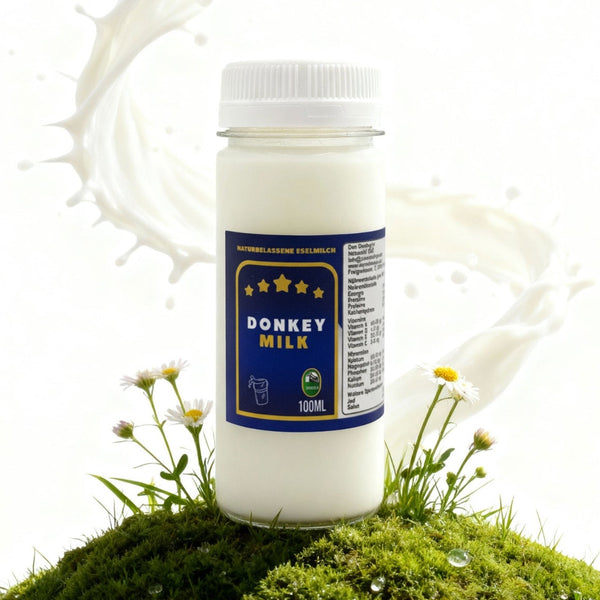
Handy: our donkey milk is delivered frozen anyway. For soap you don't thaw it – you weigh the frozen milk directly. It's easiest if you thaw it slightly first, pour it into ice cube trays and refreeze. How to thaw the rest of the milk for the kitchen is explained in our article on thawing donkey milk.
Sample recipe: how the lye was calculated
Every oil needs a different amount of lye to saponify completely. This is given by its saponification value. Soap calculators multiply the amount of oil by its NaOH saponification value and then subtract the desired superfat – the share of oil that deliberately stays unsaponified so that no free lye is left. That's exactly what we've calculated here:
| Oil | Amount | NaOH saponification value | NaOH for 100% saponification |
|---|---|---|---|
| Olive oil | 300 g (60 %) | 0.135 | 40.5 g |
| Coconut oil | 125 g (25 %) | 0.183 | 22.9 g |
| Shea butter | 50 g (10 %) | 0.128 | 6.4 g |
| Castor oil | 25 g (5 %) | 0.128 | 3.2 g |
| Total | 500 g | 73.0 g |
At 0% superfat you would need 73.0 g NaOH. We use 68 g NaOH, which gives a superfat of around 6.8%. Because saponification values vary from batch to batch, the actual superfat lies roughly between 4 and 9% – either way, oil is left over and no free lye.
Ingredients for approx. 700 g of soap:
- 300 g olive oil
- 125 g coconut oil (solid, refined or virgin)
- 50 g shea butter
- 25 g castor oil
- 68 g sodium hydroxide (NaOH, at least 99% pure)
- 150 g donkey milk, frozen (in cubes)
Check the quantities yourself with a soap calculator before you start, especially if you swap an oil. Even a different type of oil changes the amount of lye needed.
Step-by-step method
- Prepare: Put on goggles, gloves and long clothing. Cover your work surface, have the mould ready, and get children and pets out of the room.
- Melt the oils: Gently melt the coconut oil and shea butter, then add the olive and castor oil. Let cool to about 40–50 °C.
- Make the milk lye: Place the frozen milk cubes in a stainless steel container standing in an ice-water bath. Sprinkle the NaOH onto the cubes a spoonful at a time over about 10 minutes, stirring carefully until it has all dissolved. The lye should stay below 30 °C.
- Strain: Pour the milk lye through a fine stainless steel sieve into the oils so that no undissolved lye flakes get into the soap.
- Blend: Use a stick blender in short bursts until the mixture thickens like custard and a trail briefly stays on the surface.
- Pour: Pour into the mould and keep it cool – don't insulate it. This keeps the soap light and stops it overheating.
- Unmould: After 2–3 days, wearing gloves, release it from the mould and cut it into bars.
- Cure: Store the bars somewhere airy and dry for 4–6 weeks, turning them occasionally. Only then is the soap ready.
What to expect from donkey milk soap
In the recipe, donkey milk replaces the water and gives the soap a warm beige colour and a special story. A slight milky smell may be noticeable at first and usually fades during curing. White deposits on the surface (soda ash) are harmless and can be trimmed off. Oily puddles, pockets of lye or hard white crumbs in the soap, on the other hand, indicate a mistake – don't use soap like that.
If you'd rather choose ready-made cosmetics, you'll find background information in our article on buying donkey milk cosmetics. And whether powder or liquid milk suits your project better is explained in donkey milk powder vs fresh donkey milk.
Homemade means: for personal use
Home-made soap is a lovely hobby for you and your family. Anyone who sells soap or supplies it as part of a commercial activity – even free of charge, for example as a promotional gift – is placing a cosmetic product on the market. For this, the EU Cosmetics Regulation requires, among other things, a safety assessment by a qualified person, a responsible person, a product information file, prescribed labelling and notification via the EU cosmetics portal.
Frequently asked questions
Can I use thawed donkey milk instead?
It's risky: liquid milk heats up quickly as the lye dissolves, the lactose scorches and the soap discolours. Frozen milk is the safer choice for beginners.
How long does donkey milk soap need to cure?
Allow 4 to 6 weeks. During this time water evaporates and the soap becomes harder and longer-lasting.
How high should the superfat be?
Around 5 to 8% is common for beginners. Our sample recipe is at about 6.8%. A superfat below about 5% leaves less margin for weighing errors.
Can I give away or sell my soap?
Private gifts to family and friends are generally not considered commercial supply. For sale or any supply as part of a commercial activity, however, the obligations of the EU Cosmetics Regulation apply, including a safety assessment. If in doubt, ask the competent enforcement authority.
Note: These instructions are intended for adult hobby soap makers and do not replace professional training. Always work with protective equipment and check every recipe with a soap calculator. The saponification values are averages from common tables and vary with each batch of oil.
For your soap project you'll find our frozen donkey milk in the shop. And if the donkeys behind it are close to your heart, support them with a donkey sponsorship.