

Mild · 5 minutes · 1 cup
Golden evening milk
- Donkey milk, thawed
- Honey
- Cinnamon, a little turmeric
- Use thawed milk at drinking temperature.
- Stir in the spices.
- Stir in the honey at the end.
 Buyer protection
The practical guide to fresh donkey milk and donkey milk powder – with storage and thawing, drinking temperature, recipes, skincare tips and honest answers. So that every bottle tastes the way it did when it was milked.
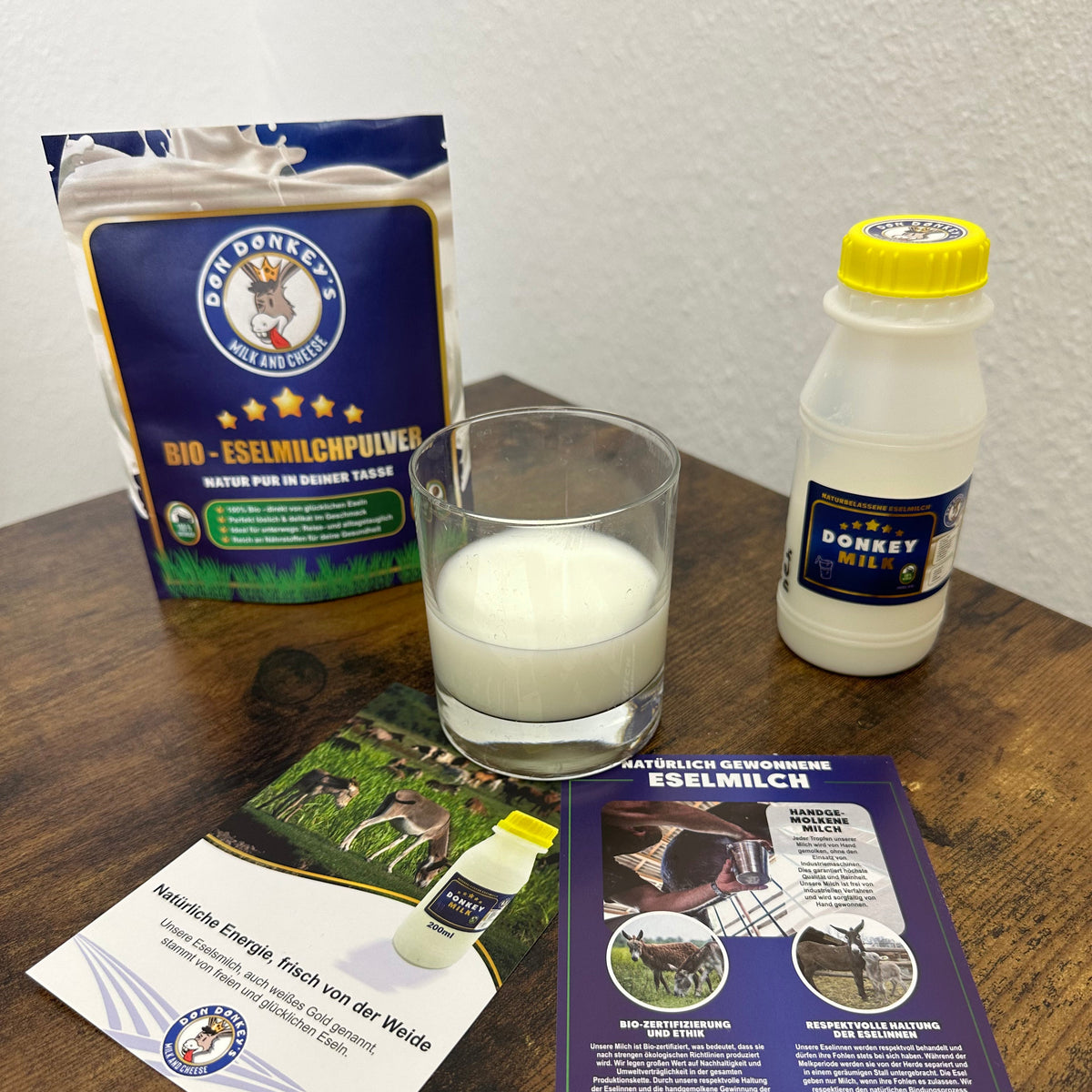
Both come from the same milk. The difference lies in how you store it, prepare it and take it with you.
| Comparison | Fresh donkey milk | Donkey milk powder |
|---|---|---|
| Form | Liquid, frozen in portion bottles | Freeze-dried |
| Storage | Freezer (−18 °C), in the fridge once thawed | Dry, tightly closed, no refrigeration |
| Preparation | Thaw slowly in the fridge, enjoy at 9–15 °C | Mix with water – ratio see label |
| Suitable for | Enjoying at home, original taste | Travel, office, supply at home, small portions |
| To get to know us | The Mini Duo contains 100 ml fresh milk and 20 g powder. | |
So that your donkey milk arrives the way it was milked, we freeze it immediately. The portion bottles make it easy: you only thaw what you need.
Put the bottles in the freezer immediately after arrival. For shelf life, see the label.
−18 °CSlowly in the fridge at 2–7 °C, ideally overnight. Not at room temperature and not in the microwave.
approx. 8–12 hrsGently swirl the bottle and take it out of the fridge 10–20 minutes before drinking. Many enjoy it at 9–15 °C.
9–15 °CKeep thawed milk in the fridge, use it up promptly and do not refreeze.
2–7 °CNatural and not pasteurised: Our fresh donkey milk reaches you the way it was milked – frozen immediately and delivered frozen. Please follow the instructions on the label. Donkey milk is not a substitute for infant formula. For children, during pregnancy and breastfeeding, please talk to your doctor first.
Many people enjoy donkey milk pure and slightly chilled – that way its delicate, slightly sweet taste comes through well.
Gently swirling the thawed bottle mixes fat and protein again, which separate slightly during freezing.
Please follow the instructions on the label.
Many of our customers enjoy donkey milk over a longer period. You decide which amount suits you – fresh in different pack sizes or as powder.
If you want regular deliveries, the Vitalprogramm gives you a predictable delivery.
Fixed term: the programme ends automatically after the 6th delivery. You can find all terms on the Vitalprogramm page.
Our powder is freeze-dried and doesn't need a freezer – for on the go, travelling or as a supply at home.
How much powder and water you need is stated on the label of your pack. Please follow the instructions there.
Many people enjoy donkey milk pure. If you'd like some variety, here are three simple recipes.
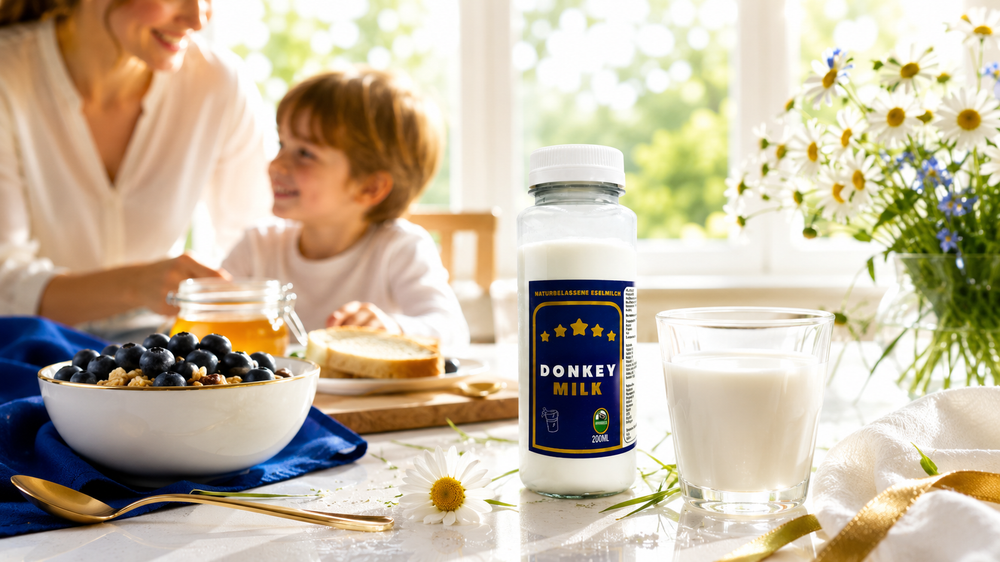
Morning, evening, pure or in a recipe – you decide according to your taste.
Donkey milk is a food. The amounts on this page are calculation examples, not a consumption recommendation.
Guide values per 100 ml of donkey milk. The composition varies depending on the animal, feeding and stage of lactation.
Donkey milk is not lactose-free and contains rather more lactose than cow's milk (around 4.7 g). Hence its slightly sweet taste.
Lactose comparedDonkey milk contains milk protein – like other types of milk. Allergen information as stated on the label.
With around 35–45 kcal per 100 ml, donkey milk is a rather light milk.
What does donkey milk taste like?Donkey milk is a food. You can find more about nutritional values and differences in our articles Components & nutritional values and Donkey milk or cow's milk.
True. Both are natural components of donkey milk. How much is contained varies depending on the animal, feeding and stage of lactation.
A matter of taste. Slightly chilled at 9–15 °C it tastes delicate to many people, at room temperature it tastes milder. Please follow the instructions on the label.
Powder and fresh milk are two forms of the same milk. The powder is freeze-dried, needs no refrigeration and is mixed with water – the ratio is on the label.
A jenny usually gives 0.5–1 litre of milk a day for milking, at most around 2 litres, alongside feeding her foal; milking is done by hand and in small quantities. That is why donkey milk is rare. More on this: Why donkey milk is so rare.
No, it contains about 6–7 g of lactose per 100 ml – rather more than cow's milk (around 4.7 g). That's why it tastes slightly sweet.
A lovely legend without ancient evidence. According to tradition, however, Poppaea Sabina, the wife of Emperor Nero, bathed in donkey milk – as reported by Pliny the Elder.
Our skincare line contains 20 to 30 % donkey milk for daily care from head to toe. The products are cosmetics and intended for external use. We show how to prepare a donkey milk bath on our Baths page.
Tip: if you have sensitive skin, test new skincare on a small area first. All ingredients are listed on the respective product page.
Our donkey milk comes from small farms in Europe, is milked by hand, shock-frozen immediately and laboratory-tested in Germany. We will gladly send you the test results on request – write to us at info@dondonkeys.com.
According to tradition, writings attributed to him mention donkey milk.
Mentions donkey milk in his Natural History.
A jenny usually gives 0.5–1 litre of milk a day for milking, at most around 2 litres, alongside feeding her foal.
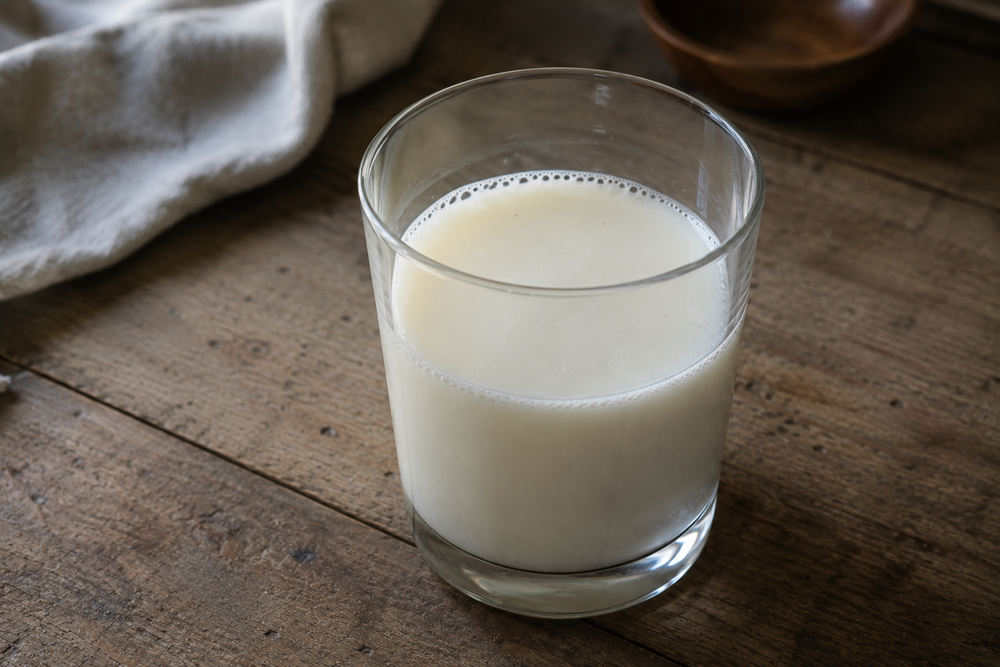
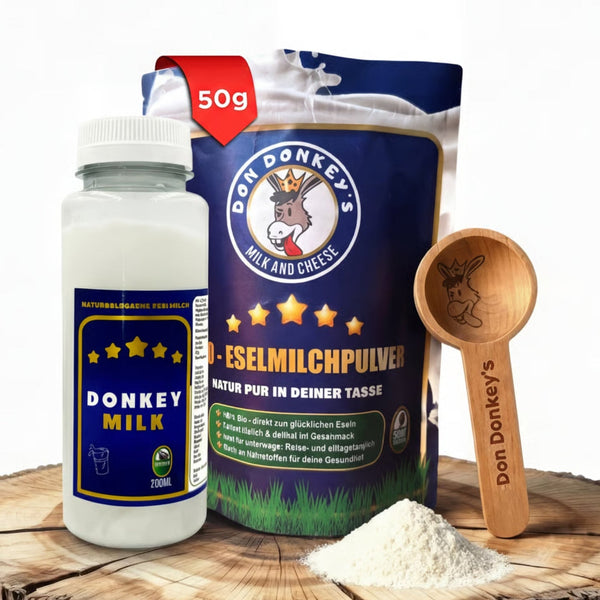
100 ml fresh donkey milk and 20 g powder in one set.
View product
Frozen in portion bottles, not pasteurised.
View product
Freeze-dried – simply mix with water.
View product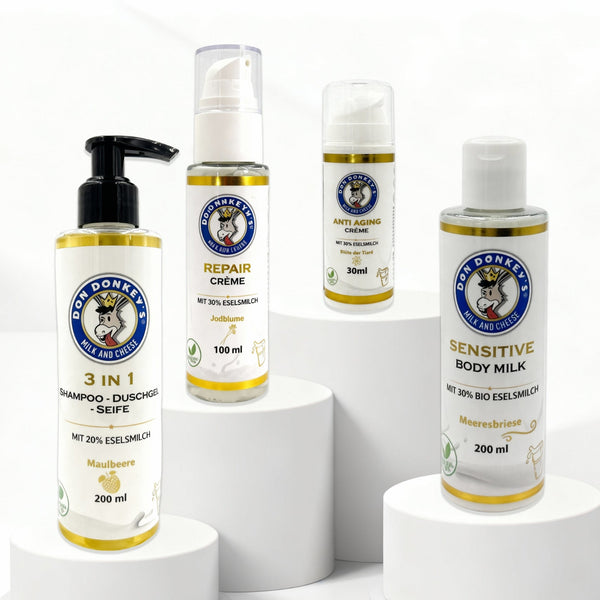
All four donkey milk skincare products in one set.
View productAnother question? Write to us at info@dondonkeys.com – we reply personally.
Our donkey milk and our donkey milk powder are foods, not medicinal products. Quantities are calculation examples, not a consumption recommendation. Please follow the instructions on the label. If you have health questions, please consult your doctor.