Buyer protection


How our donkey milk is made
You can't force a jenny.
You can only wait.
Milked by hand when the jenny is ready. The foal drinks first, then us. After that the milk only goes in one direction: cold. That is our production – no machine, no shortcuts.
- Milked by hand
- Not heated
- Frozen all the way to you
The milk's journey
From the milking stand to you:
Once frozen, it never gets warm again.
We do not heat our donkey milk. That's why we rely on something else – cold, speed and a cold chain that is never broken from the farm to your front door. Scroll along and see how its temperature changes.
-
 ≈ 37 °C
STATION 01
At the milking stand
Body-warm, by hand.
Milking only happens when the jenny is ready and her foal has drunk. By hand, at her own pace. There is no milking machine at our partner farms – and there won't be.
-
 chilled
STATION 02
Filtered, chilled, bottled
Right after milking.
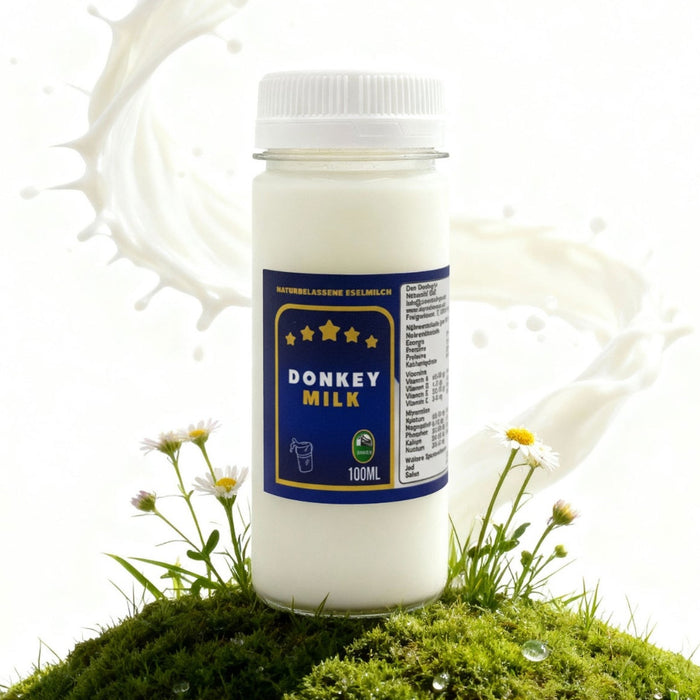
The milk is filtered immediately, cooled down and filled into food-grade PET bottles. No heating, no pasteurisation, no additives. What goes into the bottle is what the jenny gave.
-
 −18 °C
STATION 03
Shock-frozen
Within a few hours.
The milk is frozen at −18 °C and stays frozen from then on. From this moment on there is only one rule for it: the cold chain is never broken.
-
 −18 °C
STATION 04
Refrigerated transport & laboratory
Frozen to Germany.
A specialised refrigerated haulier brings the frozen bottles to Germany. Every delivery is tested in a laboratory in Germany accredited to ISO/IEC 17025. We will send you the test report on request.
-
 −18 °C
STATION 05
Shipping to you
Mondays and Wednesdays.
Packed in insulation with ice packs, your milk sets off with GO! Express – only on Mondays and Wednesdays, so it is never in transit over the weekend.
-
 9–15 °C
STATION 06
At your home
Only now does it wake up again.
Into the freezer at −18 °C, let one bottle thaw in the fridge at 2–7 °C and enjoy slightly chilled at 9–15 °C. For the first time since the milking stand, it is allowed to get a little warmer.


The cold chain is the reason we only ship on Mondays and Wednesdays – and why our donkey milk powder takes a different route: it is freeze-dried at −40 °C and then needs no refrigeration at all. To the donkey milk powder →
Report from the partner farm
A bottling day on the partner farm
Stage two of the journey, up close: the partner farm took these videos and photos for us during a bottling session – from the milk churn to the sealed bottle.
The milk is filtered, poured into the bottles by hand, sealed and then frozen.


Swipe to browse
Why donkey milk is so rare
Donkeys are not classic dairy animals.
They are characters with minds of their own.
Their ancestor is the African wild ass – and every donkey still carries that heritage today: cautious, wilful, incorruptible. A donkey that doesn't want to won't move a metre. No feed, no persuasion and no schedule changes that. And a jenny that doesn't feel comfortable gives no milk. Anyone who works with donkeys works at their pace – not their own.
What we like to say
With us, the foal drinks first.
We get what's left over.
A stressed jenny gives no milk.
That's why calm isn't a nice-to-have for us – it's a requirement.
Our jennies have names, moods and good days.
Milking only happens on the good ones.
No machine milks here.
People with patience do.
The herd
Around 200 donkeys. Each with a name.
That's how many donkeys live on our partner farms. Only the jennies that are currently nursing a foal give milk – all the others simply have time off. We introduce three of them to you.
Tap a card to turn it over.

Our promise to the animals
Donkeys first. Then the milk.
Our relationship with our animals is not a marketing line but the precondition for every bottle. These six rules apply on every farm we work with.
- The foal drinks first.We never take the whole day's milk – on average 200–500 ml.
- Milking only when the jenny is ready.No driving, no force. A stressed jenny gives no milk anyway.
- Pasture, grass and hay.The donkeys eat what their surroundings provide – without industrial concentrate feed.
- No antibiotics as a precaution.We do without prophylactic antibiotics. If an animal is ill, the vet treats it.
- Looked after by a vet.Every jenny is known by name and character and is checked regularly.
- No foal, no milk.Jennies without a foal are not milked. They live in peace in the pasture.

A rare breed
The Dalmatian donkey.
Some of our jennies belong to one of Europe's old donkey breeds that have become rare. The Dalmatian donkey is considered an endangered livestock breed and today is mainly kept in conservation breeding.
It is medium-sized, delicately built and known for its calm, balanced nature. And for a feature you will never forget:
the dark cross on its backQuality without small print
What we do. And what we deliberately don't.
What we do
- Milk every jenny by hand
- Filter and cool the milk immediately
- Freeze it at −18 °C within a few hours
- Transport it frozen throughout
- Have it tested in an accredited laboratory in Germany
- Ship only on Mondays and Wednesdays
What we don't do
- Heating or pasteurising
- Additives or preservatives
- Milking machines
- Industrial concentrate feed
- Taking the foal's milk away
- Shipping at weekends
Because our milk is not heated, it is raw milk. Please follow the instructions on the label.
Frequently asked questions
Everything about how our donkey milk is produced.
Anything else? Brian and Justin answer personally – Mon–Fri from 9 am to 5 pm.
Where is DON DONKEY'S donkey milk produced?
On small, carefully selected partner farms in Europe that specialise in keeping donkeys. That's where it is milked, filtered, bottled and frozen. Laboratory testing and shipping to you take place in Germany.
How is donkey milk obtained?
On our partner farms every jenny is milked by hand – only when she is ready and her foal has drunk. The milk is then immediately filtered, cooled, filled into food-grade PET bottles and frozen at −18 °C within a few hours.
How much milk does a jenny give per day?
While nursing a foal, a jenny usually gives 0.5–1 litre of milk a day for milking, at most around 2 litres. Of that, we take only 200 to 500 ml on average – the rest stays with the foal. For comparison: a dairy cow in Germany gives more than 25 litres a day on average.
How many donkeys live on your partner farms?
Around 200. Only the jennies that are currently nursing a foal give milk. All the others are not milked and live in peace in the pasture.
How are the donkeys kept?
Our donkeys live on spacious land with pasture, fresh water and natural hay, without industrial concentrate feed. They are looked after by a vet, we do without prophylactic antibiotics, and milking never happens under pressure. Every jenny is known by name and character.
Is your donkey milk pasteurised?
No. Our donkey milk is not heated and is therefore raw milk. Instead of heat, we rely on fast freezing and a cold chain that is never broken all the way to your front door. Please follow the instructions on the label.
What does “lab-tested” mean for you in concrete terms?
Every delivery is tested in a laboratory in Germany accredited to ISO/IEC 17025. We will send you the test report on request.
How does the milk get to me?
The frozen bottles travel to Germany with a specialised refrigerated haulier. From there we ship them in insulated packaging with ice packs via GO! Express – only on Mondays and Wednesdays, so that nothing is in transit over the weekend. Free shipping to Germany from €99, to Austria from €139 – i.e. from just 1 litre.
Why is donkey milk so rare and so expensive?
Because three things come together: a jenny gives only a little milk, and we take only a small part of it. Every jenny is milked by hand, at the animal's pace. And freezing, refrigerated transport and laboratory testing take a lot of effort. Donkey milk cannot be mass-produced – and with us, it isn't supposed to be.
How is your donkey milk powder made?
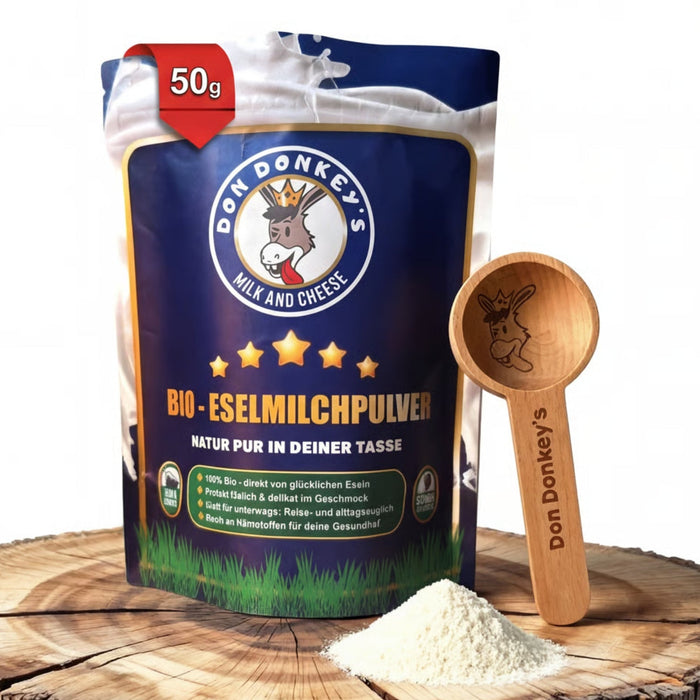
From the same milk: it is frozen at −40 °C and dried under vacuum, without being heated. What remains is a powder that needs no refrigeration and has a shelf life of 12 months (best-before date on the pack). 10 g mixed with water make around 100 ml of donkey milk. Available from 20 g to 1 kg.
What can you tell me about how the donkeys are fed?
Pasture with grass and hay, no industrial concentrate feed, no prophylactic antibiotics, and milking only once the foal has been fed.
Now you know how it's made
Time to try it.
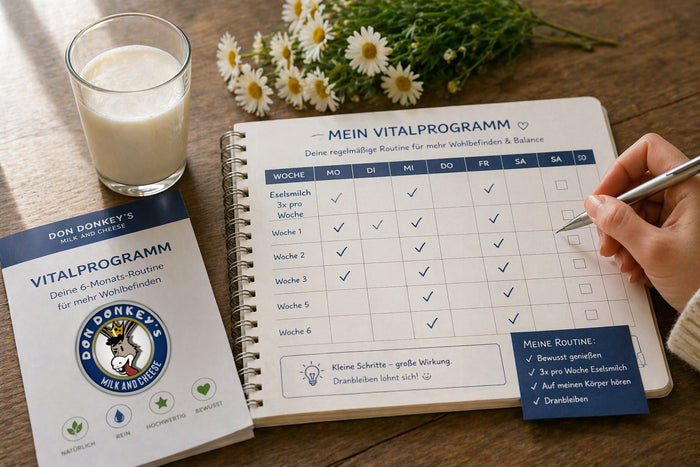
Fresh and frozen, freeze-dried as powder – or every 4 weeks with 30 % off in the Vitalprogramm.