Buyer protection


Contents
You can mix a face mask with donkey milk in two minutes: stir 2 tbsp of fine healing clay with 2–3 tbsp of donkey milk into a creamy paste, apply to your cleansed face and leave out the eye and lip area. After about 10 minutes – before the mask is completely dry – rinse off with lukewarm water. Afterwards your skin feels fresh and soft. A mask made from quark, honey and donkey milk is a milder alternative. Important: test every mixture on a small patch of skin first.
Why donkey milk in a mask?
Milk is one of the classic ingredients for homemade masks. Donkey milk is mild, runny and mixes easily with powders such as healing clay or finely ground oats. You only need a few spoonfuls for a mask – so a small amount of this precious milk is enough for several uses. The mask is a home beauty ritual: it cares for your skin, gives it a pleasant feel and makes a lovely little break.
You will also find donkey milk in ready-made care products. Our article Buying donkey milk cosmetics explains what to look for.
Three simple recipes
| Mask | Ingredients | Skin feel |
|---|---|---|
| Healing clay mask | 2 tbsp fine healing clay, 2–3 tbsp donkey milk | a fresh feel, more for normal skin |
| Quark and honey mask | 1 tbsp quark, 1 tsp runny honey, 1 tbsp donkey milk | soft and supple, very mild |
| Oat mask | 2 tbsp finely ground oats, 2 tbsp donkey milk | gentle and soft, does not dry out |
What you need
- freshly thawed donkey milk (or mixed-up donkey milk powder)
- depending on the recipe: fine healing clay, quark, runny honey or oats
- a small glass or ceramic bowl and a spoon or brush
- a hairband and a soft towel
Frozen donkey milk is best thawed overnight in the fridge. You can read how in Thawing donkey milk: guide and storage. Only use milk that is in perfect condition and smells fresh.
Step by step
- Do a patch test: The day before, apply a little of the finished mixture to a small area, for example the inside of your elbow or behind your ear, and wait to see whether your skin tolerates it well.
- Cleanse your face: Remove make-up and cleanse your face as usual. Tie your hair back.
- Mix the mask: Stir the ingredients in the bowl into a smooth, spreadable paste. If it is too thick, add a little donkey milk; if it is too runny, add a little more clay or oats.
- Apply: Spread the mask evenly over your forehead, cheeks and chin with your fingers or a brush. Leave out the delicate eye and lip area.
- Leave on: Relax for about 10 minutes. A clay mask should not dry out completely – otherwise it feels tight. Mist with a little water if needed.
- Remove: Rinse off the mask with lukewarm water without rubbing and pat your face dry with a soft towel.
- Follow up: Then apply your usual skincare, for example a face cream.
You can read about suitable aftercare in our article Donkey milk cream: face cream, use and buying tips.
What to bear in mind
- Always test first: Even natural ingredients such as honey, clay or milk can cause skin reactions in some people. If you notice redness, burning or itching, remove the mask with water immediately.
- Only on healthy skin: Do not use the mask on irritated, broken, inflamed or diseased skin. For skin problems, a doctor is the right person to ask.
- Mind allergies: Anyone allergic to milk protein or honey should not use the relevant recipes.
- Always mix fresh: Homemade masks contain no preservatives. Only mix as much as you need straight away and do not keep leftovers.
- Work cleanly: Use clean bowls and spoons and wash your hands beforehand.
- Clay and metal: Many guides recommend glass, ceramic or plastic containers for clay. This is a well-established habit you can simply adopt.
For a full-body care ritual, a donkey milk bath is ideal – the perfect partner to a mask on a quiet evening.
Frequently asked questions
How often can I use a face mask with donkey milk?
For most people, about once a week is enough. Pay attention to how your skin feels and adjust accordingly. Some people find clay masks rather drying – in that case the quark and honey or oat version is more pleasant.
Can I use donkey milk powder?
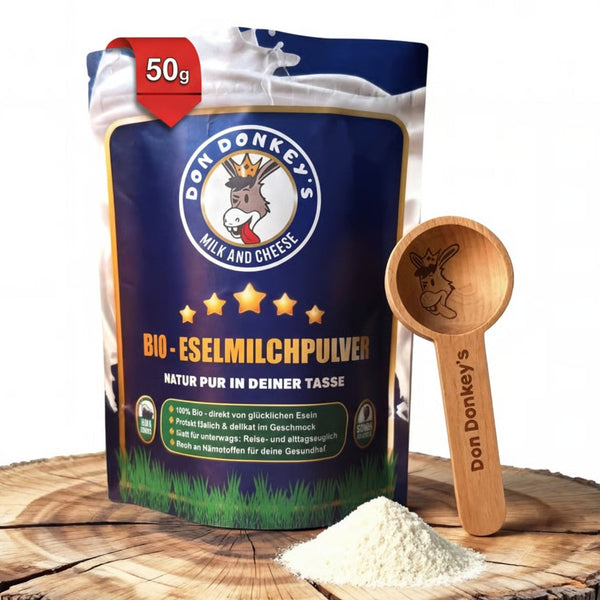
Yes. Mix the powder with a little water according to the pack instructions and use it like fresh donkey milk. A small spoonful of powder is enough for one mask.
Can I keep the mask in the fridge?
Better not. Homemade masks are not preserved. Mix them fresh each time.
Is the mask suitable for sensitive skin?
The quark and honey and the oat masks are particularly mild. But only a patch test will show whether they suit you. If your skin is irritated, it is better to skip masks altogether.
Note: This guide describes a cosmetic care ritual for home use. A mask with donkey milk cares for your skin and can make it feel soft, but it is not a treatment and does not replace medical advice. If you have skin problems, allergies or are unsure, please talk to your doctor first.
A face mask is a little break just for you. Our donkey milk comes from donkey farms in Germany. And with a donkey sponsorship you support the animals it comes from.