
 Buyer protection

Research on donkey milk · Study 70
Two donkeys from Tunisia: milk yield and composition compared by breed
A Tunisian-Italian team followed 28 jennies of two native populations – Masri and North African – for a whole lactation: how much milk did they give, and what was in it?
Trial procedure · runs automatically
One lactation in the hourglass
- Foaling, start of lactation28 jennies that had foaled several times, on average 8 years old and weighing 192 kg, on a dairy donkey farm in El Kef. Grazing on maquis scrubland, plus concentrate.
- Measured every weekMilked by hand at 10 am and 3 pm. Once a week, milk yield per animal was recorded and a sample taken. After the afternoon milking, the foals stayed with their mothers until 5 am.
- Peak North African: 1.212 kg/dayHighest daily yield according to the Wood model.
- Peak Masri: 0.991 kg/dayTwo days later and around a fifth lower.
- End: 205 ± 12.5 daysModelled total yield: 188.66 kg (North African) and 163.42 kg (Masri).
Daily values live from the Wood model with the study’s parameters (Y = a · tb · e−ct) – model values, not individual measurements.
Composition · tap a measure
Two needles, eleven measures
- North African
- Masri
- Difference
* = significant (p < 0.05) according to the study. Outer bars: ± standard deviation. Laboratory measurements.
Protein building blocks
17 amino acids, two profiles
g/100 g milk after acid hydrolysis. According to the study, only glutamate, aspartate and the total (1.45 versus 1.32) were significant (*) – leucine (0.15 versus 0.08), by contrast, was not.
Fatty acids · tap a pearl
22 fatty acids on two strings
Each pearl is a fatty acid; its area corresponds to its share (g/100 g fatty acids). Sorted from short to long chains.
- North African
- Masri
- Difference
Values given as North African | Masri, g/100 g fatty acids. * p < 0.05, ** p < 0.01 according to the study. Most common fatty acids in both milks: oleic acid (C18:1) and palmitic acid (C16:0).
Critical assessment
Recalculated by us
We cross-checked the study’s tables. Most totals add up – but in a few places the figures do not match.
Editorial assessment: The authors see the milk of both populations as a possible building block for “functional foods” and for infants. This was not examined. Donkey milk is not a substitute for breast milk or infant formula. For comparison: Study 54 (feed and lactation) and Study 55 (course of lactation).
CHECK SHEET STUDY 70
Aroua et al. · Animals 2024 · cross-checked
- Sample14 + 14 jennies, one farm, one season.SMALL
- SpreadAccording to the methods section, the ± values come from three laboratory replicates, not from comparing the animals. Read significances with caution.!
- Abstract“188.66 ± 7.19 kg” and “163.42 ± 7.21 kg”: the ± values are identical to the persistence indicators.?
- Whey proteinsα-lactalbumin + β-lactoglobulin + lysozyme = 7.87 and 6.58 mg/mL – more than the measured total whey protein (0.58 and 0.49 g/100 g). Different methods, not explained in the paper.?
- Fatty acid ratioMasri: 45.0 unsaturated / 55.0 saturated gives about 0.82 arithmetically – 0.69 is stated. North African fits (0.79).?
- TotalsCasein + whey protein + NPN = total protein (1.45 and 1.32). n-6 : n-3 recalculated: 1.84 and 1.54.OK
- InterestsNo external funding, no conflicts of interest declared.OK
Research question for DON DONKEY’S®
How much is down to the breed – and how much to the feed?
The two Tunisian populations lived on the same farm and still differed in fat, protein and fatty acids. How strongly breed, pasture and lactation stage shape the milk cannot be separated with a single study – a question we are following up.
Original publication
Preserving Mediterranean Donkeys: A Study on Milk Production and Nutritional Benefits
Original title of the publication.
Aroua M., Fatica A., Ben Said S., Mahouachi M., Salimei E.
Animals · 2024 · volume 14, issue 24, article 3713 · open access
Université de Jendouba, École Supérieure d’Agriculture du Kef (Tunisia); Università degli Studi del Molise, Campobasso (Italy)
DOI: 10.3390/ani14243713
Transparency: according to the paper, no external funding and no conflicts of interest. No product-related statement for DON DONKEY’S®.
Summarised and reviewed by the DON DONKEY’S editorial team on the basis of the original publication · as of October 2026
The study summarised above was carried out independently of DON DONKEY’S® and does not relate to our products. It serves solely to inform about the state of research.
DON DONKEY’S® donkey milk and donkey milk powder are foods. They are not intended to prevent, treat or cure any disease and do not replace medical advice.

From our shop
DON DONKEY’S® donkey milk
100 % donkey milk · raw milk, frozen
On this page we report the findings of a published study. Independently of that, you will find our donkey milk here: 100 % donkey milk, frozen as raw milk.
100 ml bottle / 100ml · Unit price: €249,00 / 1 l · incl. VAT, plus shipping
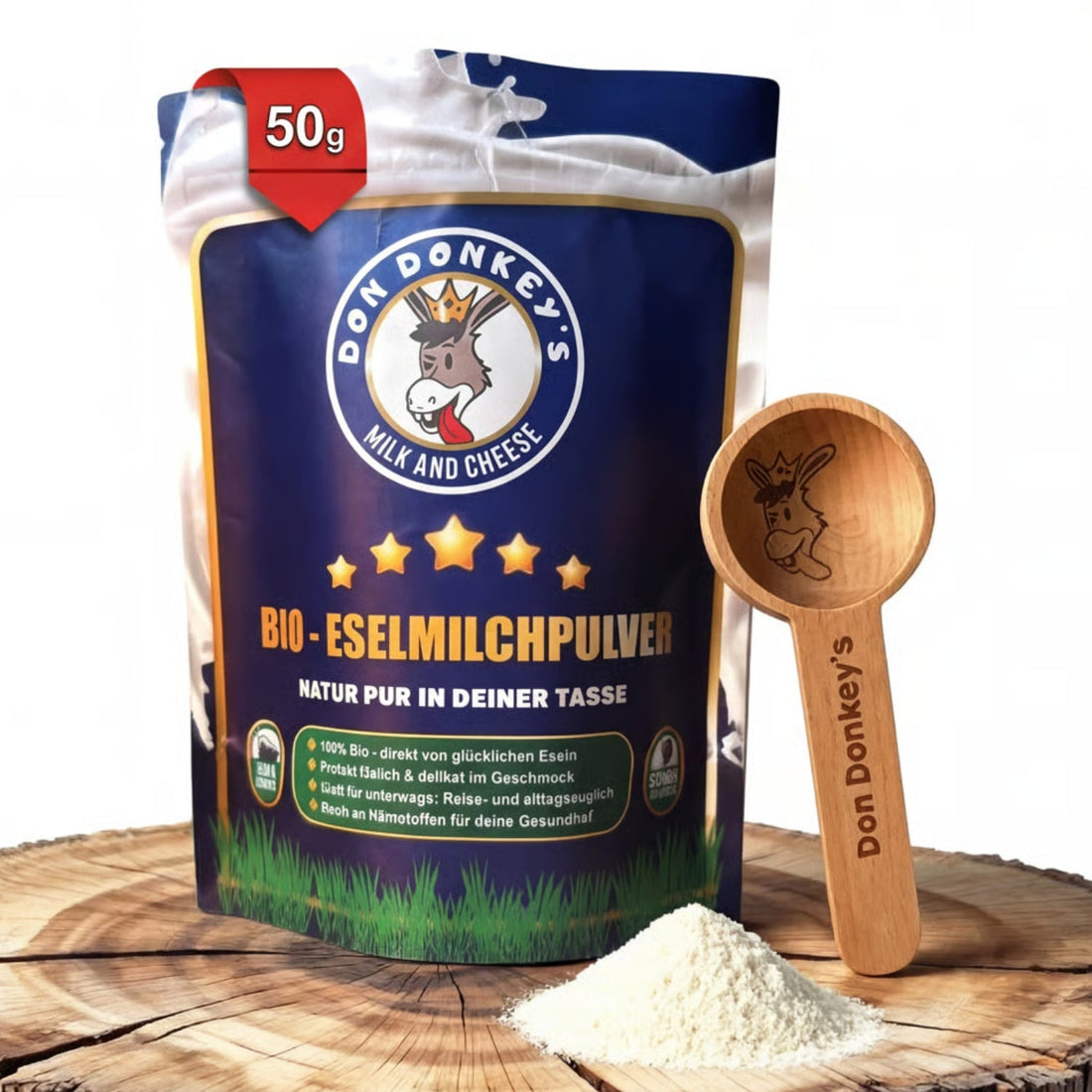
Also in our shop
Donkey Milk Powder
Donkey milk in powder form
For anyone who prefers a longer shelf life: our donkey milk in powder form – easy to store and portion.
20g · Unit price: €1.245,00 / 1 kg · incl. VAT, plus shipping