
 Buyer protection

Research on donkey milk · Study 54
Feed, lactation, milk: what changes the composition
Two Italian universities followed 16 jennies for three months. Half of them received additional trace elements in their feed. Milk yield, protein, fat, milk sugar and minerals in the animals' blood were measured every two weeks.
What it's about
What is in the feed – and what ends up in the milk
For dairy cows, it is known exactly how much minerals and trace elements they need. For jennies used for milk production, these values do not yet exist. Many farms therefore follow recommendations for horses.
The team from Camerino and Campobasso wanted to know whether a supplement of seven trace elements changes milk yield, the main milk components or the minerals in the blood – and how all this develops over the course of lactation.
What exactly was studied?
Briefly explained
Terms from the study
The period during which an animal gives milk after giving birth. The milk changes during this time.
Minerals needed only in tiny amounts, such as iron, zinc or selenium.
What remains after a sample is burned – a measure of mineral content.
The main sugar in milk. Donkey milk contains comparatively large amounts of it.
Two weeks of the same feed for all animals.
Randomly into two groups of eight jennies each.
One group received seven additional trace elements.
Milk and blood every two weeks, six times in total.
Interactive · The data at a glance
From the feed trough to the milk bottle
What the milk consisted of, what the supplement did, how the milk changed over the lactation and what was measured in the animals' blood. Switch between the views.
048 g
All values from the text of the freely available original publication. Values for individual sampling dates are only available as a graphic.
Key findings
What the researchers report
Much milk sugar, little fat
7.07 g lactose / 100 gOn average, the milk contained 7.07 g of milk sugar, 1.74 g of protein and 0.22 g of fat per 100 g. A jenny gave around 555 ml per milking on average.
Supplement does not change the milk
only magnesium in the blood ↑The additional trace elements changed neither milk yield nor the main components. In the blood, only magnesium rose slightly; the authors deliberately leave the cause open.
Time shapes the milk
all values changedThe stage of lactation influenced milk yield, protein, fat, milk sugar and ash as well as all minerals in the blood. Protein and ash decreased, milk sugar increased towards the end.
The authors see their data as a contribution to the feeding and care of dairy jennies. Requirement values for minerals in lactating jennies have not yet been established.
Critical assessment
Practical knowledge from the barn
What the study shows
What it does not show
Research question for DON DONKEY’S®
How does our milk change over the year?
The study shows how strongly the stage of lactation and feeding shape the milk. For us, this means measuring the composition regularly and keeping an eye on the feeding on our partner farms.
Original publication
Milk Yield, Major Milk Components and Macro Minerals in Blood Serum of Lactating Donkeys, as Affected by Dietary Trace Element Supplementation and Stage of Lactation
Original title of the publication.
Fantuz F., Todini L., Salimei E., Fatica A., Mariani P., Marcantoni F., Ferraro S.
Animals · 2025 · volume 15, issue 8, article 1073 · open access
University of Camerino · University of Molise (Campobasso), Italy
DOI: 10.3390/ani15081073
Transparency: according to the publication, without external funding and without conflicts of interest. A feeding study on animals – no product-related statement for DON DONKEY’S®.
Summarised and reviewed by the DON DONKEY’S editorial team on the basis of the original publication · as of October 2026
The study summarised above was carried out independently of DON DONKEY’S® and does not relate to our products. It serves solely to inform about the state of research.
DON DONKEY’S® donkey milk and donkey milk powder are foods. They are not intended to prevent, treat or cure any disease and do not replace medical advice.

From our shop
DON DONKEY’S® donkey milk
100 % donkey milk · raw milk, frozen
On this page we report the findings of a published study. Independently of that, you will find our donkey milk here: 100 % donkey milk, frozen as raw milk.
100 ml bottle / 100ml · Unit price: €249,00 / 1 l · incl. VAT, plus shipping
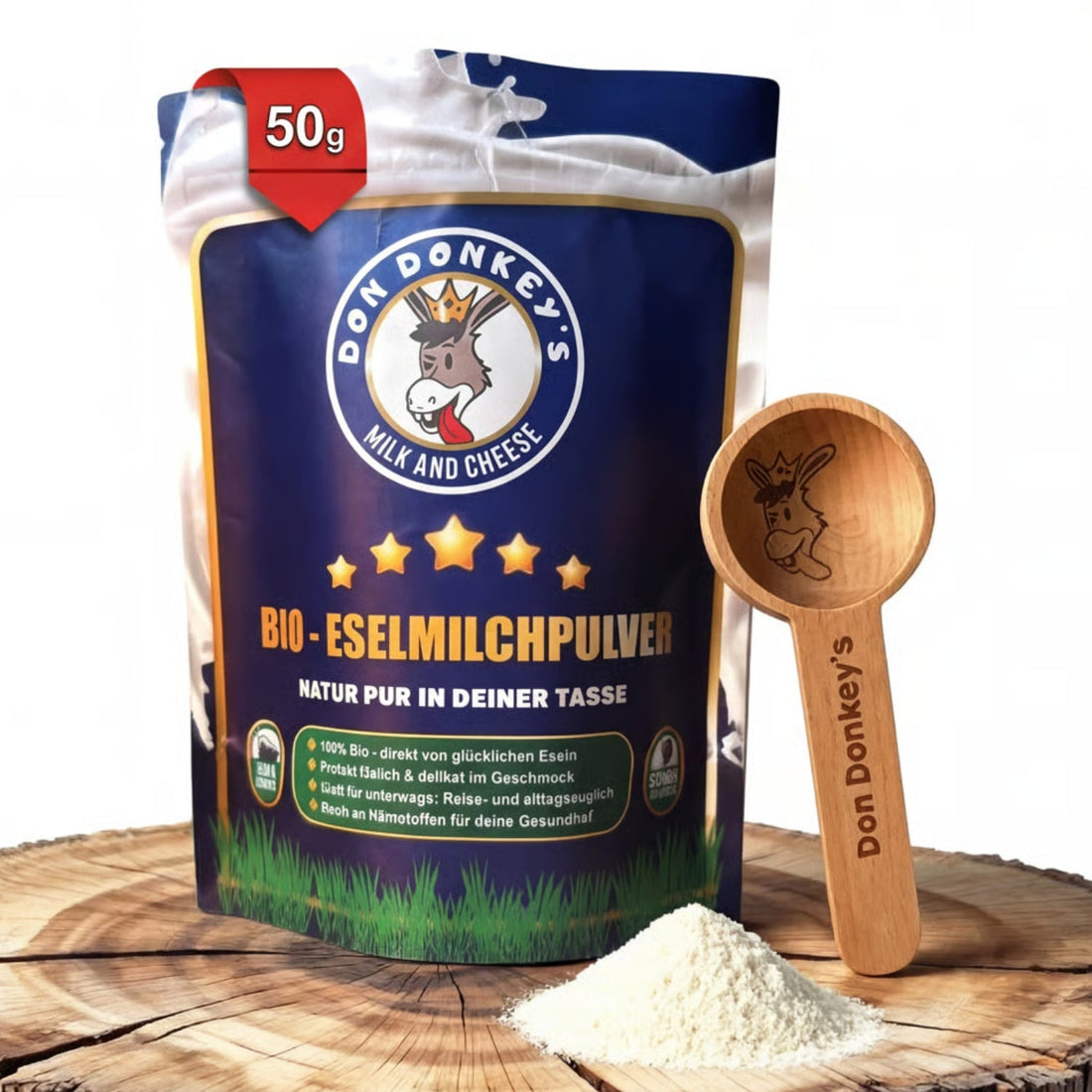
Also in our shop
Donkey Milk Powder
Donkey milk in powder form
For anyone who prefers a longer shelf life: our donkey milk in powder form – easy to store and portion.
20g · Unit price: €1.245,00 / 1 kg · incl. VAT, plus shipping