
 Buyer protection

Research on donkey milk · Study 55
210 days of donkey milk: how the milk changes over the lactation
A team from Timișoara (Romania) examined 153 milk samples from five donkey farms – from the first day after foaling to the seventh month. The main components and four special whey proteins were measured.
“The milk changes its protein profile rather than losing it.”
Paraphrased from the authors' abstractWhat it's about
Milk is not a fixed value
The composition of milk depends on how long ago the birth was. In jennies this has rarely been studied so broadly. The team therefore compared four time windows: the first three days (colostrum) and early, middle and late lactation.
In addition to protein, fat and milk sugar, the researchers determined four whey proteins that receive particular attention in milk research: lactoferrin, α-lactalbumin, β-lactoglobulin and lysozyme.
Interactive · slider
Choose a stage of lactation
Drag the slider or tap a stage. On the left you see the main components, on the right the four whey proteins and what changes.
Mean values in per cent. Ash was calculated.
Protein values in mg/ml from the abstract of the freely available original publication. Colostrum was not evaluated for the proteins.
The four whey proteins
Each protein follows its own course
Lactoferrin
0.07 → 0.14 mg/ml · risesDoubled by late lactation. The middle value lay significantly in between.
α-lactalbumin
1.91 → 2.58 → 2.25 mg/mlReached its highest value in mid-lactation – the most abundant of the four proteins.
β-lactoglobulin
0.84 → 0.55 mg/ml · fallsNo significant difference between early and middle, considerably lower in late lactation.
Lysozyme
0.95 → 0.64 mg/ml · fallsDecreased significantly from stage to stage and ran parallel to total protein.
Schematic courses; mean values for β-lactoglobulin and lysozyme in mid-lactation are not given numerically in the text.
Key findings
What the researchers report
Protein falls considerably, milk sugar rises
Protein fell from 3.09 % in colostrum to 1.14 % in late lactation, dry matter from 10.13 % to 8.45 %. Milk sugar rose from 5.76 % to up to 6.60 % in mid-lactation.
Fat remains low
After colostrum, the fat content was between 0.21 and 0.32 % – without a consistent trend. The mineral content (ash) did not change significantly.
The whey proteins shift
Lysozyme and β-lactoglobulin were highest early on, α-lactalbumin in the middle and lactoferrin at the end. The differences were statistically significant.
reviewed
What we noticed while reading
- The relationships between the values (correlations) are based on only three to four stage mean values. The authors themselves warn against over-interpretation.
- The discussion section mentions 0.68 % fat in mid-lactation – the results table shows 0.21 %. We report the table values.
- Each stage comes from different animals on five farms with different feeding. Differences between farms have not been accounted for.
Critical assessment
What the study shows – and what it doesn't
SHOWSDonkey milk changes measurably over the lactation
Protein and dry matter decrease, milk sugar increases. Anyone describing donkey milk should therefore always state which phase it comes from.
SHOWSThe four whey proteins follow their own patterns
Lactoferrin rises, lysozyme and β-lactoglobulin fall, α-lactalbumin reaches its maximum in the middle.
DOES NOT SHOWAn effect in humans
Only what the milk contains was measured. Whether and how the proteins act after drinking was not investigated.
DOES NOT SHOWThe course in individual animals
The stages come from different jennies. A true longitudinal measurement on the same animal is missing.
Research question for DON DONKEY’S®
How does our milk change over the year?
The study shows how strongly lactation shapes the milk. For us, this is a reason to document the composition of our milk regularly over the season.
- 01 · ANALYSISHave protein, fat and milk sugar measured for each lactation phase.
- 02 · COMPARISONCompare with other lactation studies (cf. studies 38 and 54).
- 03 · PROTEINSKeep an eye on lysozyme (cf. studies 5 and 19).
Original publication
Bioactive Protein Profile and Compositional Evolution of Donkey Milk Across Lactation Reflecting Its Nutritional and Functional Food Value
Original title of the publication.
Plotuna A.-M., Hotea I., Ban-Cucerzan A., Imre K., Herman V., Nichita I., Popa I., Tîrziu E.
Foods · 2025 · volume 14, issue 24, article 4284 · open access
University of Life Sciences “King Mihai I”, Timișoara, Romania
Transparency: publication fee paid by the university; according to the publication, no conflicts of interest. Same research group as Study 45, separate investigation. No product-related statement for DON DONKEY’S®.
Summarised and reviewed by the DON DONKEY’S editorial team on the basis of the original publication · as of October 2026
The study summarised above was carried out independently of DON DONKEY’S® and does not relate to our products. It serves solely to inform about the state of research.
DON DONKEY’S® donkey milk and donkey milk powder are foods. They are not intended to prevent, treat or cure any disease and do not replace medical advice.

From our shop
DON DONKEY’S® donkey milk
100 % donkey milk · raw milk, frozen
On this page we report the findings of a published study. Independently of that, you will find our donkey milk here: 100 % donkey milk, frozen as raw milk.
100 ml bottle / 100ml · Unit price: €249,00 / 1 l · incl. VAT, plus shipping
Also in our shop
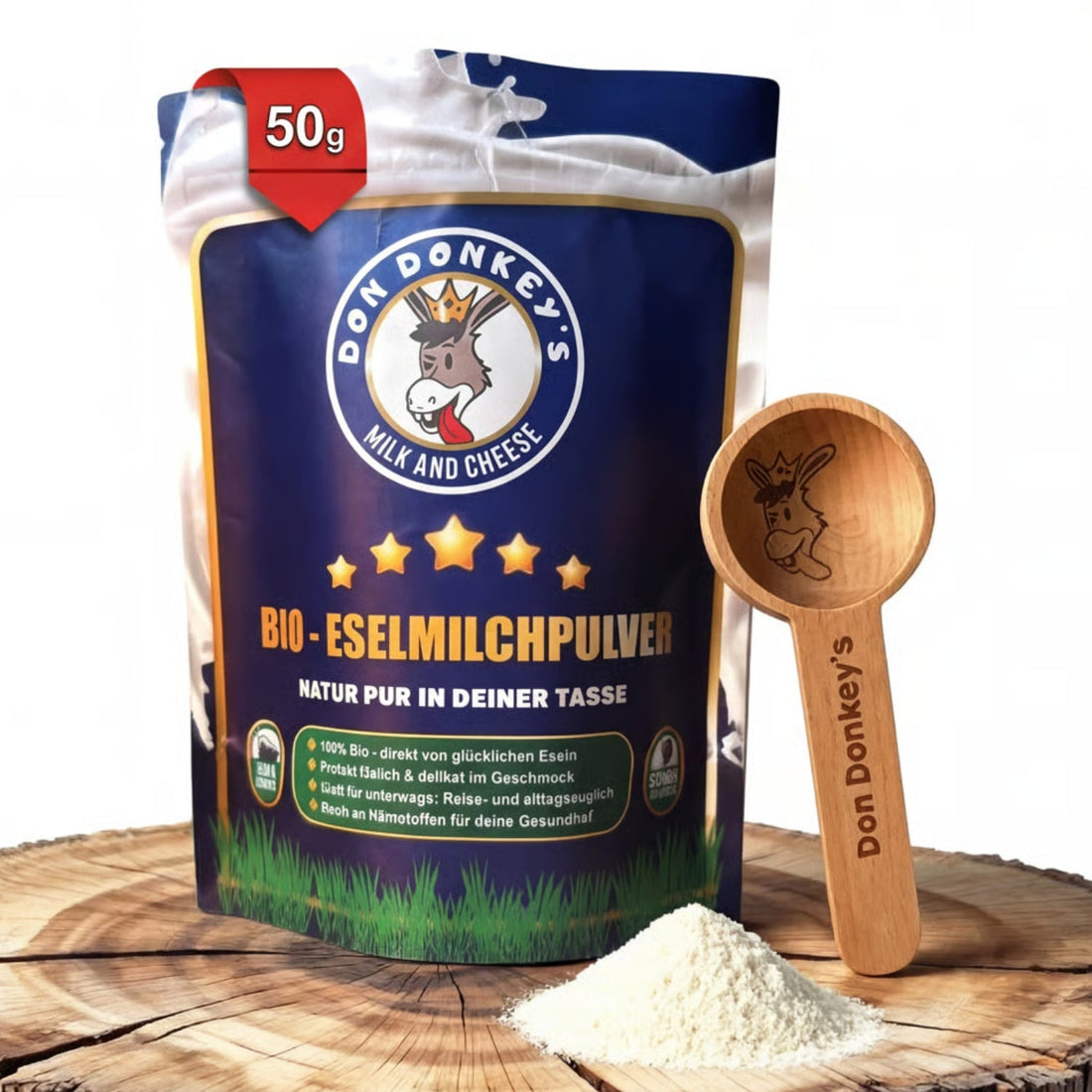
Donkey Milk Powder
Donkey milk in powder form
For anyone who prefers a longer shelf life: our donkey milk in powder form – easy to store and portion.
20g · Unit price: €1.245,00 / 1 kg · incl. VAT, plus shipping