
 Buyer protection

Research on donkey milk · Study 59
Three months, three profiles: fatty acids and redox values in Bulgarian donkey milk
A team from Trakia University examined the milk of 40 jennies of a Bulgarian local breed – in the first, second and third month of lactation. The focus: fatty acids and measurements relating to oxidation.
Fat content of the milk per month of lactation
Study profile
Who, where, how measured
Swipe or scroll for all cards →
Fatty acid classes
More saturated, slightly less unsaturated
* calculated remainder, mainly polyunsaturated fatty acids. The publication gives no totals for month 2.
The share of saturated fatty acids rose from 62.5 to 65.1 %, while the share of monounsaturated fell from around 32 to 30 %. Polyunsaturated fatty acids decreased by about one percentage point.
Among the individual fatty acids, only one difference was statistically significant: caproic acid (C6:0) was lower in the third month.
Interactive · Fatty acid magnifier
Individual fatty acids over time
Calculated indices
Two indices of fat quality
Atherogenic indexmonth 1 → month 3
Thrombogenic indexup to month 3
Both indices are calculated from the fatty acid pattern and used in food research to compare fats. They rose over the course of lactation but remained below the values the authors cite from the literature for cow’s milk. Such indices say nothing about an effect in humans.
Redox values of the milk
What shifted most
| Measurement | Days 0–30 | Days 31–60 | Days 61–90 | Simply explained |
|---|
Mean values according to Table 3 of the publication. Colour = level within the row (darker = higher). EPR signals in arbitrary units (a.u.).
Key findings
The study in three headlines
Fat decreases, pattern shifts
The fat content fell from 0.70 % in the first to 0.55 % in the third month. At the same time, the share of saturated fatty acids increased slightly, especially palmitic acid, while oleic acid and alpha-linolenic acid decreased.
Enzymes up, total capacity down
The activity of the enzymes SOD and GPx-1 rose with lactation. The measured total antioxidant capacity, by contrast, fell from 213.4 to 199.8 µmol, while radical scavenging activity in the DPPH test remained at around 62 %.
Late milk, more radical signals
In the third month, the signals for reactive oxygen and nitrogen species were higher and the thiol signal (5-MSL) considerably lower. The authors interpret this as stronger oxidation in late lactation.
Critical assessment
What struck us while reading
Different animals per month
Each jenny provided only one sample. Differences between the months may therefore also be due to the animals – a cross-section, not a time course.
Duplicate DPPH values
For month 1 and month 3, Table 3 gives exactly the same value (61.75 ± 4.14). Possibly a transcription error.
Copied equation?
The regression equations for MDA in Table 4 are the same as those for 5-MSL. This suggests a copying error.
Implausible unit
The energy value is given as around 42 kcal per gram – not plausible with less than 1 % fat. We therefore do not adopt the figure.
What the study delivers
40 animals of a rarely studied local breed, a broad measurement programme of fatty acids, enzymes and EPR markers, and openly stated limitations.
What it does not show
No measurements in humans, no inflammatory markers in the animals, only one farm and one season. Many individual differences were not significant.
Research question for DON DONKEY’S®
Does the milk of our partner farms also change over the course of lactation?
Several studies show that donkey milk changes with lactation. For us, this means looking at milk samples not just once but at different points in time.
Original publication
Fatty Acid Composition and Antioxidant Activity of Milk from the Bulgarian Local Donkey Breed
Original title of the publication.
Naydenova N., Veleva P., Georgieva A., Petkova-Parlapanska K., Georgieva E., Nikolova G., Karamalakova Y.
Foods · 2026 · volume 15, issue 4, article 614 · open access
Trakia University, Stara Zagora, Bulgaria
Transparency: publication costs covered by a Trakia University project under Bulgaria’s Recovery and Resilience Plan. According to the publication, no conflicts of interest. No product-related statement for DON DONKEY’S®.
Summarised and reviewed by the DON DONKEY’S editorial team on the basis of the original publication · as of October 2026
The study summarised above was carried out independently of DON DONKEY’S® and does not relate to our products. It serves solely to inform about the state of research.
DON DONKEY’S® donkey milk and donkey milk powder are foods. They are not intended to prevent, treat or cure any disease and do not replace medical advice.

From our shop
DON DONKEY’S® donkey milk
100 % donkey milk · raw milk, frozen
On this page we report the findings of a published study. Independently of that, you will find our donkey milk here: 100 % donkey milk, frozen as raw milk.
100 ml bottle / 100ml · Unit price: €249,00 / 1 l · incl. VAT, plus shipping
Also in our shop
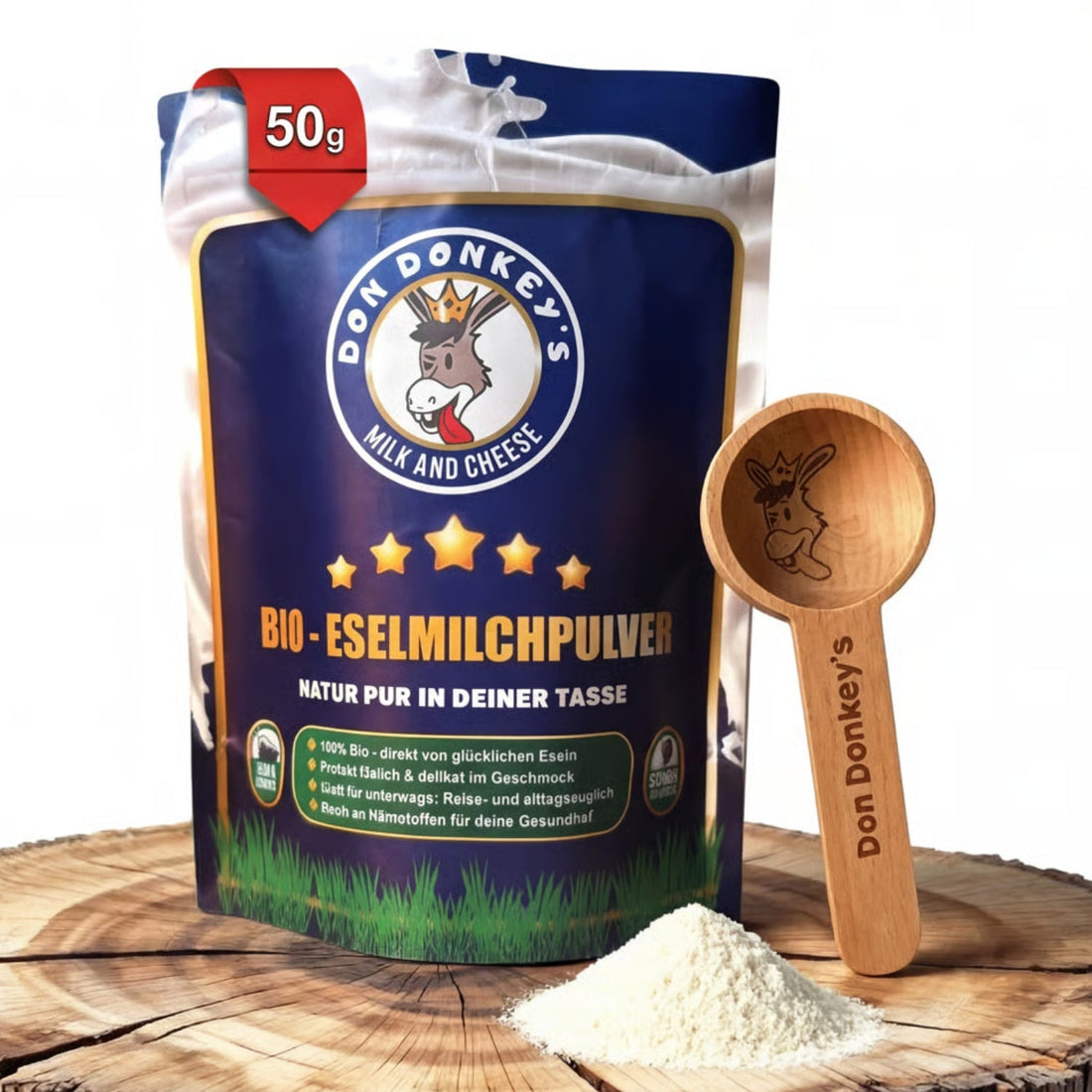
Donkey Milk Powder
Donkey milk in powder form
For anyone who prefers a longer shelf life: our donkey milk in powder form – easy to store and portion.
20g · Unit price: €1.245,00 / 1 kg · incl. VAT, plus shipping