
 Buyer protection

Donkey milk · origin & science
Why science is interested in donkey milk
It is rare, its composition differs from cow’s milk – and it occupies researchers from Italy to China. A brief exploration.

in donkey milk (Study 3)
A milk with a long history
Donkey milk is not a trend but an old food. It appears in ancient writings, and according to legend Cleopatra bathed in donkey milk. Nobody knows whether that is true – but it shows how special this milk was considered even then.
It is still special today for one reason above all: there is very little of it. A jenny only gives milk while she is suckling a foal, and only a small part of that remains for milking.
Milk available for milking per animal per day · guide values
One symbol corresponds to about one litre. Amounts vary by breed, feeding and stage of lactation.
What's in donkey milk
In the glass, donkey milk looks like any other milk. Its composition, however, is different: less fat and protein than cow’s milk but more milk sugar – which is why it tastes mild and slightly sweet.
Researchers are mainly interested in its proteins. An analysis from Italy identified 94 of them. Some occur in much larger amounts in donkey milk than in cow’s milk.
What research examines
We have collected, read and summarised the scientific publications on donkey milk in plain language. Italy leads the way, where research on it has been carried out for almost twenty years; in recent years many papers have also come from China.
94 proteins in a glass of milk
Using mass spectrometry, donkey milk was broken down into its proteins. Result: 94 identified gene products – including lysozyme, lactoferrin and immunoglobulins.
To the summary → Study 5 · Serbia · laboratory137 samples, 21 months
Researchers from Novi Sad sampled milk from 33 jennies for almost two years, measuring lysozyme and lactoferrin content among other things.
To the summary → Study 29 · Germany · ongoingResearch with our milk
In Kiel, a research team is examining individual constituents of donkey milk at molecular level – with milk from DON DONKEY’S®.
To the project →What the studies show
- how donkey milk is composed and how much it varies
- which constituents researchers find particularly interesting
- what was observed in laboratory and animal experiments
What they do not show
- that donkey milk has a particular effect when drunk
- that results from laboratory or animal experiments are transferable to humans
- anything about our products – with the exception of the project in Kiel
04 · Research in Kiel
Our milk in the laboratory
At the RI-B-NT Research Institute of Bioinformatics and Nanotechnology in Kiel, the team led by Prof. Dr. Dr. Hans-Christian Siebert is working with donkey milk from DON DONKEY’S®. It is not the milk as a whole that is being studied but individual constituents – at the level of individual molecules.
The project is still ongoing. It is basic research and makes no statement about any effect when drunk – but it shows how much there is still to discover about this milk.
More about the project and Prof. Siebert →And how does it taste?
Mild, light and slightly sweet. Anyone trying donkey milk for the first time is usually surprised by how unassuming it tastes. This is how our customers like to enjoy it most:
Pure & well chilled
Thawed in the fridge and cold from the glass – this brings out its own flavour best.
In coffee or tea
As a mild, slightly sweet note in a hot drink – best added at the end.
In a smoothie or porridge
As a base for breakfast and smoothies. Simply mix the powder with water according to the instructions on the pack.


How it reaches you
Frozen – until you need it
Our fresh donkey milk is frozen as raw milk and sent to you that way. You keep it in the freezer and only ever thaw as much in the fridge as you want to drink at the time.

Who is behind it
Two brothers, many donkeys
DON DONKEY’S® is a family business from Lüdinghausen in the Münsterland region, founded by two brothers. Our donkey milk comes from partner farms; we make sure it reaches you frozen.
Because we wanted to know for ourselves what lies behind this milk, we read the studies and summarised them for you – and we are delighted that research is being carried out in Kiel with our milk.
Frequently asked questions
Good to know
Why is donkey milk so expensive?
A jenny gives only a fraction of the amount of milk a cow gives, and she is only milked while suckling a foal. Herds are small and the work is laborious – that makes every litre valuable.
Fresh milk or powder – what is the difference?
Our fresh donkey milk is 100 % donkey milk, frozen as raw milk. The powder is long-life and easy to store and portion. Which option suits you is mainly a question of taste and everyday routine.
What do the studies mean for me?
They show what researchers have observed in the laboratory, in animal experiments or in individual clinical studies. They do not demonstrate any effect of our products. Donkey milk is a food – not a medicine and not a substitute for medical treatment.
Is donkey milk suitable for babies?
No. Donkey milk is not a substitute for breast milk or infant formula. For questions about feeding infants, please consult your paediatrician.
I have a milk allergy – what should I consider?
Only after consulting a doctor, please. Donkey milk can also trigger allergic reactions.
This feature describes the origin, composition and research on donkey milk in general. Our products are foods and are not intended to prevent, treat or cure diseases.

Fresh · frozen
DON DONKEY’S® donkey milk
100 % donkey milk · raw milk, frozen
100 % donkey milk from our partner farms, frozen as raw milk – mild, slightly sweet, with no additives.
100 ml bottle / 100ml · Unit price: €249,00 / 1 l · incl. VAT, plus shipping
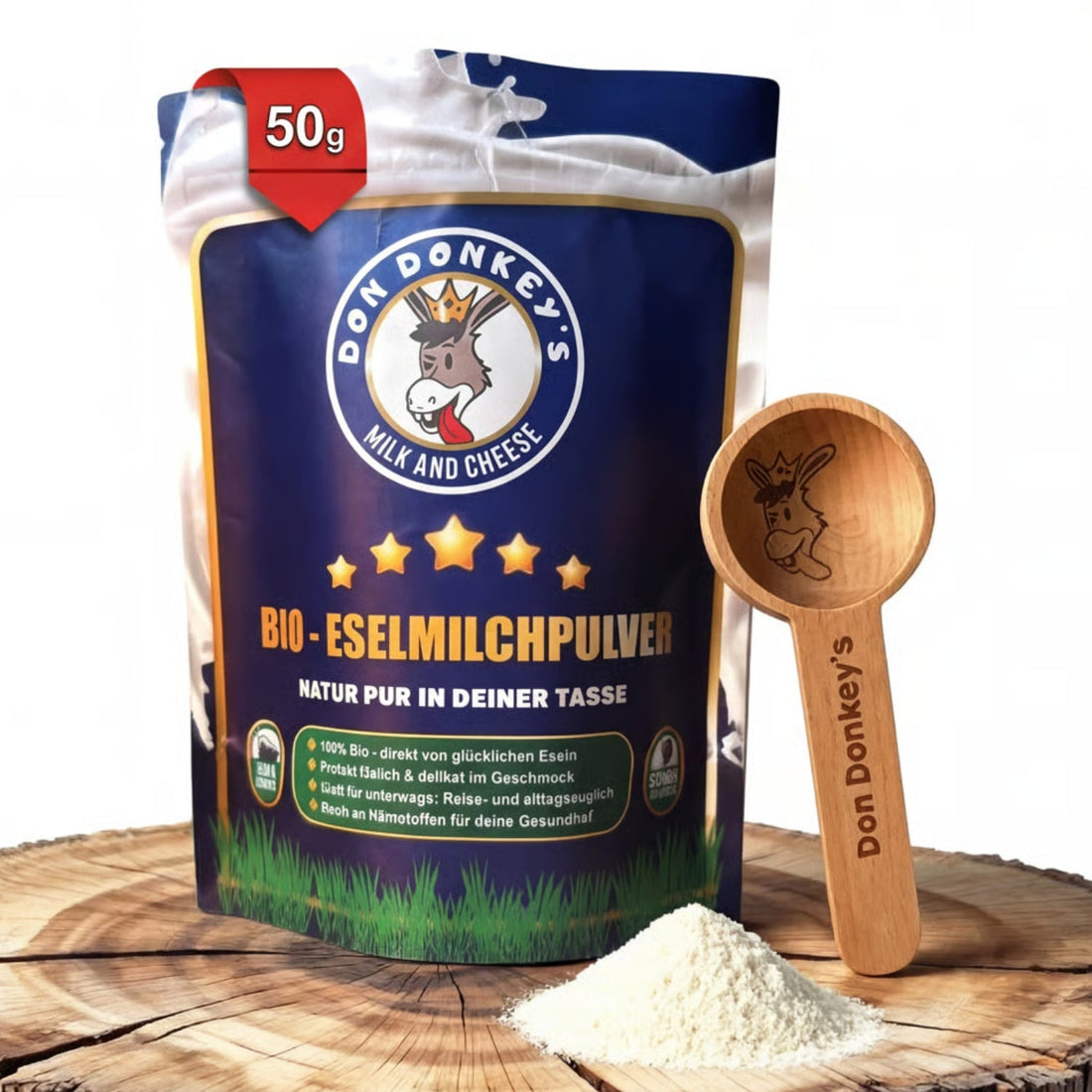
Long-life · powder
Donkey Milk Powder
Donkey milk in powder form
For anyone who prefers something longer-lasting: our donkey milk in powder form – easy to store and portion.
20g · Unit price: €1.245,00 / 1 kg · incl. VAT, plus shipping
Try donkey milkTo the products
Sources
- Spada V. et al. (2021): Antibacterial potential of donkey's milk disclosed by untargeted proteomics. Journal of Proteomics. DOI ↗
- Šarić L. Ć. et al. (2012): Antibacterial properties of Domestic Balkan donkeys' milk. International Dairy Journal. DOI ↗
- Šarić L. et al. (2023): Microbiological Quality of Raw Donkey Milk from Serbia and Its Antibacterial Properties at Pre-Cooling Temperature. Animals. DOI ↗
- Salimei E., Fantuz F. (2012): Equid milk for human consumption. International Dairy Journal. 24(2), 130–142.
- Ongoing research project RI-B-NT Kiel (Prof. Dr. Dr. H.-C. Siebert), details as provided by the institute.
Advertisement. This feature is advertising by Netuschil Enterprise GmbH for the DON DONKEY’S® brand. It summarises general information and published studies and does not replace medical advice. An overview of all studies with original sources can be found on our research page.