
 Buyer protection

Research on donkey milk · Study 5
Raw donkey milk under the microscope
In 2023, Šarić et al. examined 137 raw milk samples from 33 jennies in Serbia: what was the microbiological quality of the milk, how stable did it remain when chilled – and how did selected bacteria respond to it in the laboratory?
What it's about
What is the microbiological quality of fresh donkey milk?
Balkan donkeys, whose milk is traditionally valued, live in the Zasavica nature reserve in Serbia. Researchers from the universities of Novi Sad and Belgrade examined it systematically over almost two years.
They tested each sample for bacterial count and important pathogens, observed the milk for six days in the fridge and tested in the laboratory how three bacterial species behave in it. They also determined the levels of the proteins lysozyme and lactoferrin.
Milking was done by hand in the morning, after cleaning the udder, into sterile containers.
What exactly was studied?
Briefly explained
The terms used in this study
A natural enzyme that can attack the cell wall of certain bacteria. Present in particularly large amounts in donkey milk.
An iron-binding milk protein to which research attributes antibacterial properties.
The number of all viable bacteria in a sample – a classic measure of milking hygiene.
A group of staphylococci that includes Staphylococcus aureus. They are routinely recorded in milk.
33 jennies were milked repeatedly over 21 months by hand and after udder cleaning.
137 samples were tested for bacterial count and pathogens.
A pooled sample was observed for six days at 4 °C.
In the laboratory, three bacterial species were added and followed for four days at 15 °C.
Interactive · The data at a glance
137 samples, five views
How many samples, which pathogens, how high the bacterial count – and how did the milk behave in the fridge and in the laboratory test? Switch between the views.
Pooled sample · 4 °C · 6 daysTotal bacterial count and lactic acid bacteria
Illustration of the findings reported in the original publication. The arrangement of the dots and the bar heights are schematic.
Key findings
What the researchers report
No salmonella, no Listeria
According to the authors, the absence of the pathogens tested indicates good milking hygiene.
Mostly very low
Most samples had a very low total bacterial count. In the storage experiment, bacterial count and lactic acid bacteria remained at their starting level for six days.
Much lysozyme, inhibition mainly of E. coli
In the laboratory test, the milk showed an antibacterial effect against all three bacteria – strongest against E. coli, weakest against S. aureus.
Coagulase-positive staphylococci were found in low numbers in 51 of the 137 samples (up to 2.62 log CFU/ml). "Not detected" does not mean sterile. The presence of lysozyme and lactoferrin does not prove that they alone caused the inhibition in the laboratory test.
Critical assessment
Milking hygiene, made measurable
What the study shows
What it does not show
Research question for DON DONKEY’S®
How does our own milk compare?
The Serbian study shows what careful milking makes measurable. For us it is a benchmark: we would like to document the quality of our milk using comparable methods.
Original publication
Microbiological Quality of Raw Donkey Milk from Serbia and Its Antibacterial Properties at Pre-Cooling Temperature
Šarić L., Šarić B., Čabarkapa I., Todorić O., Miljanić J., Lazarević J., Premović T., Karabasil N.
Animals · 2023 · 13(3):327
University of Novi Sad, University Union – Nikola Tesla Belgrade, University of Belgrade
DOI: 10.3390/ani13030327
Full text: PMC9913105
The publication describes the milk of a specific donkey herd in Serbia. It does not allow any product-related statement for DON DONKEY’S®.

From our shop
DON DONKEY’S® donkey milk
100 % donkey milk · raw milk, frozen
On this page we report the findings of a published study. Independently of that, you will find our donkey milk here: 100 % donkey milk, frozen as raw milk.
100 ml bottle / 100ml · Unit price: €249,00 / 1 l · incl. VAT, plus shipping
Also in our shop
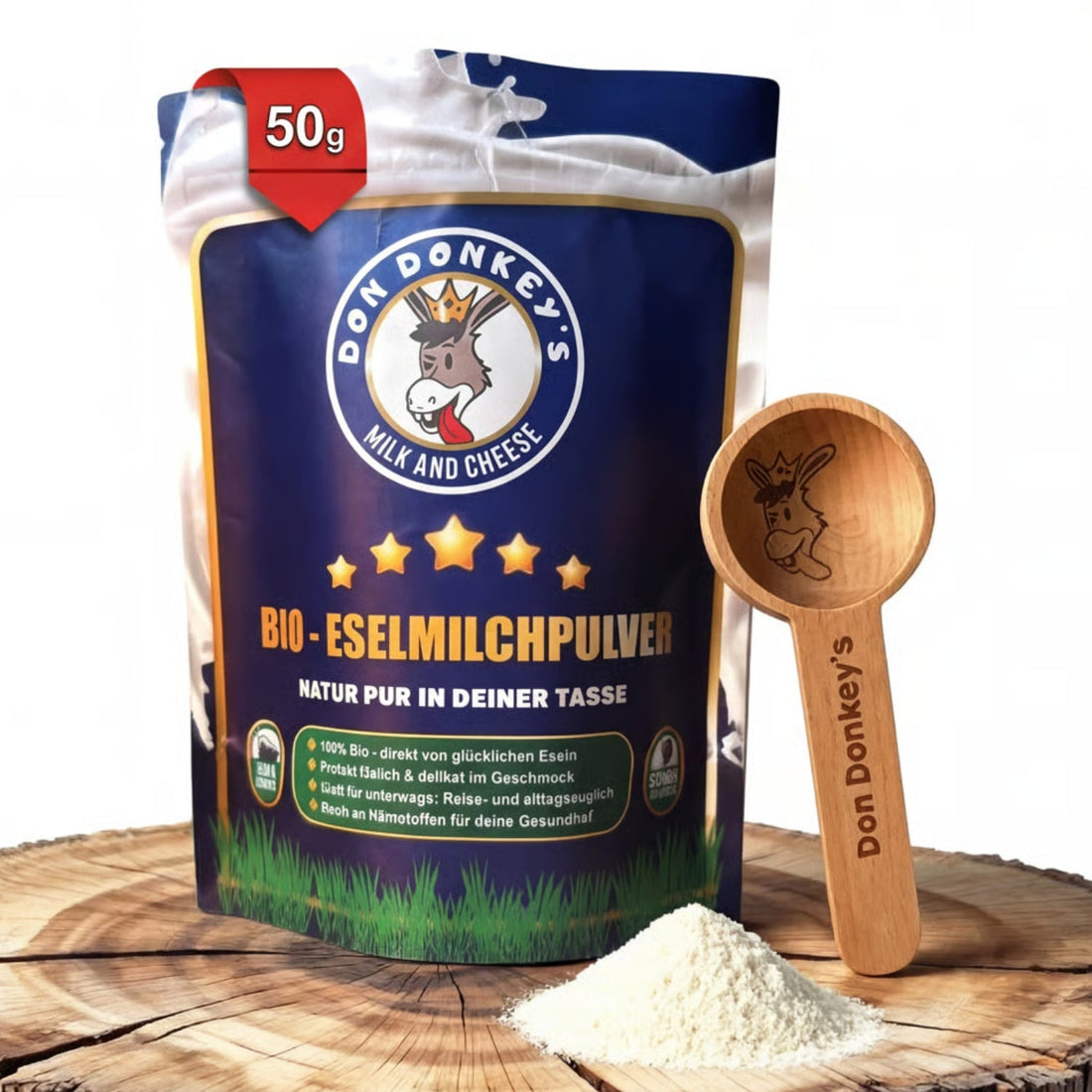
Donkey Milk Powder
Donkey milk in powder form
For anyone who prefers a longer shelf life: our donkey milk in powder form – easy to store and portion.
20g · Unit price: €1.245,00 / 1 kg · incl. VAT, plus shipping