
 Buyer protection

Research on donkey milk · Study 29
Ongoing research project
Donkey milk in the Kiel laboratory
Prof. Hans-Christian Siebert and his team are researching which building blocks make donkey milk special: proteins that recognise sugars, rare enzymes and tiny vesicles called exosomes. In this research project, Prof. Siebert’s team is working with donkey milk from DON DONKEY’S®.
What it's about
What is in the smallest components of donkey milk?
Most studies on our research page examined donkey milk from other herds. This project is different: In this research project, Prof. Siebert’s team is working with donkey milk from DON DONKEY’S®.
The group is not interested in the milk as a whole, but in individual components – such as lysozyme, sialidases and exosomes. To do this, it combines biophysics, biochemistry and computer models.
The group has also compared donkey milk and donkey colostrum with the milk of six other animal species.
The project at a glance
Briefly explained
The terms used in this project
The science of sugar chains on cells and proteins – and of how molecules recognise these sugars.
A protein that recognises and binds certain sugar structures – without being an enzyme or an antibody.
An enzyme that cleaves off sialic acids – sugar building blocks at the outermost end of many sugar chains.
A tiny vesicle in milk enclosed by a lipid envelope. The envelope can protect its contents from degradation.
Prof. Dr. rer. nat. Dr. med. vet. habil. Hans-Christian Siebert
Physicist and veterinarian · co-founder of the RI-B-NT Research Institute of Bioinformatics and Nanotechnology, KielRI-B-NT was founded in 2011 at the Kiel Innovation and Technology Centre and is now part of an international research network. Prof. Siebert studies how proteins interact with sugar chains – at the level of individual molecules.
Interactive · The project at a glance
One project, five views
Which types of milk were compared, what is rare about donkey milk – and what is the team working on right now? Switch between the views.
Illustration based on information from Prof. Siebert and the publications listed. The graphics are schematic.
Findings so far
What the research group reports
Sialidases – a rarity
donkey, llama, dogIn a comparison of seven types of milk, sialidases were only found in donkey milk and in the colostrum of llamas and dogs.
An enzyme with a second role
NMR · 2017 and 2024Lysozyme can not only cleave sugar chains but, like a lectin, can also recognise certain sugar structures. The group investigated this using, among other things, lysozyme from donkey milk.
Richly loaded vesicles
research goal, not an applicationAccording to Prof. Siebert, lysozymes, sialidases and sialylated oligosaccharides were found in high concentrations in the exosomes of donkey milk.
It turned out that lysozymes and sialidases as well as sialylated oligosaccharides occur in high concentrations in the exosomes of donkey milk.
Prof. Hans-Christian Siebert
Using natural and cell-produced donkey milk, we are working on making the exosomes usable as nanomedical tools in the form of standardisable and scalable vesicles.
Prof. Hans-Christian Siebert
The project is still ongoing; some of the information comes from a text that Prof. Siebert wrote for this page and has not yet been formally published. The findings concern individual components in the laboratory, not the effect of donkey milk as a food.
Critical assessment
Basic research, step by step
What the project shows
What is (still) open
DON DONKEY’S® in the project
Our milk in the laboratory
We are proud that our donkey milk is part of genuine basic research. We will update this page as soon as new results are published.
Institute & publications
RI-B-NT – Research Institute of Bioinformatics and Nanotechnology
Prof. Dr. rer. nat. Dr. med. vet. habil. Hans-Christian Siebert
Schauenburgerstraße 116 · 24118 Kiel
Zhang N., Li L., … Siebert H.-C. (2024): Protein–carbohydrate interaction studies using domestic animals as role models support the search of new glycomimetic molecules. Int. J. Biol. Macromol. 279, 134951. DOI
Zhang R., Wu L., … Siebert H.-C. (2017): Lysozyme’s lectin-like characteristics facilitates its immune defense function. Q. Rev. Biophys. 50, e9. DOI
Liu Y. et al. (2025): Proteomic profiling of donkey milk exosomes highlights bioactive proteins with immune-related functions. Int. J. Mol. Sci. 26, 2892. DOI
The information on the ongoing project is based on a text by Prof. Siebert for DON DONKEY’S® (September 2026). It describes laboratory research and is not a statement about any effect of our products.

From our shop
DON DONKEY’S® donkey milk
100 % donkey milk · raw milk, frozen
The milk used in the project: 100 % donkey milk from our partner farms, frozen as raw milk.
100 ml bottle / 100ml · Unit price: €249,00 / 1 l · incl. VAT, plus shipping
Also in our shop
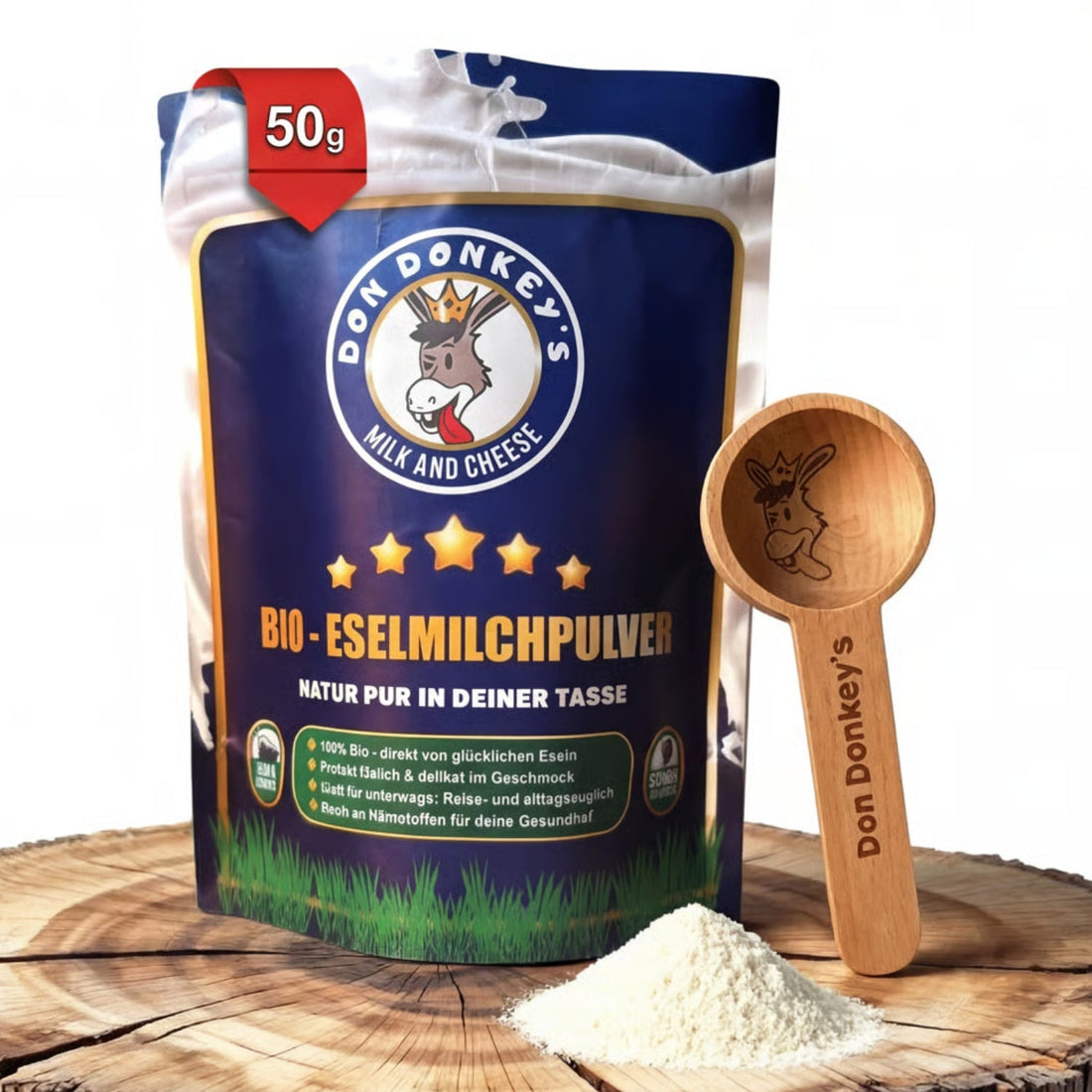
Donkey Milk Powder
Donkey milk in powder form
For anyone who prefers a longer shelf life: our donkey milk in powder form – easy to store and portion.
20g · Unit price: €1.245,00 / 1 kg · incl. VAT, plus shipping