
 Buyer protection

Research on donkey milk · Study 3
Donkey milk protein by protein
Spada et al. examined donkey milk using modern protein analysis: which proteins does it contain – and which of them are known from research as part of natural defence systems?
What it's about
Which proteins are in donkey milk?
The scientific literature describes donkey milk as having a comparatively low microbial load. Researchers from the Italian National Research Council (CNR) and the universities of Naples and Molise wanted to know which proteins might play a role in this.
To do so, they separated the milk into fractions and analysed them using untargeted proteomics – a broad method that captures as many of the proteins in a sample as possible at once. They then classified the proteins found on the basis of the scientific literature.
According to the authors, the result is the most extensive protein list for equid milk to date.
What exactly was studied?
Briefly explained
The terms used in this study
The analysis of as many proteins in a sample as possible. "Untargeted" means: rather than looking for specific proteins, everything measurable is captured.
A protein that can be assigned to a specific gene. Each gene product counts once – regardless of how much of it is in the milk.
Proteins are broken down into small fragments and their mass is measured. The pattern reveals which protein it is.
Protective substances such as antibodies that a young animal receives via its mother's milk instead of producing them itself.
The milk was divided into fractions, including at pH 4.6.
The proteins of each fraction were cleaved into short fragments (peptides).
The peptides were recorded in the mass spectrometer and assigned to proteins.
For each protein, the literature was searched for known functions.
Interactive · The data at a glance
94 proteins, five views
How many proteins were found, how many have a defence-related function – and which candidates do the researchers particularly highlight? Switch between the views.
Illustration of the findings reported in the original publication. The arrangement of the dots and the graphics are schematic; the functions of the proteins come from the scientific literature.
Key findings
What the researchers report
94 proteins identified
For around 41 % of the proteins found, the literature describes antimicrobial functions or a link to the passive immunity of the foal.
Lysozyme, lactoferrin, antibodies
According to the authors, these three protein groups explain part of the antibacterial properties of donkey milk – but not all of them.
An enzyme and sugar chains
L-amino acid oxidase produces hydrogen peroxide when breaking down amino acids. According to the authors' hypothesis, sugar chains on κ-casein might make it harder for pathogens to attach.
The 41 % refers to the number of proteins found, not to their proportion of the milk by quantity. The functions come from earlier studies; whether the proteins actually act in this way in this milk was not tested.
Critical assessment
A protein list, not proof of an effect
What the study shows
What it does not show
Research question for DON DONKEY’S®
Which proteins are in our milk?
The Italian study shows how much modern protein analysis can reveal. For us it is a prompt: we would like to get to know the protein profile of our own milk – fresh and as powder.
Original publication
Antibacterial potential of donkey’s milk disclosed by untargeted proteomics
Spada V., Ferranti P., Chianese L., Salimei E., Addeo F., Picariello G.
Journal of Proteomics · 2021 · 231:104007
CNR – Istituto di Scienze dell’Alimentazione (Avellino), University of Naples Federico II, University of Molise
DOI: 10.1016/j.jprot.2020.104007
PubMed: 33038512
The publication describes the proteins of the donkey milk studied. It does not allow any product-related statement for DON DONKEY’S®.

From our shop
DON DONKEY’S® donkey milk
100 % donkey milk · raw milk, frozen
On this page we report the findings of a published study. Independently of that, you will find our donkey milk here: 100 % donkey milk, frozen as raw milk.
100 ml bottle / 100ml · Unit price: €249,00 / 1 l · incl. VAT, plus shipping
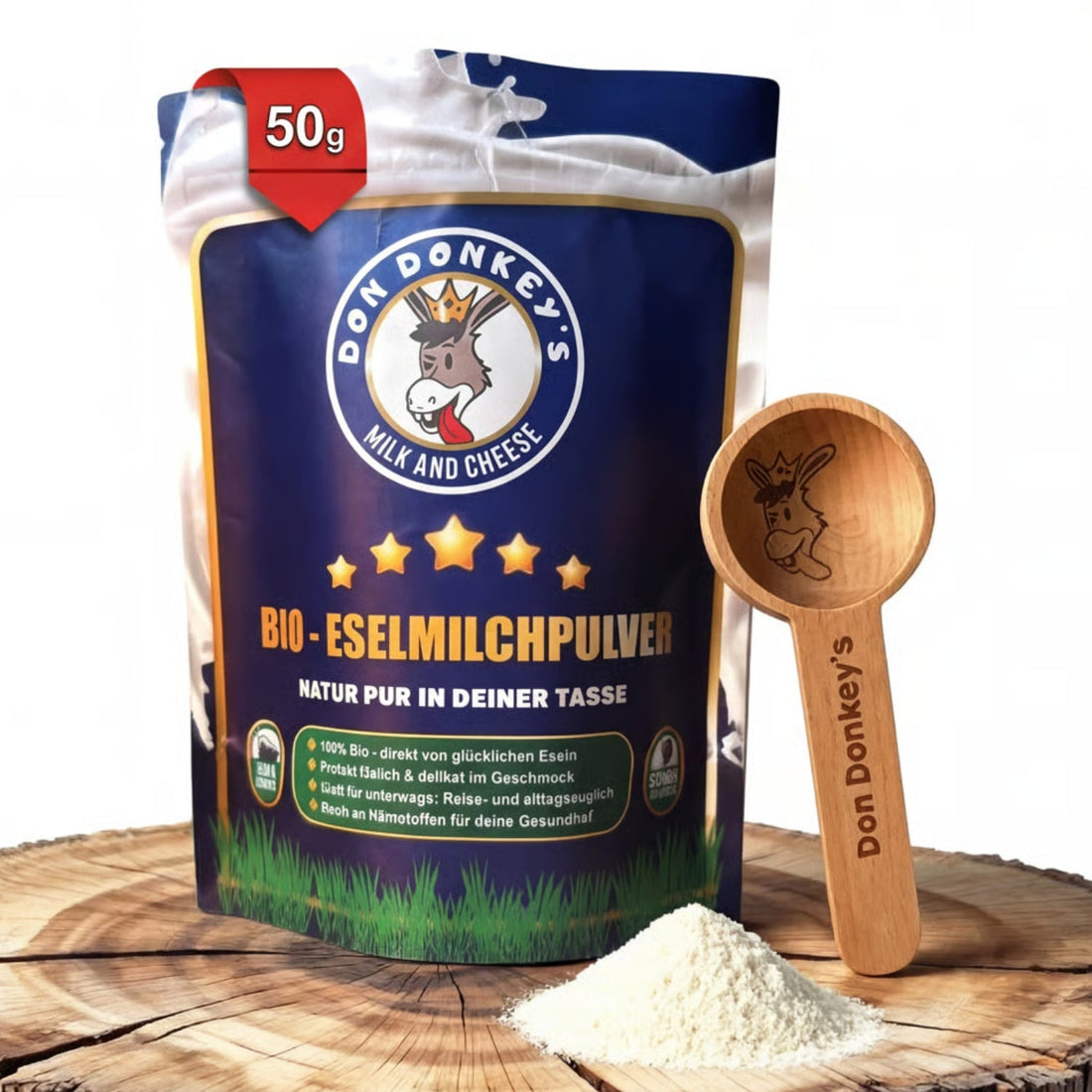
Also in our shop
Donkey Milk Powder
Donkey milk in powder form
For anyone who prefers a longer shelf life: our donkey milk in powder form – easy to store and portion.
20g · Unit price: €1.245,00 / 1 kg · incl. VAT, plus shipping