

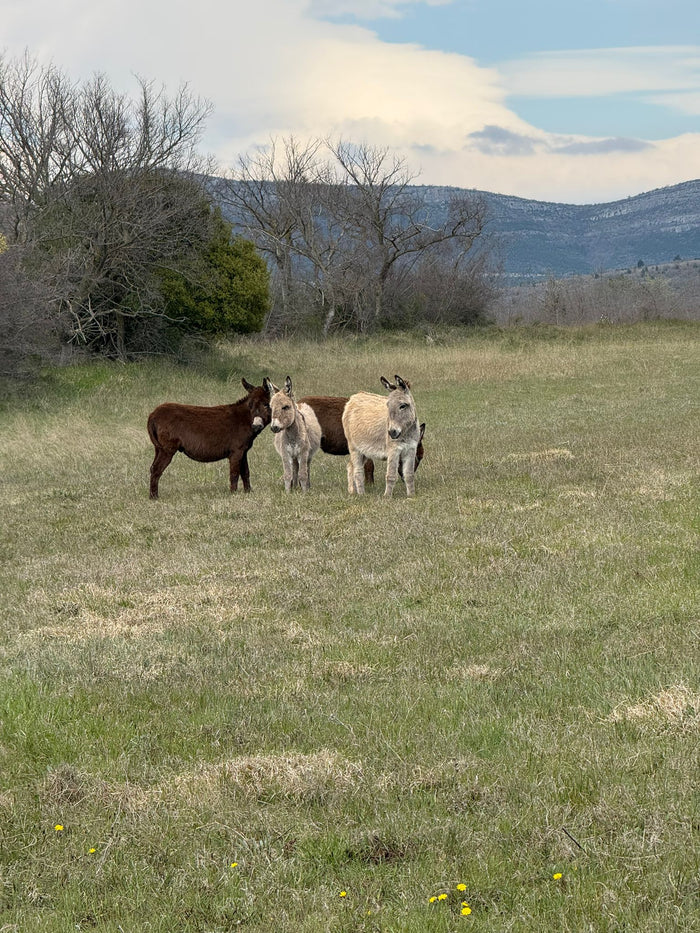
Large pastures
The jennies live in their herds on open land – with space to move and to rest.
 Buyer protection


Freeze-dried · no cold chain
The same hand-milked donkey milk as our fresh milk – frozen at −40 °C and gently dried under vacuum. 10 g of powder makes about 100 ml of donkey milk, no freezer needed.
without cold chain via DHL · within DE usually 2–4 working days after dispatch
All prices incl. VAT, unit price per kg. Powder sample once only for the first order with delivery within Germany.
Call us or write to us – Brian and Justin will advise you personally. In case of illness, during pregnancy or for children, please talk to your doctor beforehand.
Mon–Fri from 9am to 5pm Try it fresh: First sip 200 mlFresh donkey milk, delivered frozen – 200 ml for €49.90, shipping is on us (new customers in Germany, unit price €249.50 / l incl. shipping).
›
 Mini Duo: fresh + powder100 ml donkey milk and 20 g powder to compare.
The powder does not need a cold chain and travels to you with DHL, packed dry and protected from light – within Germany usually 2–4 working days after dispatch. We ship on Mondays and Wednesdays. Free shipping to Germany from an order value of €49 (below that €4.90), to Austria from €100 (below that €7.90). All shipping information
Weigh out 10 g of powder, stir it into a smooth paste with a splash of cold or lukewarm water and top up to 100 ml. Leave to swell for 1–2 minutes, stir again and enjoy lightly chilled at 9–15 °C. Please follow the instructions on the label.
Made from unpasteurised donkey milk (raw milk), freeze-dried. Please follow the instructions on the label.
Directly from the partner farm
Where our donkey milk comes from – filmed on site.
With subtitles · tap for sound
Our powder is freeze-dried donkey milk – without additives. When you mix it, it becomes donkey milk again. Here you can see what it is made of: from the big picture down to the individual proteins.
Around nine tenths is water. That is exactly what we remove during freeze-drying.
Milk sugar makes up the largest part – hence the mild, slightly sweet taste. It contains only a little fat.
There are around 1.8 g of protein in 100 ml. About half of this is whey protein – including two components that are characteristic of donkey milk.
ca. 0,1 g / 100 ml
An enzyme that occurs naturally in donkey milk – in a considerably larger amount than in cow’s milk, where it is only present in traces.
ca. 0,01 g / 100 ml
An iron-binding milk protein that occurs naturally in milk. Small in quantity, but a typical component.
ca. 0,5 g / 100 ml
The whey proteins present in the largest quantities. In donkey milk, the whey share of total protein is considerably higher than in cow’s milk.
ca. 0,8 g / 100 ml
About half of the protein. For comparison: in cow’s milk, casein makes up around 80 % of the protein.
| Nutrient | per 100 g powder | per 100 ml* |
|---|---|---|
| Energy | 1650 kJ / 390 kcal | 165 kJ / 39 kcal |
| Fat | 6 g | 0.6 g |
| of which saturates | 3 g | 0.3 g |
| Carbohydrate | 65 g | 6.5 g |
| of which sugars | 65 g | 6.5 g |
| Protein | 18 g | 1.8 g |
| Salt | 0.4 g | 0.04 g |
* 10 g of powder mixed with water to make 100 ml. Average values – the binding information is on the packaging.
All figures are average guide values. As a natural product, the composition of donkey milk varies depending on the animal, lactation stage, feeding and season.
The same milk – rethought
Some of our customers travel a lot, others like to keep a small reserve in the cupboard or portion their donkey milk themselves. That is what our powder is for: from the same farms, milked by hand – except that the milk is freeze-dried instead of frozen.
No refrigeration needed – shelf life 12 months (best-before date on the pack).
10 g of powder makes about 100 ml – just as much as you need right now.
Frozen at −40 °C and dried under vacuum, not heated.
Shipped dry and protected from light – handy at home and on the go.
How your powder is made
Our powder is made from the same hand-milked donkey milk as our fresh milk. Instead of heating it, we remove the water in an elaborate process: the milk is deep-frozen, and the ice evaporates in a vacuum without melting first. Experts call this lyophilisation.
Two ways to make powder
Most milk powders in the world are spray-dried – quickly and efficiently. We have chosen the slower, more elaborate route.
| Freeze-drying · DON DONKEY’S® | Spray-drying | |
|---|---|---|
| Principle | Milk is frozen, the ice evaporates in a vacuum | Milk is atomised in hot air and dries |
| Temperature | Below freezing point, the milk is not heated | Hot air stream, the milk droplets warm up briefly |
| Duration | Many hours per batch | A few seconds |
| Effort | High – small batches, a lot of energy for cold and vacuum | Low – made for large quantities |
| Considered | A gentle, elaborate process | Industry standard for milk powder |
Why so rare
Donkey milk is not a mass-market milk. A jenny usually gives 0.5–1 litre a day, at most around 2 litres – in addition to what her foal drinks. Our partners milk by hand, on small farms in Europe.
It takes about one litre of this milk to make 100 g of powder. That is why every pack is the result of a lot of handwork – and why it costs more than supermarket milk powder.
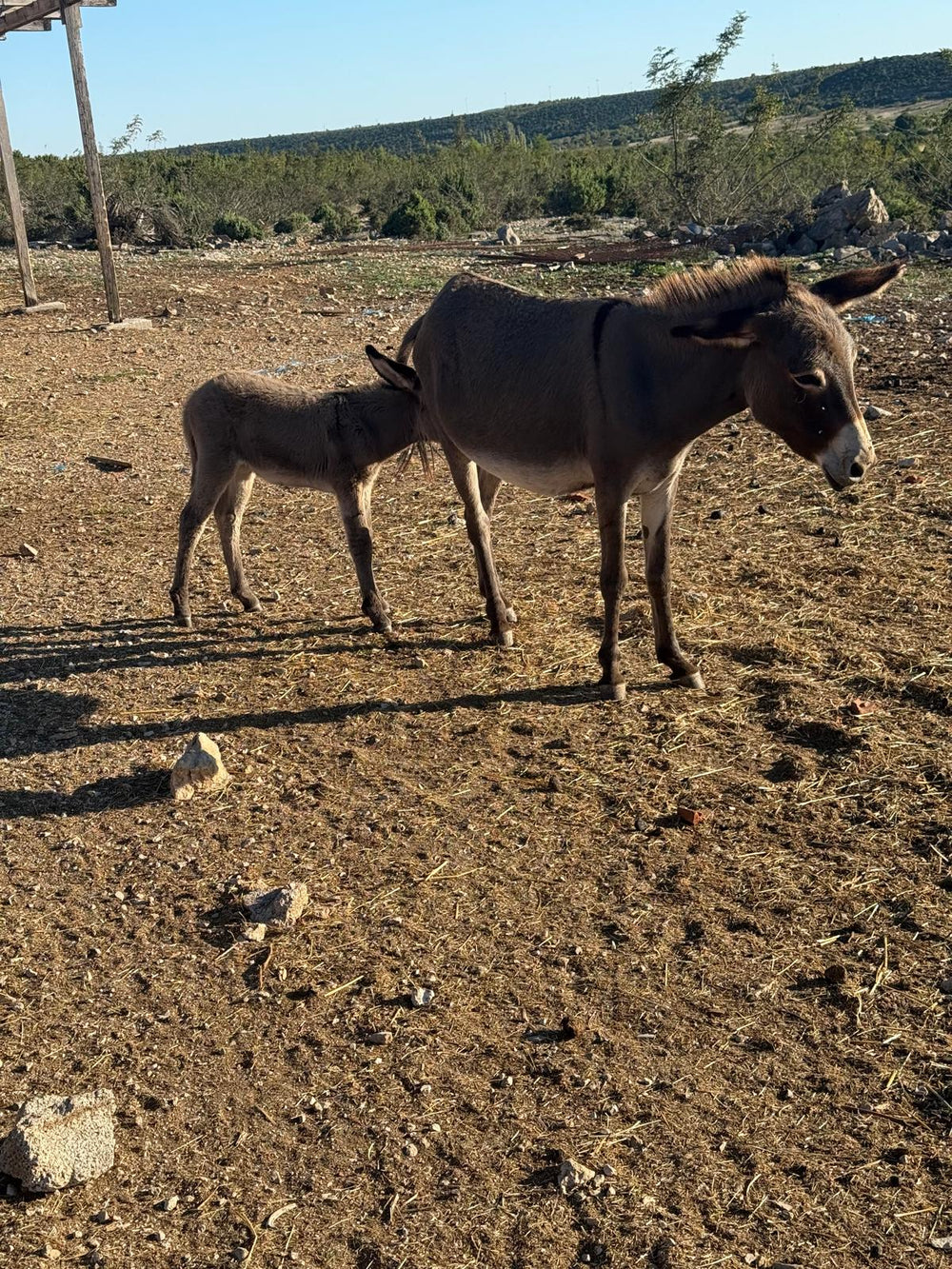
Where our donkeys live
The jennies live in stable herds on the pastures of their farms. For milking, some of them come into the stable for a short time – calmly and by hand. We know every partner farm personally and look at the processes on site.
The jennies live in their herds on open land – with space to move and to rest.
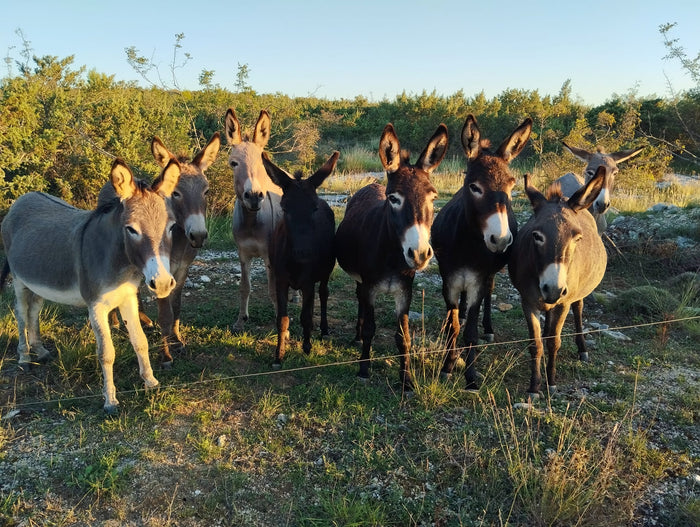
Donkeys are social animals. On our partner farms they stay together in their herds – from foal to older jenny.

Some jennies like to retreat into the bushes with their foals. Then the keepers come to them and milk directly on the pasture.
A jenny only gives her milk when she is calm. That's why our partners take their time when milking.
How to mix it
With these four steps your powder turns back into donkey milk – creamy and without lumps.
10 g of powder per 100 ml. Small precision scales measure more accurately than a spoon.
First stir into a paste with a small splash of cold or lukewarm water, then top up to 100 ml.
Leave to stand for 1–2 minutes and stir again or shake in a closed bottle.
Ideally lightly chilled at 9–15 °C. Store mixed milk in the fridge and drink promptly.
Please follow the instructions on the packaging.
Supply calculator
Tell us who will be drinking and for how many days – we put together the lowest-priced combination of our packs for you.
01 Who will be drinking?
Adults
Children aged 1 and over
02 For how many days?
03 What you need
The planning values are a calculation aid for your supply, not a consumption recommendation. For children, please talk to your paediatrician beforehand. All prices incl. VAT, plus shipping costs.

The people behind it
We are Brian and Justin Netuschil – two brothers from Lüdinghausen in the Münsterland region. DON DONKEY'S® exists because we believe that such a special natural product should find its way to people who appreciate it.
We know each of our partner farms personally, talk to the keepers and are here for you ourselves if you have any questions – via WhatsApp, email or phone.
Brian & Justin Netuschil

Customer story
When Karl-Heinz came across DON DONKEY'S® more than three years ago, donkey milk was something completely new to him. Out of curiosity, he wanted to try it himself.
That first encounter became a firm habit: Karl-Heinz has been ordering from us regularly for more than three years. Stories like this mean a lot to us – because behind every order is a person with their own preferences and rituals.
Frequently asked questions
Without cold chain, packed dry and protected from light, with DHL – within Germany usually 2–4 working days after dispatch. We ship on Mondays and Wednesdays. Shipping to Germany is free from an order value of €49, to Austria from €100; below that it costs €4.90 (Germany) or €7.90 (Austria).
Shelf life 12 months (best-before date on the pack). After opening, store dry, protected from light and tightly closed. Mixed milk belongs in the fridge and should be drunk promptly.
Stir 10 g of powder into a smooth paste with a small splash of cold or lukewarm water, then top up to 100 ml. Leave to swell for 1–2 minutes and stir again – that way no lumps form. It tastes good lightly chilled at 9–15 °C.
No. The powder is made from unpasteurised donkey milk, which is frozen at −40 °C and dried under vacuum – without heating. Please follow the instructions on the packaging.
Yes, you can stir the powder into drinks. It can also be used in smoothies, yoghurt or overnight oats.
Very similar: mild and slightly sweet. Some people find the mixed milk a touch creamier. It is the same milk from the same farms – just without the water.
In spray-drying, the milk is atomised in hot air and dries in seconds. In freeze-drying, it is frozen at −40 °C and the ice turns directly into vapour under vacuum – over many hours and without heating. This takes more effort.
With powder, there is no frozen storage, no dry ice and no express shipping. That is why a litre of donkey milk made from powder costs less than fresh milk – especially noticeable with the large packs.
Donkey milk is not a substitute for breast milk or infant formula and is not intended for infants. Whether and how children drink donkey milk is something to discuss beforehand with your paediatrician – the same applies during pregnancy and in case of illness.
Donkey milk is milk and contains milk protein and lactose. If you have a known milk protein allergy or lactose intolerance, please check with your doctor beforehand whether you can try it.
To get to know us
New to us? Your first order: 20 g of donkey milk powder for €24.90 incl. shipping (€1,245.00/kg, Germany only) – makes about 200 ml. Or choose your quantity straight away.
All prices incl. VAT.