
 Buyer protection


Contents
- Lactose is the natural sugar in milk.
- How much lactose does each type of milk contain?
- What happens to lactose in the body?
- Lactose intolerance or milk protein allergy?
- Why lactose-free milk still contains sugar.
- Donkey's milk has its own nutrient profile.
- How much milk sugar is in a serving?
- Not every milk serves the same purpose.
- Which milk suits your goal?
- Fresh donkey's milk and raw milk: What should be...
- Answers about milk sugar.
- Get to know donkey milk consciously.
- Transparently informed.
How much lactose does each type of milk contain?
Cow's milk, goat's milk, sheep's milk or donkey's milk: How do the natural levels of milk sugar differ?
Seven milk varieties compared directly. With concrete values, easy-to-understand explanations and an interactive decision aid.
Go to the lactose comparison →
Lactose is the natural sugar in milk.
Lactose, also known as milk sugar, is a natural component of mammalian milk.
Chemically, lactose consists of two linked simple sugars: glucose and galactose. For the body to absorb it, the bond must first be broken.
The lactase required for this is produced in the small intestine. How much lactose a milk contains depends on several factors, including the type of animal. Donkey's milk, for example, contains more milk sugar than cow's milk.
Typical lactose content per 100 ml.
Declared natural sugar per 100 ml at DON DONKEY'S®.
Usual labeling value per 100 ml in Germany.
Important: *The 6.5 g at DON DONKEY'S® refers to the declared total sugar. In unprocessed donkey's milk, this consists predominantly of lactose. A separate lactose measurement is therefore not stated.
How much lactose does each type of milk contain?
The following values refer to 100 ml of milk. We also calculate them for a typical serving of 250 ml.
| Milk variety | Per 100 ml | For 250 ml | Classification |
|---|---|---|---|
| Cow's milk | approx. 4.7–4.9 g | approx. 11.8–12.3 g | Natural lactose |
| Goat's milk | approx. 4.1–4.7 g | approx. 10.3–11.8 g | Not lactose-free |
| Sheep's milk | approx. 4.5–5.1 g | approx. 11.3–12.8 g | Not lactose-free |
| DON DONKEY'S® donkey's milk | approx. 6.5 g* | approx. 16.25 g* | Total sugar as an approximation |
| Lactose-free cow's milk | under 0.1 g | under 0.25 g | Enzymatically treated |
| Unsweetened soy drink | 0 g | 0 g | Naturally lactose-free |
| Unsweetened oat drink | 0 g | 0 g | Naturally lactose-free |
The animal milk values are typical reference ranges. *At DON DONKEY'S®, the declared total sugar was used as an approximation. It is not equivalent to a separately measured lactose amount.
Bar scale: 0–7 g per 100 ml. Typical average values or the declared approximate value are shown.
What happens to lactose in the body?
Whether milk sugar is well digested depends on how much lactase is available in the small intestine.
Ingestion
Lactose enters the small intestine with the food bolus.
Breakdown
The enzyme lactase breaks down milk sugar into glucose and galactose.
Lactase deficiency
Incompletely broken down lactose can enter the large intestine.
In the large intestine, bacteria can break down the remaining lactose. This can produce gases that cause discomfort in sensitive people.
Individual tolerance: Not everyone with lactose intolerance reacts to the same amount of milk sugar. Portion size and combination with other foods can also play a role.
Lactose intolerance or milk protein allergy?
Both terms are often confused. However, they are different physical reactions.
Lactose intolerance
This centers on the incomplete digestion of milk sugar. Possible discomforts include bloating, abdominal pain, and diarrhea.
Milk protein allergy
This is an allergic reaction to certain milk proteins. Other animal milks can also be problematic. Medical clarification is important.
Recurring discomfort after consuming milk should not be categorized solely based on your own assumption. For example, a hydrogen breath test can be used to diagnose lactose intolerance.
Why lactose-free milk still contains sugar.
Lactose-free cow's milk can still contain around 4.7 to 5 g of sugar per 100 ml.
The reason lies in the production process. The enzyme lactase is often added to the milk. It breaks down the lactose into glucose and galactose.
This reduces the content of unbroken lactose. However, the two resulting sugars remain in the product.
Why does it taste sweeter? Glucose and galactose together taste sweeter than the original lactose. Lactose-free milk can therefore taste sweeter without the need to add sugar.
Donkey's milk has its own nutrient profile.
Our donkey's milk differs significantly from classic cow's milk. This includes its relatively high natural milk sugar content.
Our published nutritional declaration states an average of 6.5 g of natural sugar per 100 ml. In unprocessed donkey's milk, this consists predominantly of lactose.
At the same time, our milk contains an average of 0.6 g of fat and 1.8 g of protein per 100 ml.
The composition can vary depending on the animal, feeding, and lactation phase.
Donkey's milk and cow's milk compared →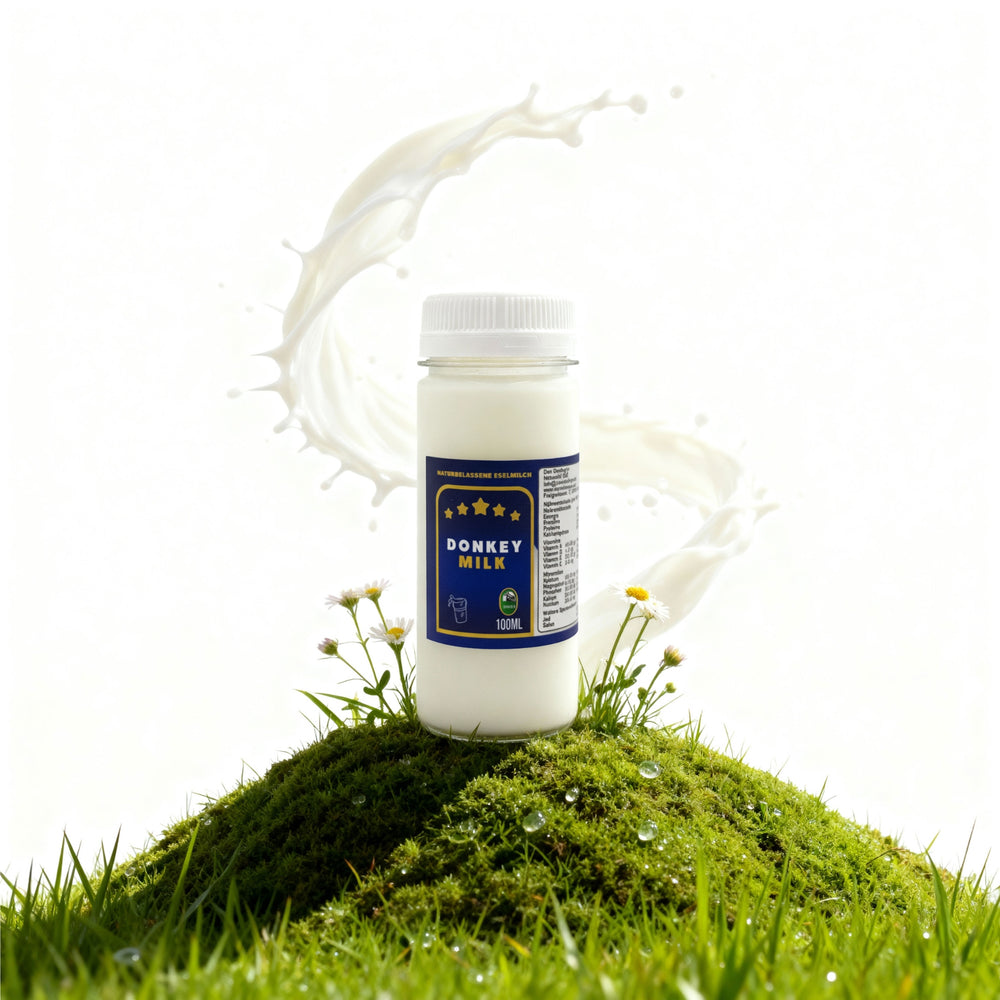
Per 100 ml
Per 100 ml
Per 100 ml
Important for intolerances: Donkey's milk is not lactose-free and is not a lactose-free alternative for lactose intolerance. For milk protein allergies, the use of other animal milks should be clarified by a doctor.
How much milk sugar is in a serving?
In addition to the content per 100 ml, the actual amount consumed plays an important role.
As a calculation example, we use the declared natural sugar of our donkey's milk.
Natural sugar
Natural sugar
Natural sugar
For comparison: A glass of cow's milk with 200 ml contains approximately 9.6 g of lactose, assuming 4.8 g of lactose per 100 ml.
The values illustrate why portion size is just as important as composition for a practical comparison.
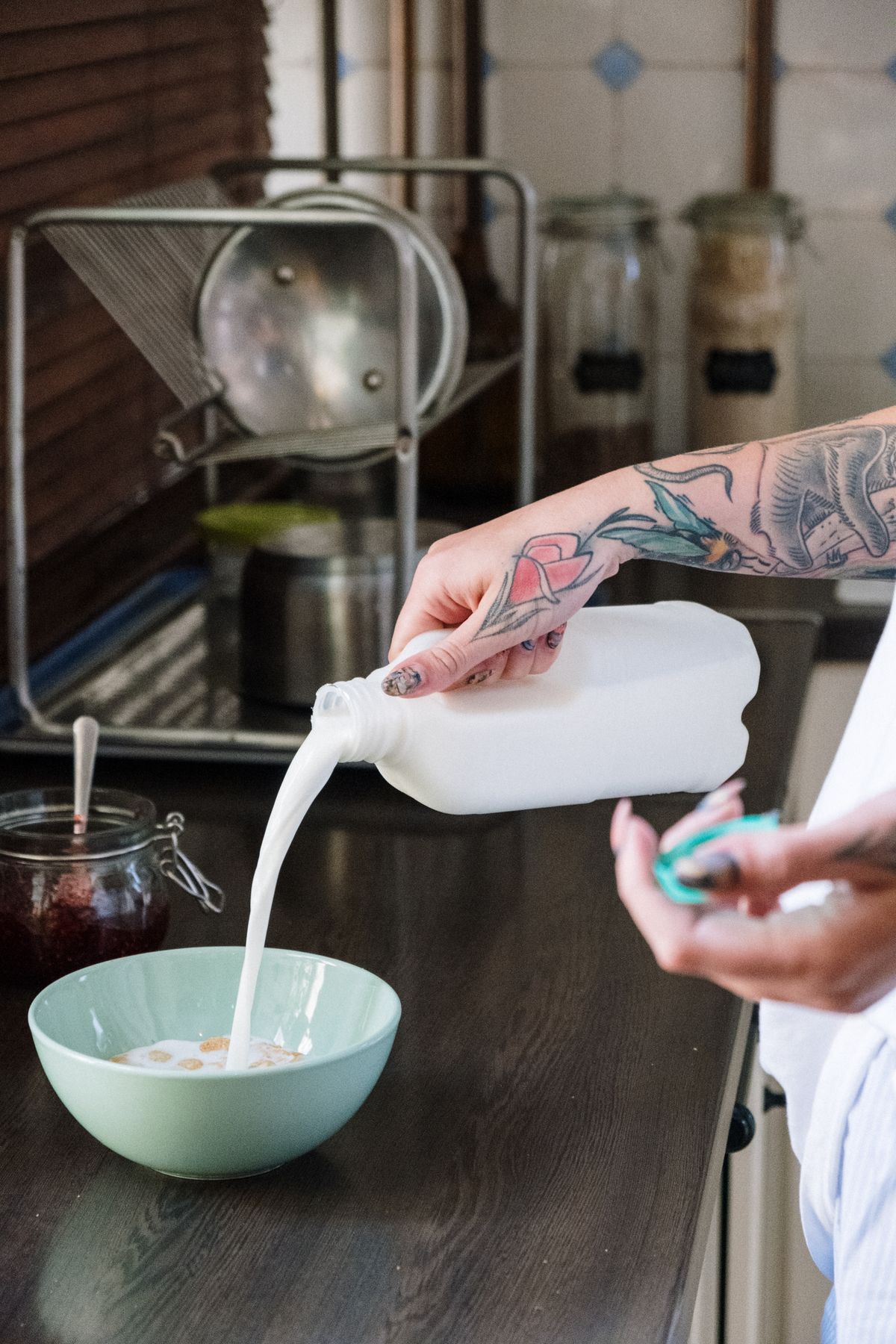
Not every milk serves the same purpose.
If you want to avoid lactose, appropriately labeled lactose-free products or pure plant-based drinks are obvious options.
If you want to compare the composition of different types of animal milk, it is worth taking a look at the complete nutrient profile.
Donkey's milk is characterized, among other things, by its relatively low fat content and its higher natural milk sugar content.
Soy and oat drinks are lactose-free, but differ in protein, total sugar, and other nutrients.
Which milk suits your goal?
Choose your priority and get concrete guidance.
This selection aid works without JavaScript.
What is important to you?
Lactose-free cow's milk and pure plant-based drinks are suitable starting points. Donkey's milk, goat's milk, and sheep's milk contain natural milk sugar.
Lactose-free milk can still contain sugar. The lactose was largely broken down into glucose and galactose during production.
DON DONKEY'S® donkey's milk contains an average of 6.5 g of natural sugar, 0.6 g of fat, and 1.8 g of protein per 100 ml.
Pure plant-based drinks contain no lactose. Additionally, compare protein, total sugar, and possible calcium fortification.
Fresh donkey's milk and raw milk: What should be considered?
Our fresh donkey's milk is offered as unpasteurized raw milk and shipped frozen.
Store the milk frozen at −18 °C until use and thaw it slowly in the refrigerator at 2–7 °C. Please follow the instructions on the label.
After thawing, store continuously refrigerated and consume promptly in accordance with the product instructions. Do not refreeze.
Good to know: Heating does not make milk lactose-free. The milk sugar remains largely intact.
Answers about milk sugar.
The most important questions about lactose and different types of milk.
Which milk contains particularly high levels of lactose?
Donkey's milk is among the milk varieties with relatively high lactose content. DON DONKEY'S® declares an average of 6.5 g of natural sugar per 100 ml, predominantly lactose.
Is goat's milk lactose-free?
No. Goat's milk typically contains about 4.1–4.7 g of lactose per 100 ml.
Does sheep's milk contain lactose?
Yes. Typical values are around 4.5–5.1 g per 100 ml.
Is DON DONKEY'S® donkey's milk lactose-free?
No. It contains natural milk sugar and is not a lactose-free alternative.
Why does lactose-free milk taste sweeter?
Lactose is broken down into glucose and galactose. These sugars taste sweeter together than lactose.
Is oat milk lactose-free?
Pure oat drinks naturally contain no lactose. For mixed products, the list of ingredients should be checked.
Does boiling milk make it lactose-free?
No. Normal boiling does not remove enough lactose.
Is lactose intolerance the same as a milk allergy?
No. Lactose intolerance affects the digestion of milk sugar. A milk protein allergy is an allergic reaction to certain proteins.
Get to know donkey milk consciously.
Discover our fresh donkey milk or the powdered form. Both contain natural milk sugar.
Natural, delivered frozen, and with a transparent nutritional declaration.
Storage and thawing →Freeze-dried donkey milk for preparation according to the product instructions.
View donkey milk powder →Transparently informed.
Our donkey milk values come from the published product declaration. The remaining information is typical orientation ranges.
- DON DONKEY'S® – Product declaration of the fresh donkey milk (nutritional values).
- German Nutrition Society – Information on milk and nutrition.
- NIDDK – Lactose Intolerance – Basics of lactose intolerance.
This article is for general information and does not replace individual medical advice. For specific products, the current manufacturer's specifications apply.





