Buyer protection


Contents
Ejiao is a gelatine made from donkey hides. It has a long history in traditional Chinese medicine and today is also used in foods and cosmetics. Because demand has risen sharply, The Donkey Sanctuary estimates that at least 5.9 million donkeys are slaughtered every year for the skin trade. This is putting pressure on donkey populations in many countries. In February 2024 the African Union therefore adopted a moratorium on slaughtering donkeys for their skins.
What is ejiao?
Ejiao (also written e-jiao, or donkey-hide gelatine) is a traditional product from China. To make it, donkey hides are boiled for a long time to extract the collagen they contain. The resulting gelatine is dried and usually traded as blocks or bars.
Ejiao has been used in traditional Chinese medicine for centuries. Today the gelatine is also found in snacks, drinks, food supplements and cosmetic products. We deliberately make no statements here about any effects of ejiao – this article is about what the trade means for the animals.
Why demand has become a problem
As prosperity has grown, demand for ejiao has risen sharply over recent decades. Domestic donkey numbers can no longer meet the need for hides. According to The Donkey Sanctuary, for example, the number of donkeys in China fell from around 11 million in 1992 to fewer than two million. As a result, hides are now sourced on a large scale from other parts of the world, mainly Africa but also South America and Asia.
The problem is that donkeys reproduce slowly. A jenny is pregnant for around a year and usually has just one foal. Find out more in How long are donkeys pregnant?. If more animals are slaughtered than are born, populations shrink quickly.
The consequences of the skin trade
Animal welfare organisations such as The Donkey Sanctuary have documented a range of problems linked to the trade for years:
- Animal welfare: reports describe long journeys, overcrowding and slaughter in poor conditions.
- Theft: several countries report stolen donkeys ending up in the skin trade.
- Livelihoods: for many families a donkey is transport, a working animal and a source of income. Losing it often hits women and children hardest, who use donkeys to carry water, firewood or goods.
- Animal health and biosecurity: uncontrolled movements across borders can increase the risk of spreading disease.
Donkeys' importance to people is reflected in their history too: they have accompanied us as working animals for thousands of years. Find out more in Where do donkeys come from?.
The African Union moratorium of 2024
In February 2024, African Union heads of state and government meeting at their summit in Addis Ababa adopted a moratorium on slaughtering donkeys for their skins. It applies to member states and aims to protect donkey populations across the continent. Some African countries had already introduced their own bans beforehand.
How effective the moratorium proves depends on how individual countries implement it. Animal welfare organisations have welcomed the decision but stress that enforcement and action against illegal exports remain crucial. The situation is still evolving, and rules in individual countries may change.
| Aspect | What is known |
|---|---|
| Raw material | Donkey hides, from which collagen is boiled out |
| Estimated donkeys slaughtered | At least 5.9 million a year (The Donkey Sanctuary) |
| Origin of hides | Including Africa, South America and Asia |
| African Union | Moratorium adopted in February 2024 |
Keeping it factual
With this topic it is easy to point the finger at a single country or culture. That does not do the issue justice. Ejiao has a long tradition, and many people are unaware of the background to today's trade. The real problem is scale: demand far exceeds what donkey populations can sustainably supply.
Animal welfare organisations therefore focus on education, cooperation with governments and alternatives that do not rely on donkey hides.
What you can do
- Stay informed: read reports from reputable animal welfare organisations and share factual information.
- Shop consciously: check what you are buying when a product lists ejiao or donkey-hide gelatine.
- Give support: help organisations and yards that work for donkeys. You will find ideas in Helping donkeys without owning one.
Frequently asked questions
Is ejiao the same as donkey milk?
No. Ejiao is made from the skin of slaughtered donkeys. Donkey milk comes from living jennies, which usually continue to suckle their foals. We explain how this works in How is donkey milk obtained?.
Is the donkey skin trade banned?
It depends on the country. The African Union adopted a moratorium for its member states in 2024, and some countries already had their own bans. There is, however, no single worldwide ban.
Where does the figure of 5.9 million donkeys come from?
It is an estimate by The Donkey Sanctuary, a UK animal welfare charity that has monitored the trade for years. Exact numbers are hard to establish because part of the trade is not officially recorded.
Is ejiao sold in Europe?
Products containing ejiao are traded internationally, including online. If you want to be sure, check the ingredients list.
Note: this article gives a factual overview of the donkey skin trade and makes no claims about any health effects of ejiao. Information is based in part on publications by The Donkey Sanctuary and reports on the African Union decision. Status: 2026.
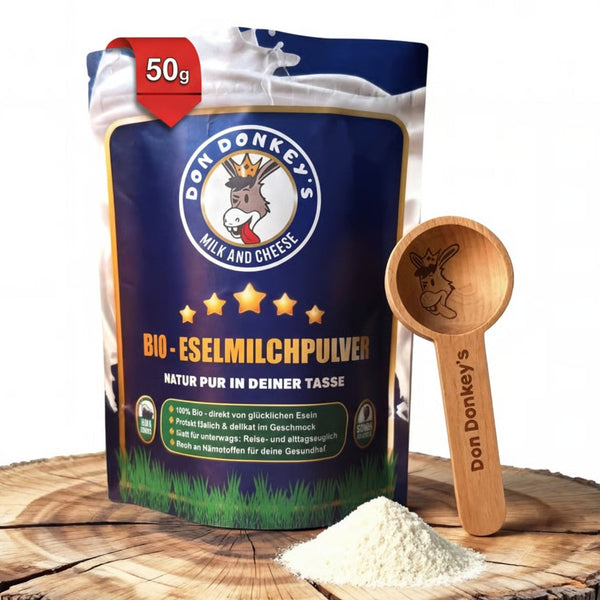
Donkeys are living, social animals that deserve protection. With a donkey sponsorship you support donkey yards in Germany directly. And if you would like to get to know donkeys from a very different angle, try our donkey milk.