
 Buyer protection

Research on donkey milk · Study 85
5 % donkey milk in the cheese vat: how 80 tasters judged
A team from the University of Basilicata made a caciotta from cow’s milk – once plain, once with 5 % donkey milk. After 10 and 45 days of ripening, 80 cheese consumers rated colour, aroma, taste, texture and overall impression.
The starting milk
Cow’s and donkey milk compared
Figures in per cent, means of duplicate determinations. Donkey milk contained less fat and protein but more milk sugar. Because only 5 % donkey milk was added, the finished cheeses did not differ statistically in dry matter, protein, fat and ash – but they did in pH.
Production · runs automatically
From the vat to the ripening shelf
The cow’s milk was pasteurised for 30 minutes at 65 °C; according to the paper, the donkey milk was not heated. 100 litres of cow’s milk per vat; the whole trial was carried out twice. Wheels shown schematically.
Key results · choose an attribute
Nine levels of liking
Each level is one point on the 9-point scale (1 = dislike extremely, 5 = neither like nor dislike, 9 = like extremely). The markers sit at the means from Table 2 and are placed to scale between the levels. Standard deviations are around 0.9 to 1.5 points.
Critical assessment
Our checklist for the tasting test
Checklist · Study 85
Samples with random three-digit codes, in random order, in individual booths. The participants did not know the experimental design.
80 habitual cheese eaters, recruited via notices at the university – not a representative sample.
Whether the same people rated all four cheeses is not stated explicitly.The text calls the aroma difference after 10 days “significant (p < 0.05)”, while Table 2 gives p = 0.051.
According to the paper, the interaction of cheese type and ripening time was not significant – even though the ranking reversed between 10 and 45 days. How the two trial runs were factored in remains open.
A short paper (“Communication”), described by the authors themselves as preliminary. A trained expert panel and an aroma compound analysis are missing.
Shelf life, antimicrobial or probiotic properties, which the authors mention in the discussion, were not measured.
We do not adopt these assumptions.Funding & interests
Funded by the rural development programme of the Basilicata region (project INNOPROLATTE). The authors declare no conflicts of interest; according to the paper, the funder had no influence.
Level of evidence
Sensory consumer test in humans – describes taste preferences, no statement about effects.
Research question for DON DONKEY’S®
How does ripening time change the taste of cheese with donkey milk?
In this study, the verdict reversed between 10 and 45 days. We would like to understand better how the aroma and texture of donkey milk cheese develop with ripening – as a question of taste, not of health.
Original publication
Effect of the Addition of Donkey Milk on the Acceptability of Caciotta Cow Cheese
Original title of the publication.
Cosentino C., Paolino R., Rubino M., Freschi P.
Animals · 2022 · volume 12, issue 11, article 1444 · open access (short communication)
School of Agricultural, Forestry, Food and Environmental Sciences (SAFE), University of Basilicata, Potenza (Italy)
DOI: 10.3390/ani12111444
Transparency: funded by the Basilicata region (project INNOPROLATTE), no conflicts of interest according to the paper. Consent of all participants was obtained. No product-related statement for DON DONKEY’S®.
Summarised and reviewed by the DON DONKEY’S editorial team on the basis of the original publication · as of October 2026
The study summarised above was carried out independently of DON DONKEY’S® and does not relate to our products. It serves solely to inform about the state of research.
DON DONKEY’S® donkey cheese and donkey milk are foods. They are not intended to prevent, treat or cure diseases and do not replace medical advice.
From our shop
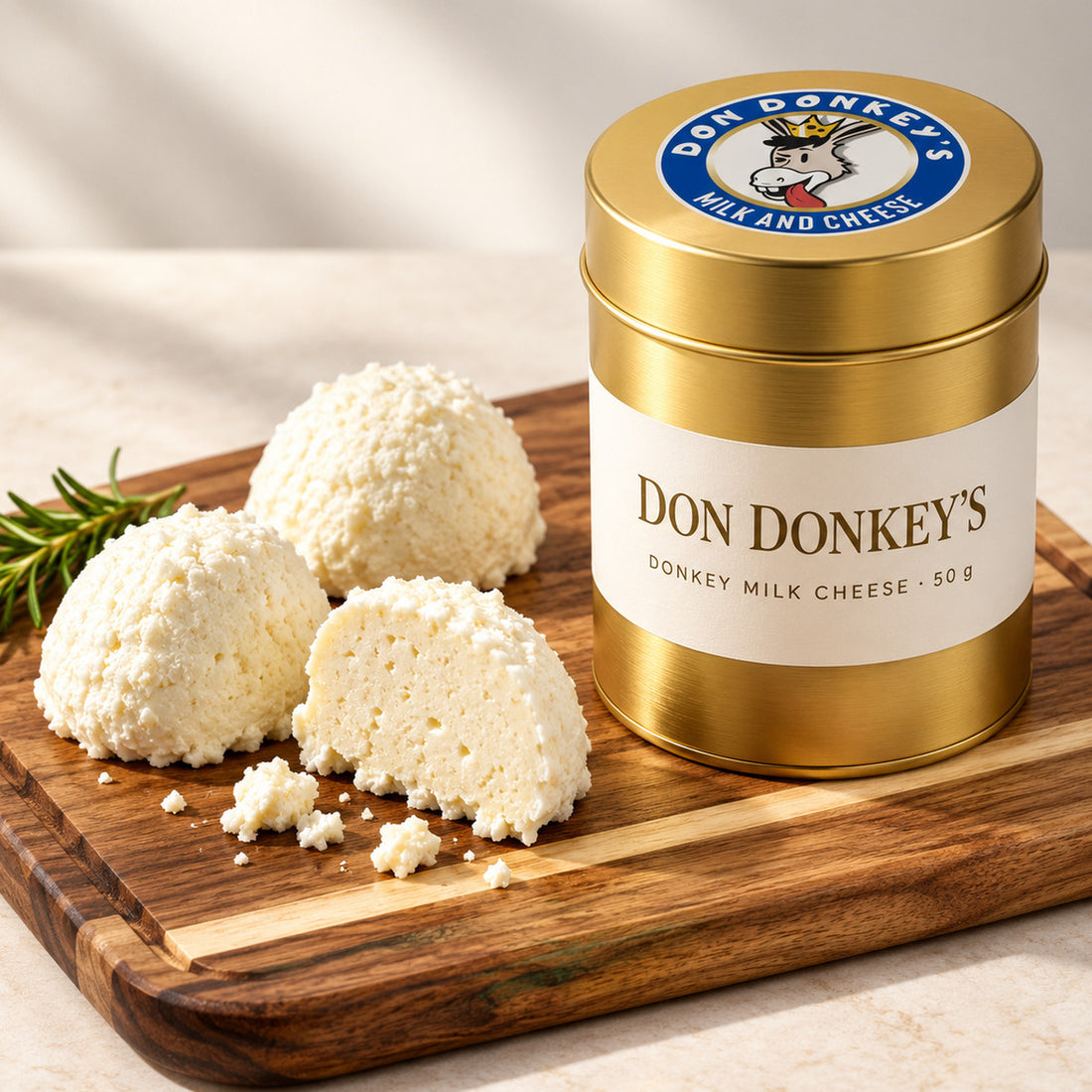
DON DONKEY’S® donkey cheese
Cheese nuggets from 50 g
Matching the topic of this page: our donkey cheese. Around 25 litres of donkey milk go into one kilogram; the taste is slightly nutty, the texture firm and creamy at the same time.
50 grams · Unit price: €4.998,00 / 1 kg · incl. VAT, plus shipping

Also in our shop
DON DONKEY’S® donkey milk
100 % donkey milk · raw milk, frozen
On this page we present the findings of a published study. Independently of that, you will find our donkey milk here: 100 % donkey milk, frozen as raw milk.
100 ml bottle / 100ml · Unit price: €249,00 / 1 l · incl. VAT, plus shipping