
 Buyer protection

Research on donkey milk · Study 68
Donkey milk in the cheese vat: rolled cheese with 10 and 20 % donkey milk
A team from Novi Sad made a traditional pasta filata cheese from Vojvodina three times – from pure cow’s milk and with a share of donkey milk. They compared production, microorganisms, composition, minerals and the verdict of 24 tasters.
Starting material
Two very different raw milks
Cow’s milk = 100. The further left the donkey milk dot lies, the less it contains by comparison. Measured in the study; raw milk from Balkan and Banat donkeys from the Zasavica nature reserve, collected in December 2024.
Production · runs automatically
Coagulation took up to five times as long
10 litres of milk each, same amount of rennet (0.3 g). With donkey milk, coagulation took considerably longer.
- Warmingmilk to 40 °C
- Coagulatingstir in rennet, let it set
- Cuttingcurd into cubes of approx. 2 cm
- Drainingdrain whey, drain in a cloth
- Stretchingsteep the curd in water at 80 °C
- Rolling5 mm thin, salt, roll into two rolls
Then drained for 24 hours at 4 °C, without ripening. All analyses within 24 hours. Salting was done by hand; the paper does not state the amount of salt.
Composition of the cheese · drag the slider
Less fat, more salt
Drag the slider to 0, 10 or 20 % donkey milk. Marked red: significant difference between the three cheeses.
Mean values; bar length per row relates to the highest of the three values. Fat in dry matter: the authors classify the cow’s milk cheese as full-fat and the cheeses with donkey milk as semi-fat (Serbian classification).
Microbiology · choose a tab
No difference in microorganisms
Counts as log10 CFU per gram. The colonies in the dishes are schematic: their number follows the measured value, not a real plate.
All differences not significant (p = 0.14 to 0.72). According to the authors, all cheeses met the criteria of EU Regulation 2073/2005. Measurements were taken once, not over the course of storage.
Tasting with 24 people
Equally liked, but recognisably different
Rating on a scale from 1 (dislike completely) to 5 (like very much). No difference was significant; for taste the value was just above the threshold (p = 0.087).
Triangle test: each person received three samples, two of them identical, and had to find the odd one out. From 16 correct out of 24, the difference counts as recognisable (dark line). The tasters were institute staff, 15 women and 9 men.
Critical assessment
Donkey milk effect or something else?
For each clear finding, we checked whether it can be explained by the donkey milk (left) or whether another factor is more likely (right).
Editorial assessment: The study shows that a traditional pasta filata cheese can be made with up to 20 % donkey milk and was liked about as well by the tasters. The differences in salt and sodium cannot be attributed to the donkey milk with certainty.
Research question for DON DONKEY’S®
What happens to donkey milk when it is processed?
Cheese, powder, heating: every processing step changes milk. We are interested in which properties of donkey milk are preserved in the process – and how to measure this properly.
Original publication
Impact of Balkan and Banat Donkey Milk on the Technological Process, Microbiological Quality, Composition, and Consumer Acceptability of Rolled Cheese
Original title of the publication.
Vidaković Knežević S., Vranešević J., Popov N., Knežević S., Ljubojević Pelić D., Živkov Baloš M.
Foods · 2025 · volume 14, article 2041 · open access
Scientific Veterinary Institute “Novi Sad”, Serbia
Transparency: funded by the Science Fund of the Republic of Serbia (PROTECTDonkey) and the Serbian Ministry of Science. According to the publication, no conflicts of interest. No product-related statement for DON DONKEY’S®.
Summarised and reviewed by the DON DONKEY’S editorial team on the basis of the original publication · as of October 2026
The study summarised above was carried out independently of DON DONKEY’S® and does not relate to our products. It serves solely to inform about the state of research.
DON DONKEY’S® donkey milk and donkey milk powder are foods. They are not intended to prevent, treat or cure any disease and do not replace medical advice.
From our shop
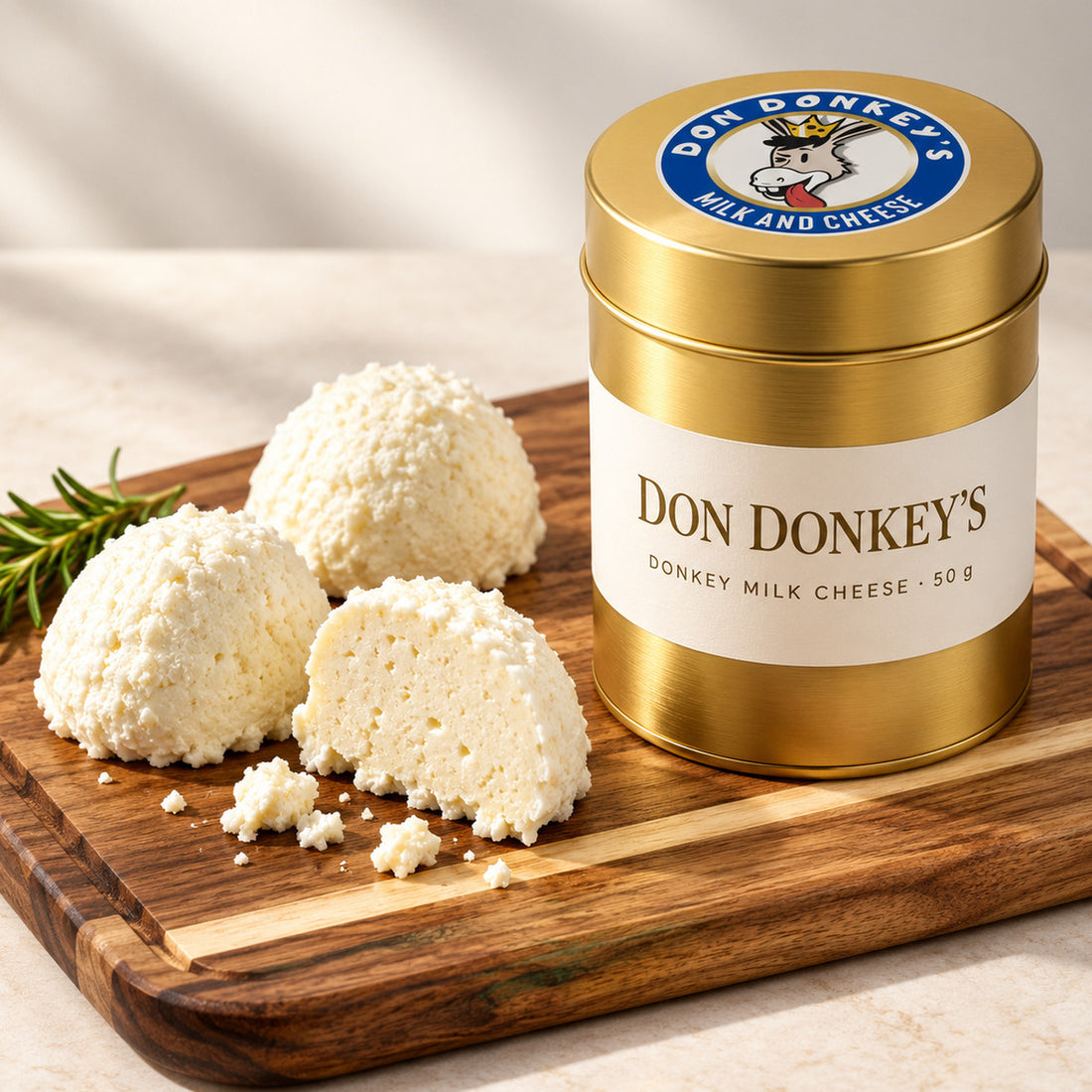
DON DONKEY’S® donkey cheese
Cheese nuggets from 50 g
Matching the topic of this page: our donkey cheese. Around 25 litres of donkey milk go into one kilogram; the taste is slightly nutty, the texture firm and creamy at the same time.
50 grams · Unit price: €4.998,00 / 1 kg · incl. VAT, plus shipping

Also in the shop
DON DONKEY’S® donkey milk
100 % donkey milk · raw milk, frozen
On this page we present the findings of a published study. Independently of that, you will find our donkey milk here: 100 % donkey milk, frozen as raw milk.
100 ml bottle / 100ml · Unit price: €249,00 / 1 l · incl. VAT, plus shipping
Also in the shop
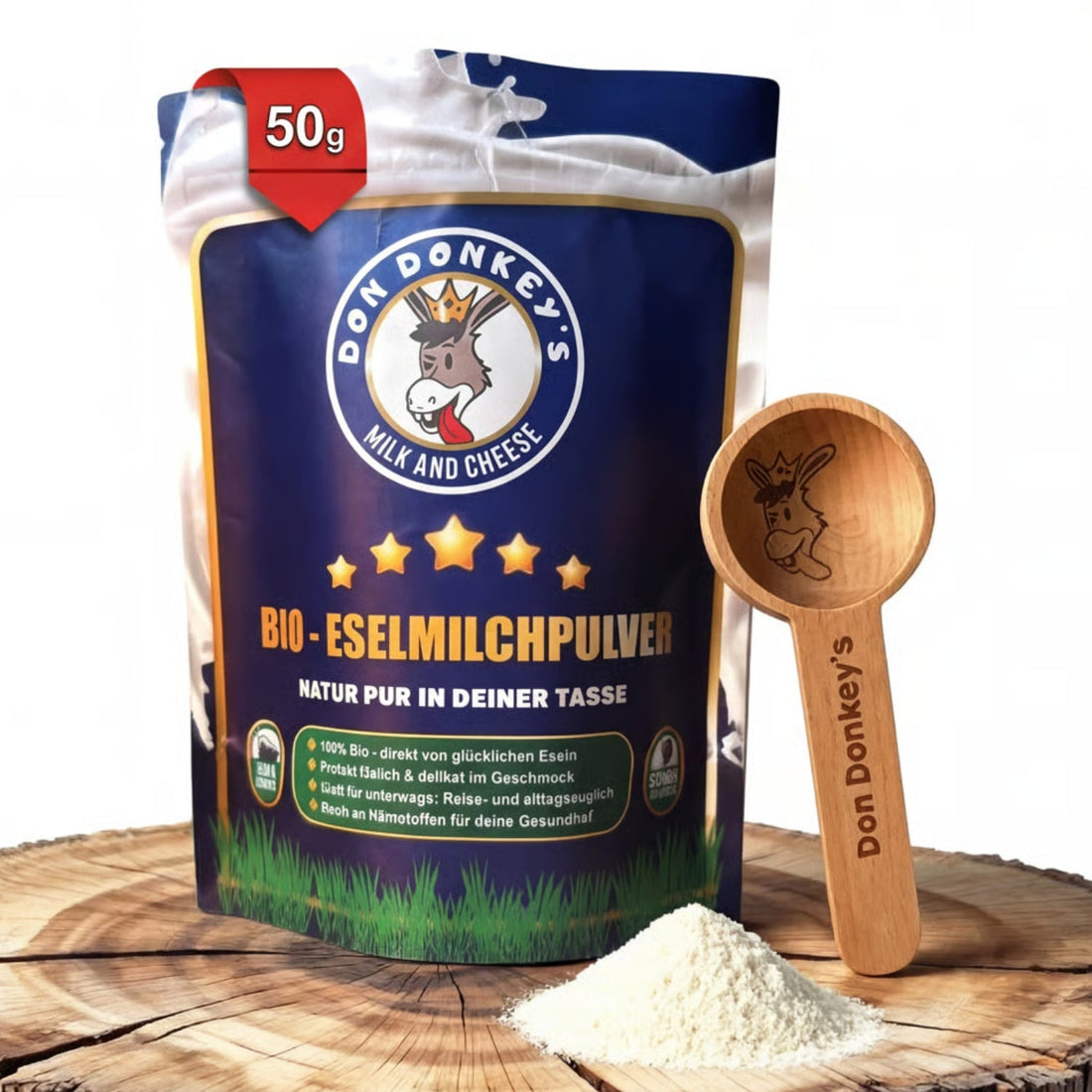
Donkey Milk Powder
Donkey milk in powder form
For anyone who prefers it longer-lasting: our donkey milk in powder form – easy to store and portion.
20g · Unit price: €1.245,00 / 1 kg · incl. VAT, plus shipping