
 Buyer protection

Research on donkey milk · Study 84
Selenium-enriched donkey milk with a high-fat diet: what was measured in the rat model
A team from Wuxi fed rats a high-fat diet for eight weeks and gave some of the animals donkey milk or selenium-enriched donkey milk in addition. Blood and liver values, gut bacteria and metabolites in the faeces were measured.
Experimental setup
Five groups, two types of feed
Normal donkey milk (DM) was given only in the low amount. The clearest findings concern Se-H – with four times the amount and selenium at the same time. The paper does not describe how the milk was enriched with selenium.
The authors’ explanation · assembles itself
Six puzzle pieces – and a gap
Schematic representation of the authors’ hypothesis. The labels show where each piece of evidence comes from.
Figures from Table 1 · tap a row
What the selenium milk contained differently
- Donkey milk
- Selenium donkey milk
Dot = percentage difference according to Table 1 (mean, n = 3). Filled = statistically different according to the paper; open = no significant difference. At +241.67 %, selenium lies outside the axis. Measured on defatted, freeze-dried samples. The table’s units are partly not plausible (e.g. milk sugar in “mg/kg”).
Metabolites in the faeces
How many substances differed
Number of faecal metabolites that differed statistically between two groups. The high-fat feed itself changed the profile the most. The figures say nothing about whether a difference is favourable or unfavourable.
Critical assessment · tap a row
The traffic-light matrix: how well is what supported?
Figures = measured values are in the text or tables · DM comparison = the result of the group with normal donkey milk is reported · Consistent = no contradictions in the paper. Green = yes, yellow = partly, red = no.
Conflict of interest
Three authors (Jie Cheng, Guangyuan Liu, Zhuoru Ren) were employed by a Chinese manufacturer of donkey-hide products; the same company supplied the donkey milk and the selenium donkey milk.
Funding
Programme of Shandong Province (Taishan Industrial Leading Talent) and the National Natural Science Foundation of China.
Level of evidence
Preclinical: disease model in rats plus cell and bacterial culture. No statement about humans, no recommendation.
Research question for DON DONKEY’S®
How much selenium does donkey milk naturally contain?
For normal donkey milk, the study gives 0.024 mg selenium per kg (defatted dry sample). How much the selenium content varies between farms and feeding is a question of composition that we continue to watch – without deriving any effects from it.
Original publication
Effect of Selenium-Enriched Donkey Milk on Lipid Metabolism Disorders Induced by a High-Fat Diet
Original title; the word “effect” comes from the original title and describes the rat model.
Zhong Q., Cheng J., Huang G., Zhan J., Chen X., Liu M., Liu G., Ren Z., Chen X., Tang X., Wang Z.
Foods · 2026 · volume 15, issue 10, article 1640 · open access
Jiangnan University Wuxi; Dong’e Ejiao Co., Ltd., Liaocheng (China)
Transparency: three authors employed by a Chinese manufacturer of donkey-hide products, milk from the same company. Animal experiment approved by the ethics committee of Jiangnan University. No product-related statement for DON DONKEY’S®.
Summarised and reviewed by the DON DONKEY’S editorial team on the basis of the original publication · as of October 2026
The study summarised above was carried out independently of DON DONKEY’S® and does not relate to our products. It serves solely to inform about the state of research.
DON DONKEY’S® donkey milk and donkey milk powder are foods. They are not intended to prevent, treat or cure any disease and do not replace medical advice.

From our shop
DON DONKEY’S® donkey milk
100 % donkey milk · raw milk, frozen
On this page we report the findings of a published study. Independently of that, you will find our donkey milk here: 100 % donkey milk, frozen as raw milk.
100 ml bottle / 100ml · Unit price: €249,00 / 1 l · incl. VAT, plus shipping
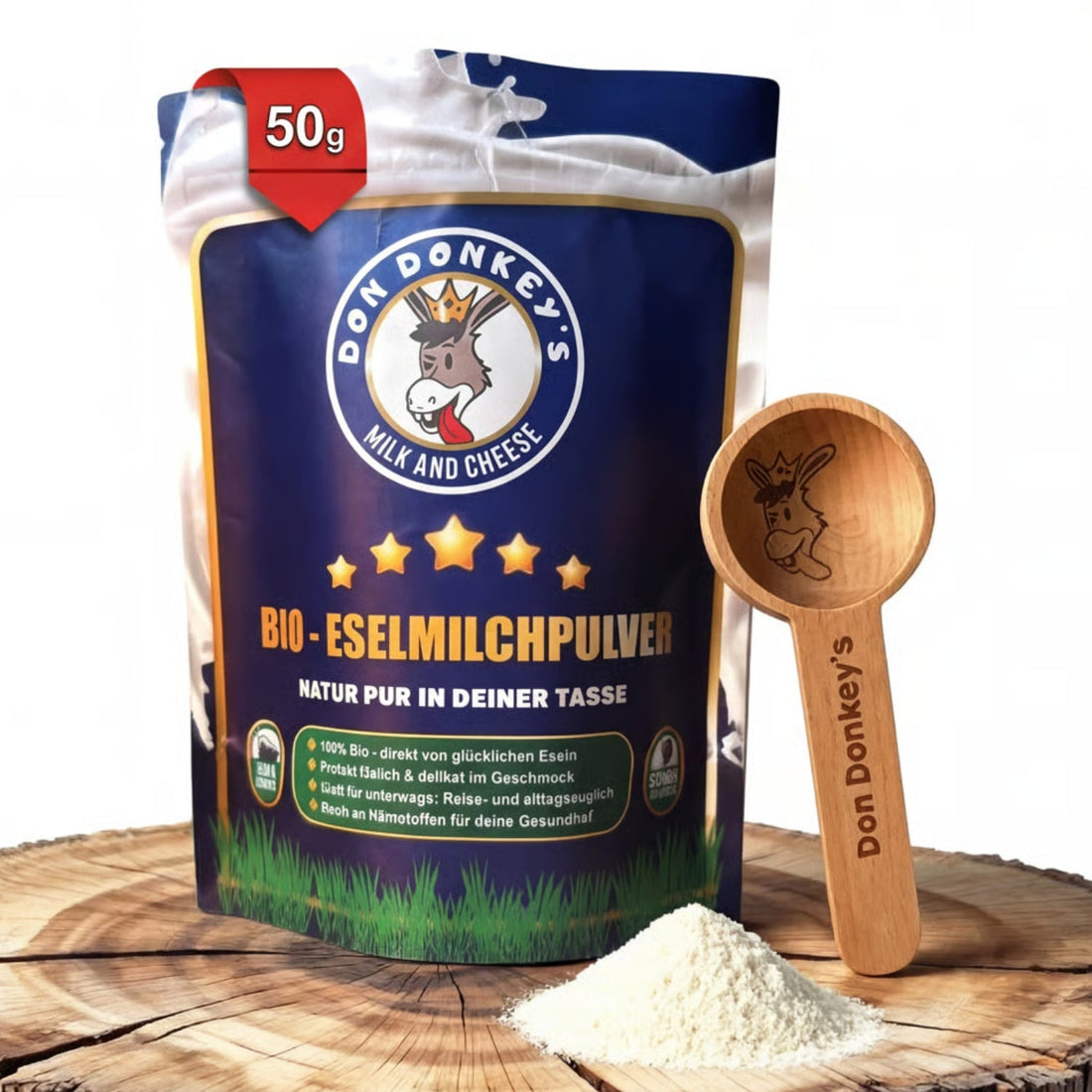
Also in our shop
Donkey Milk Powder
Donkey milk in powder form
For anyone who prefers a longer shelf life: our donkey milk in powder form – easy to store and portion.
20g · Unit price: €1.245,00 / 1 kg · incl. VAT, plus shipping