
 Buyer protection

Research on donkey milk · Study 49
What the jenny eats ends up in the milk fat
In 2025, a team from Inner Mongolia fed jennies two different rations for eight weeks – one of them with more roughage and considerably more alfalfa. They examined how the fatty acid pattern of the milk changed.
What it's about
Feed as an adjusting screw
Donkey milk is low in fat, but its fat has a pattern of its own: compared with cow's milk, it contains more polyunsaturated fatty acids, especially alpha-linolenic acid, an omega-3 fatty acid. How strongly this pattern depends on feed has hardly been studied in donkeys.
The researchers therefore replaced part of the low-quality roughage (millet straw) with alfalfa hay and increased the roughage proportion. Energy and protein were the same in both rations.
What exactly was studied?
Briefly explained
Feed and fatty acids
A protein-rich forage plant, usually fed as hay. It contains more unsaturated fatty acids than straw.
Alpha-linolenic acid (C18:3n3), an omega-3 fatty acid that mainly comes from plants.
How many omega-6 fatty acids there are per omega-3 fatty acid. A figure used to describe fat.
Calculated indices from the fatty acid pattern. They describe fat; they do not measure an effect.
16 jennies, around 40 days after foaling, randomly divided into two groups.
One week of adaptation, then eight weeks on the respective ration.
Milk fat weekly, pooled samples from morning and evening milking at the end.
Fatty acids in milk and blood, plus blood values of the jennies.
Interactive · The data at a glance
Two rations, two fat profiles
How the rations differed, how much more alfalfa was involved, what changed in the milk fat, which figures resulted – and how the jennies fared. Switch between the views.
Group LG · little alfalfa
Group HG · much alfalfa
↑ higher in HG
↓ lower in HG
= unchanged
Values from the freely available original publication. Individual fatty acid values per group are given there in tables; we report the direction of the differences reported.
Key findings
What the researchers report
More alpha-linolenic acid in the milk fat
C18:3n3 · p = 0,048With more alfalfa in the feed, the proportion of alpha-linolenic acid in the milk fat rose. Omega-3 fatty acids in total and polyunsaturated fatty acids were also higher.
Lower omega-6 to omega-3 ratio
n-6/n-3 ↓ · IT ↓The ratio of omega-6 to omega-3 fell, as did the calculated thrombogenic index. The fat content of the milk itself remained the same.
More milk, same weight
milk yield · p = 0.042The jennies in the alfalfa group gave more milk. Feed intake and body weight did not differ; cholesterol and LDL in their blood fell.
The authors attribute the changes to the higher content of long-chain and unsaturated fatty acids in alfalfa. They regard the exact mechanisms as open.
Critical assessment
A finding about milk, not about health
What the study shows
What it does not show
Research question for DON DONKEY’S®
How does feed shape our milk?
This study shows how closely feeding and milk composition are linked. For us, this is a question of transparency: what do the jennies whose milk we offer eat – and how does the milk change over the year?
Original publication
The Effect of Increasing the Proportion of Dietary Roughage Based on the Partial Replacement of Low-Quality Roughage with Alfalfa Hay on the Fatty Acid Profile of Donkey Milk
Liang X., Guo X., Yue Y., Hui F., Tong M., Guo Y., Zheng Y., Shi B., Yan S.
Animals · 2025 · volume 15, issue 3, article 423 · open access
DOI: 10.3390/ani15030423
A feeding study with jennies – no product-related statement for DON DONKEY’S®.
The study summarised above was carried out independently of DON DONKEY’S® and does not relate to our products. It serves solely to inform about the state of research.
DON DONKEY’S® donkey milk and donkey milk powder are foods. They are not intended to prevent, treat or cure any disease and do not replace medical advice.

From our shop
DON DONKEY’S® donkey milk
100 % donkey milk · raw milk, frozen
On this page we report the findings of a published study. Independently of that, you will find our donkey milk here: 100 % donkey milk, frozen as raw milk.
100 ml bottle / 100ml · Unit price: €249,00 / 1 l · incl. VAT, plus shipping
View all sizes & purchase options →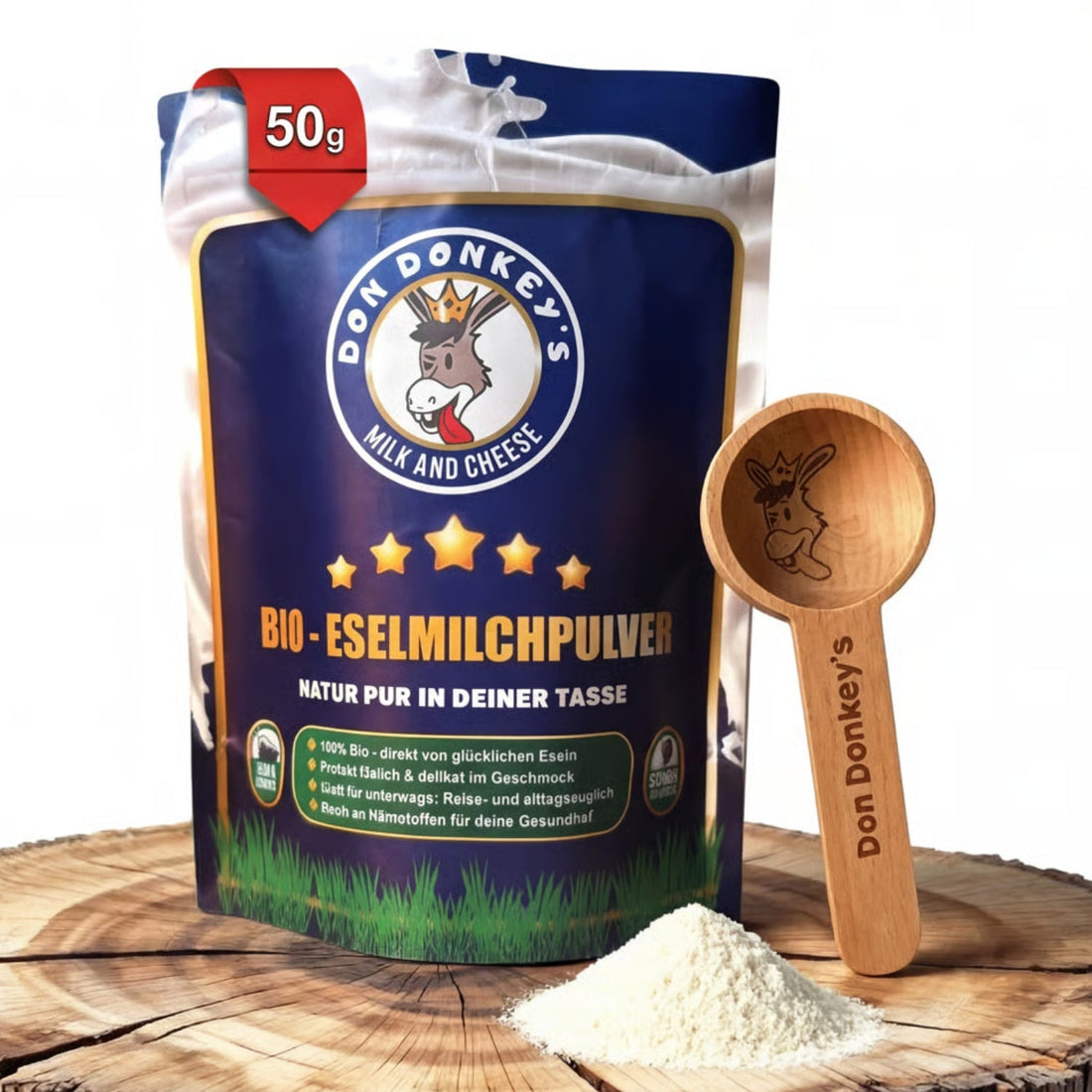
Also in our shop
Donkey Milk Powder
Donkey milk in powder form
For anyone who prefers a longer shelf life: our donkey milk in powder form – easy to store and portion.
20g · Unit price: €1.245,00 / 1 kg · incl. VAT, plus shipping
View all sizes & purchase options →