
 Buyer protection

Research on donkey milk · Study 77
Three temperatures, three times: short-time heating of donkey milk
An Italian team heated donkey milk in a small continuous-flow unit to 75, 85 or 92 °C – for 3, 6 or 12 seconds each. They measured how much lysozyme, β-lactoglobulin and B vitamins remained in the milk afterwards.
Experimental unit · runs automatically
60 litres an hour through the plates
Key findings · tap a field
Nine heat treatments, one comparison with raw milk
- Lysozyme
- β-lactoglobulin
Circle area = measured amount relative to raw milk (lysozyme 1.17 g/L, β-lactoglobulin 3.43 g/L). Rows: temperature, columns: holding time. Values as mean ± standard deviation from the paper.
Further measurements
How far the values fell
Bars: range of decrease compared with raw milk across all nine heat treatments, as stated in the paper. ABTS, FRAP and SH groups are laboratory tests for reducing or radical-scavenging properties – laboratory measurements, not effects. For the four measurable B vitamins, the authors found no significant decrease.
Critical assessment
The rating plate of the study
Study 77 · test data
One batch
One pooled milk from 120 Martina Franca jennies, taken once in February 2019. No comparison across seasons or farms.
Slight contradictions
β-lactoglobulin: 2–22 % decrease in the abstract, 2–25 % in the results section. For the polyphenols, units and percentages do not quite match.
No process verification
Whether the heat treatments achieve their technical goal was not checked – there was no enzyme test and no microbiological examination.
Little significance
For β-lactoglobulin, according to the table, only three variants differed clearly from raw milk: 85 °C/12 s, 92 °C/6 s and 92 °C/12 s.
Small unit
60 L per hour in the university laboratory. How this transfers to larger plants is open – the authors call the results preliminary.
None declared
No conflicts of interest, no funding named. One author works for a regional breeders’ association (ARA Campania).
Editorial assessment: The study reports what remains measurable in the milk after different heat treatments. We do not derive a recommendation for or against heating from it. For comparison: Study 19 (gently heated donkey milk) and Study 58 (verification of pasteurisation).
Research question for DON DONKEY’S®
Which measurements belong in a transparent analysis of donkey milk?
The study shows how differently sensitive individual components such as lysozyme or B vitamins are to processing. Which values we will have determined in the laboratory in future and show openly is a question we are following up.
Original publication
Effect of continuous flow HTST treatments on donkey milk nutritional quality
Original title of the publication.
Matera A., Altieri G., Genovese F., Polidori P., Vincenzetti S., Perna A., Simonetti A., Rashvand Avei M., Calbi A., Di Renzo G. C.
LWT – Food Science and Technology · 2022 · volume 153, article 112444 · full text via the University of Camerino repository
University of Basilicata (Potenza), University of Camerino (Matelica), ARA Campania (Caserta), Italy
DOI: 10.1016/j.lwt.2021.112444
Transparency: no funding named in the paper. The authors declare no conflicts of interest. Thanks are given to a regional breeders’ association and to the farm in Laterza (Apulia) that supplied the milk. No product-related statement for DON DONKEY’S®.
Summarised and reviewed by the DON DONKEY’S editorial team on the basis of the original publication · as of October 2026
The study summarised above was carried out independently of DON DONKEY’S® and does not relate to our products. It serves solely to inform about the state of research.
DON DONKEY’S® donkey milk and donkey milk powder are foods. They are not intended to prevent, treat or cure any disease and do not replace medical advice.

From our shop
DON DONKEY’S® donkey milk
100 % donkey milk · raw milk, frozen
On this page we present the findings of a published study. Independently of that, you will find our donkey milk here: 100 % donkey milk, frozen as raw milk.
100 ml bottle / 100ml · Unit price: €249,00 / 1 l · incl. VAT, plus shipping
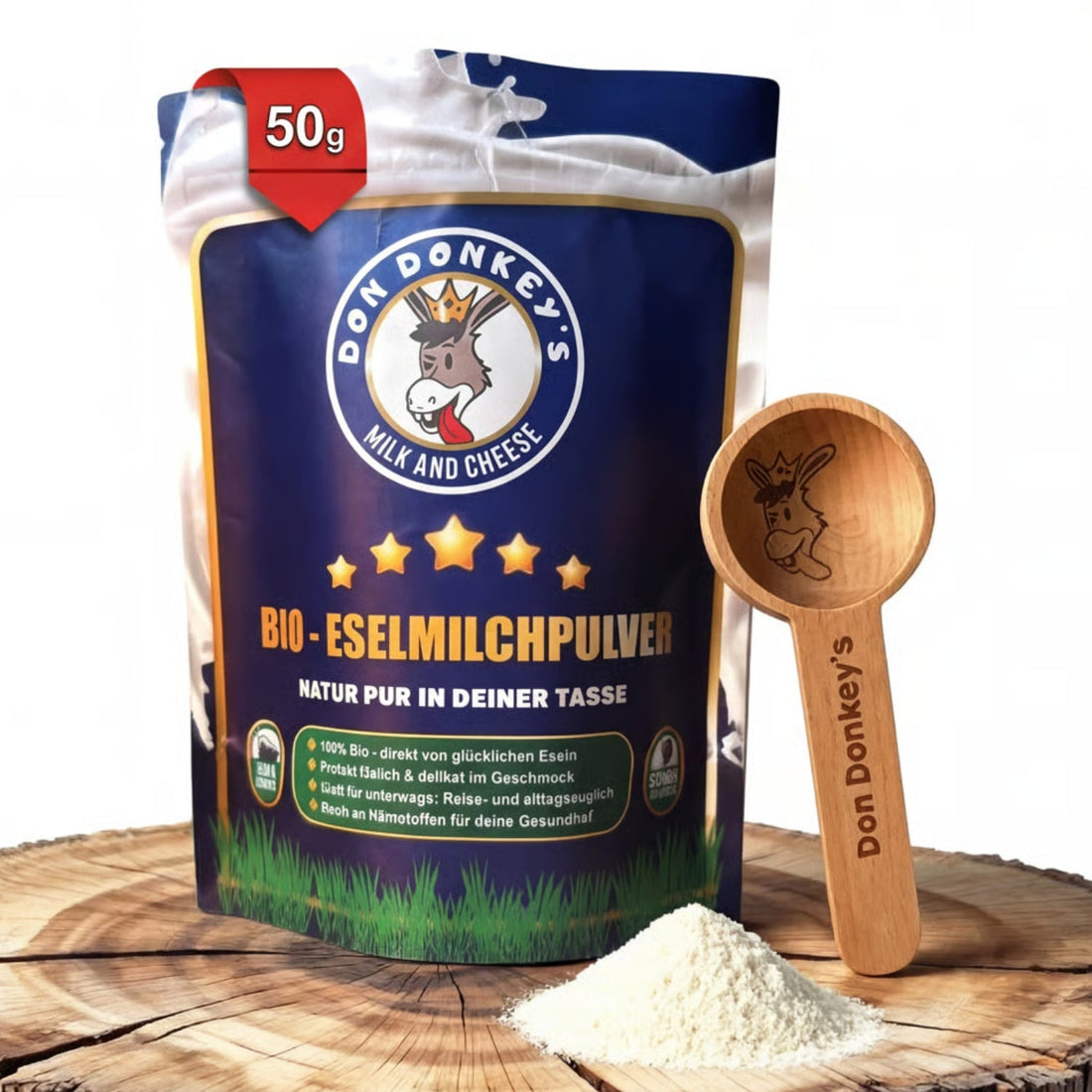
Also in our shop
DON DONKEY’S® donkey milk powder
Donkey milk in powder form · freeze-dried
For anyone who prefers it longer-lasting: our donkey milk in powder form, freeze-dried – easy to store and portion.
20g · Unit price: €1.245,00 / 1 kg · incl. VAT, plus shipping