
 Buyer protection

Study 58 · Laboratory study · Italy 2026
Pasteurised – or not? Why the standard test reaches its limits with donkey milk
Laboratories check whether milk has been heated sufficiently using the enzyme alkaline phosphatase (ALP). The method comes from cow's milk testing. A team from Sicily examined whether it also works for donkey milk.
The test in three pictures
An enzyme as a heat witness
Raw milk
Milk naturally contains ALP. In raw milk the enzyme is fully active.
Heating
ALP is heat-sensitive. With sufficient heating it loses almost all of its activity.
Measuring the residual value
The laboratory measures the remaining activity. If it is below a limit, the milk is considered pasteurised.
Method: ISO 11816-1 (fluorimetric). Limit for pasteurised cow's milk: 350 milli-units per litre (mU/L).
Starting point
Donkey milk starts with very little ALP
In the raw milk of the 14 jennies, ALP activity averaged 2,867 mU/L, ranging from 1,758 to 6,086 depending on the animal. According to the publication, cow's milk is typically above 700,000 mU/L.
Raw donkey milk is therefore only around eight times above the limit that cow's milk must meet after heating.
Experimental setup
Time times temperature: what was tested in the heating block
- Compliant – regarded as sufficient pasteurisation, e.g. 63 °C · 30 min or 72 °C · 15 s.
- Non-compliant – deliberately too short or too cool. A good test should detect them.
- Not tested.
1.5 ml of milk each in the heating block, then on ice. Samples from October to April, one farm, same feed.
Interactive · switch the limit
Which samples pass the test?
Bar = range of residual values in mU/L. For 55 °C · 30 min the text only states "above 350".
How quickly activity falls
Seconds to minus 90 per cent
The D-value indicates how long it takes at a given temperature for 90 % of ALP activity to disappear. The hotter, the faster.
63 °C
13,0 sD-value · scale 0–15 s
after 15 s: −91.0 %72 °C
9,6 sD-value · scale 0–15 s
after 15 s: −97.0 %76 °C
7,7 sD-value · scale 0–15 s
after 15 s: −98.9 %Secondary finding
What withstands the heat best
Lysozyme activity
The enzyme typical of donkey milk remained active best.
Antioxidant capacity
A laboratory value for substances measurable as antioxidants.
ALP
That is exactly why ALP serves as a heat indicator.
Longer heating at 72 and 76 °C reduced both values; at 76 °C · 15 s they were largely preserved according to the authors. Laboratory measurements – no statement about an effect in humans.
Key findings
Four questions, four answers
Is the cow's milk limit suitable for donkey milk?
No. Almost all non-compliantly heated samples were below 350 mU/L and would have passed the test. Only 55 °C · 30 min was above it.
Is the residual value alone enough to distinguish?
Not reliably. The ranges of 63 °C · 30 min and 72 °C · 15 s overlap with the non-compliant variant 63 °C · 10 min.
Which heat treatment do the authors propose?
76 °C for 15 seconds. It gave the lowest residual values (12 to 61 mU/L) and separated most clearly from the non-compliant samples.
Why does the starting value vary so much?
With more days in lactation and more milk sugar, ALP was lower; with more somatic cells, higher.
Critical assessment
What the study supports – and what it doesn't
Strengths
- 42 raw milk samples from 14 animals on three dates
- Many time–temperature combinations, compliant and non-compliant
- Measurement uncertainty included in the decision rule
- The limit of 61 mU/L is explicitly described as provisional
Limitations
- One farm, one breed (Ragusano) – transferability open
- 1.5 ml was heated in the laboratory, not batches in a plant
- The limit analysis is based on only two non-compliant variants
- The text gives no figures for lysozyme and antioxidant capacity
Editorial assessment: For donkey milk, specific reference values in food control are lacking. The authors call for larger data sets and further markers. No consumer recommendation follows from this.
Research question for DON DONKEY’S®
How can heat treatment of donkey milk be tested fairly?
Test methods from the cow's milk world do not automatically suit donkey milk. For us, this means looking closely at which method belongs to which product.
- Disclose processing per productDescribe raw milk and powder separately and traceably.
- Follow donkey-milk-specific test methodsWatch for new reference values and markers.
- Compare with earlier studiesStudy 19 (gently heated donkey milk) and Study 52 (fermented donkey milk).
Original publication
Donkey Milk Quality and Safety: Challenges of Using the ISO 11816-1 ALP Method for Pasteurization Verification
Original title of the publication.
Marino V. M., Schadt I., Belvedere G., La Terra S., Caccamo M., Caggia C.
Foods · 2026 · volume 15, issue 4, article 677 · open access
CoRFiLaC, Ragusa, and University of Catania, Italy
Transparency: funded by Sicily's 2014–2022 rural development programme (EU, Italy, Sicily region). According to the publication, no conflicts of interest. No product-related statement for DON DONKEY’S®.
Summarised and reviewed by the DON DONKEY’S editorial team on the basis of the original publication · as of October 2026
The study summarised above was carried out independently of DON DONKEY’S® and does not relate to our products. It serves solely to inform about the state of research.
DON DONKEY’S® donkey milk and donkey milk powder are foods. They are not intended to prevent, treat or cure any disease and do not replace medical advice.

From our shop
DON DONKEY’S® donkey milk
100 % donkey milk · raw milk, frozen
On this page we report the findings of a published study. Independently of that, you will find our donkey milk here: 100 % donkey milk, frozen as raw milk.
100 ml bottle / 100ml · Unit price: €249,00 / 1 l · incl. VAT, plus shipping
Also in our shop
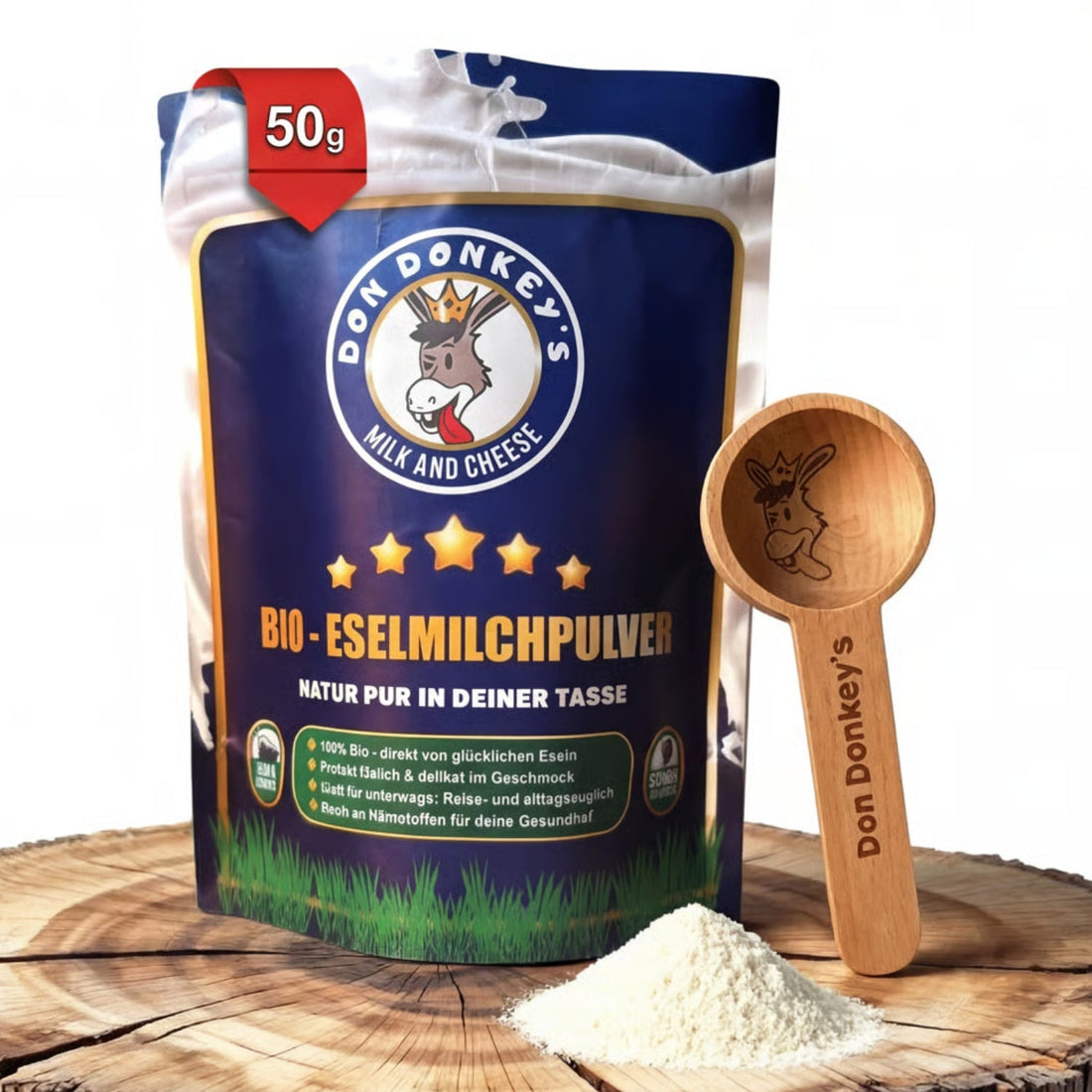
Donkey Milk Powder
Donkey milk in powder form
For anyone who prefers a longer shelf life: our donkey milk in powder form – easy to store and portion.
20g · Unit price: €1.245,00 / 1 kg · incl. VAT, plus shipping