
 Buyer protection

Research on donkey milk · Study 75
Cheese from donkey milk: what a membrane changes about the protein
Donkey milk is considered difficult to make into cheese – it contains little protein. A team from the University of Bari concentrated the milk by ultrafiltration and made eight variants into cheese in the laboratory.
Interactive · move the sliders
Eight recipes on the mixing desk
Channel 1 · Milk
Channel 2 · Pretreatment
Level on the left = cheese yield after 24 hours (1 % per light). Lactic acid and starter culture pre-acidified the milk to pH 6.3; the cow’s milk was skimmed. Values are means from three runs.
Coagulation · runs automatically
How quickly the milk thickens
Viscosity in mPa·s, measured with a vibrational viscometer 0, 30 and 60 minutes after adding calf rennet. For the start (11.65–11.9) and for three samples after 30 minutes (25–27), the paper only gives ranges – they are drawn as bands. Lines connect only exactly reported values.
The result
Cheese yield after 24 hours
The superscript letters come from the paper’s statistics: values with the same letter do not differ significantly. The starter culture variant (10.97 %) and the pure UF variant (9.60 %) both carry an “a”. In yield relative to dry matter, the starter culture variant was ahead at 2.86 %.
Critical assessment
What belongs on the board
Three runs, one farm
Pooled milk from one farm, three times from late May to early June. Breed, number of animals and lactation stage are missing.
No finished cheese
Measured after one night in the fridge. With 70–74 % moisture, the curd does not yet resemble a ripened cheese – as the authors themselves say.
Texture only “by hand”
Firmness was assessed by touching and cutting, not with a measuring instrument.
Basis of yield unclear
The paper does not describe how the yield relative to dry matter was calculated. The difference between UF and starter culture in total yield is not significant.
Long filtration
Ultrafiltration ran for several hours at room temperature; the pH fell slightly in the process (7.08 instead of 7.30).
Interests
No funding named, no conflicts of interest declared. A cost-effectiveness analysis for farms is missing, although the authors stress transferability.
Editorial assessment: A technical feasibility study on cheesemaking, not a study on nutrition or effects. In the “+10 % cow’s milk” variant, the cheese contains cow’s milk casein. Study 68 takes a different route: cow’s milk rolled cheese with 10 and 20 % donkey milk.
Research question for DON DONKEY’S®
How can the low casein content of donkey milk in cheesemaking be explained transparently?
The study shows how strongly protein content determines coagulation. We would like to explain, traceably and with sources, how much milk goes into a kilogram of donkey cheese and why.
Original publication
Effect of ultrafiltration on the cheesemaking properties of donkey milk
Original title of the publication.
Natrella G., Maggiolino A., De Palo P., Mefleh M., Faccia M.
International Dairy Journal · 2024 · volume 149, article 105830 · open access (CC BY 4.0)
University of Bari Aldo Moro, Departments of Soil, Plant and Food Sciences and of Veterinary Medicine (Italy)
DOI: 10.1016/j.idairyj.2023.105830
Transparency: no funding is named in the paper. The authors declare no competing interests. The milk came from a farm in Laterza (Apulia). No product-related statement for DON DONKEY’S®.
Summarised and reviewed by the DON DONKEY’S editorial team on the basis of the original publication · as of October 2026
The study summarised above was carried out independently of DON DONKEY’S® and does not relate to our products. It serves solely to inform about the state of research.
DON DONKEY’S® donkey cheese and donkey milk are foods. They are not intended to prevent, treat or cure diseases and do not replace medical advice.
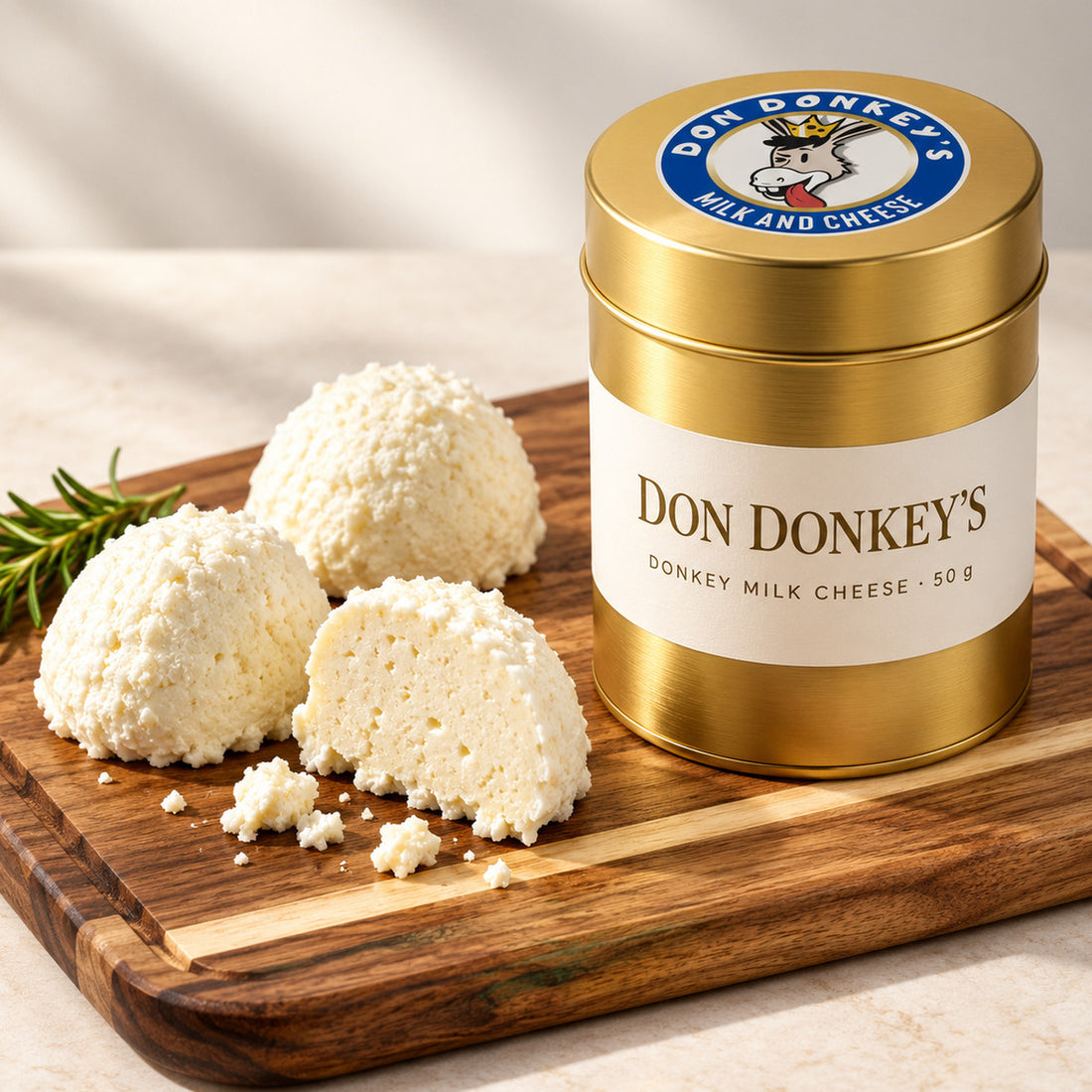
From our shop
DON DONKEY’S® donkey cheese
Cheese nuggets from 50 g
Matching the topic of this page: our donkey cheese. Around 25 litres of donkey milk go into one kilogram; the taste is slightly nutty, the texture firm and creamy at the same time.
50 grams · Unit price: €4.998,00 / 1 kg · incl. VAT, plus shipping

Also in our shop
DON DONKEY’S® donkey milk
100 % donkey milk · raw milk, frozen
On this page we present the findings of a published study. Independently of that, you will find our donkey milk here: 100 % donkey milk, frozen as raw milk.
100 ml bottle / 100ml · Unit price: €249,00 / 1 l · incl. VAT, plus shipping