
 Buyer protection

Donkey milk knowledge archive · Historical source
Aristotle on donkey milk: types of milk compared in the “History of Animals”
In the 4th century BC, Aristotle ranked types of milk by their thickness: camel’s milk the thinnest, then human and donkey milk, cow’s milk the thickest. Mare’s and donkey milk, he wrote, were mixed into Phrygian cheese.
- Author
- Aristotle
- Work
- Historia animalium (History of Animals)
- Passage
- Book III, ch. 20–21 (Bekker 521b–522a)
- Time & place
- 4th c. BC · Ancient Greece
- Type of source
- Ancient natural history
In the original words
What the original says
Now the camel's milk is the thinnest, and that of the human species next after it, and that of the ass next again, but cow's milk is the thickest.
Camel’s milk is the thinnest, followed by human milk, then donkey milk; cow’s milk is the thickest.
Mare's milk, by the way, and milk of the she-ass are mixed in with Phrygian cheese.
Mare’s milk and the milk of the she-ass are, incidentally, mixed into Phrygian cheese.
English rendering: our own translation by the DON DONKEY’S editorial team, following the sense of the text.
Background
Who, when, what kind of text
With the “Historia animalium”, Aristotle (384–322 BC) wrote an extensive collection of observations on the anatomy, reproduction and way of life of animals. The work was probably written in the 340s and 330s BC and draws on his own observations as well as reports from herdsmen, fishermen and hunters.
In the third book, Aristotle deals with the “uniform parts” of the body, including blood, fat and milk. He describes milk as a mixture of a watery part (whey) and a solid part (cheesy matter); the thicker the milk, the more cheese can be obtained.
As the Greek text could not be checked here in a freely accessible online edition with precise passage references, we quote the public-domain English translation by D’Arcy Wentworth Thompson (Oxford 1910). The passage reference follows the usual Bekker numbering.
Content
What the source reports about donkey milk
Aristotle ranks types of milk by their thickness: camel’s milk is the thinnest, followed by human milk, with donkey milk in third place; cow’s milk is the thickest. He links this to the observation that thin milk contains little cheesy matter.
He goes on to report on cheesemaking: mare’s milk and donkey milk were mixed into Phrygian cheese. Donkey milk was thus not only a subject of natural observation but was also mentioned in Asia Minor as an ingredient in cheesemaking.
Aristotle does not mention any healing uses of donkey milk in these passages. His statements are descriptive and comparative.
At a glance
Figures & facts from the source
Critical assessment
How reliable is this source?
Observation rather than recipe
The passage is one of the early natural-history descriptions of donkey milk without medical intent. It classifies types of milk by visible properties.
Contradiction in Pliny
Pliny the Elder takes much from Aristotle but, in Naturalis historia 11.237, names donkey milk as the thickest of all. The editor Mayhoff refers to Aristotle at this point; Pliny apparently altered or misunderstood his source.
Comparison with today’s analyses
Modern milk analyses (see, for example, archive studies 71 and 97) tend to support Aristotle’s classification as “thin” milk rather than Pliny’s statement.
Limits of the source
Aristotle’s categories such as “thin” and “thick” are not measured values. The comparison with today’s data is only a rough plausibility check.
Our assessment
What we like about this passage is its sobriety: Aristotle compares without promoting. The note on Phrygian cheese also shows that donkey milk was already processed as a food in antiquity.
References
Sources to check
- Primary sourceEnglish translation by D’A. W. Thompson, 1910 (Elpenor), page with the milk ranking
https://www.ellopos.net/elpenor/greek-texts/ancient-greece/aristotle/history-animals.asp?pg=94 - Primary sourceContinuation: milk and cheese, Phrygian cheese (Elpenor)
https://www.ellopos.net/elpenor/greek-texts/ancient-greece/aristotle/history-animals.asp?pg=95
More sources and studies in the research archive. Summarised by the DON DONKEY’S editorial team, as of November 2026.
The source summarised above does not come from DON DONKEY’S® and does not refer to our products. It serves solely to inform about knowledge of donkey milk.
DON DONKEY’S® donkey milk and donkey milk powder are foods. They are not intended to prevent, treat or cure any disease and do not replace medical advice.

From our shop
DON DONKEY’S® donkey milk
100 % donkey milk · raw milk, frozen
On this page we reproduce a source on donkey milk. Independently of that, you will find our donkey milk here: 100 % donkey milk, frozen as raw milk.
100 ml bottle / 100ml · Unit price: €249,00 / 1 l · incl. VAT, plus shipping
Also in our shop
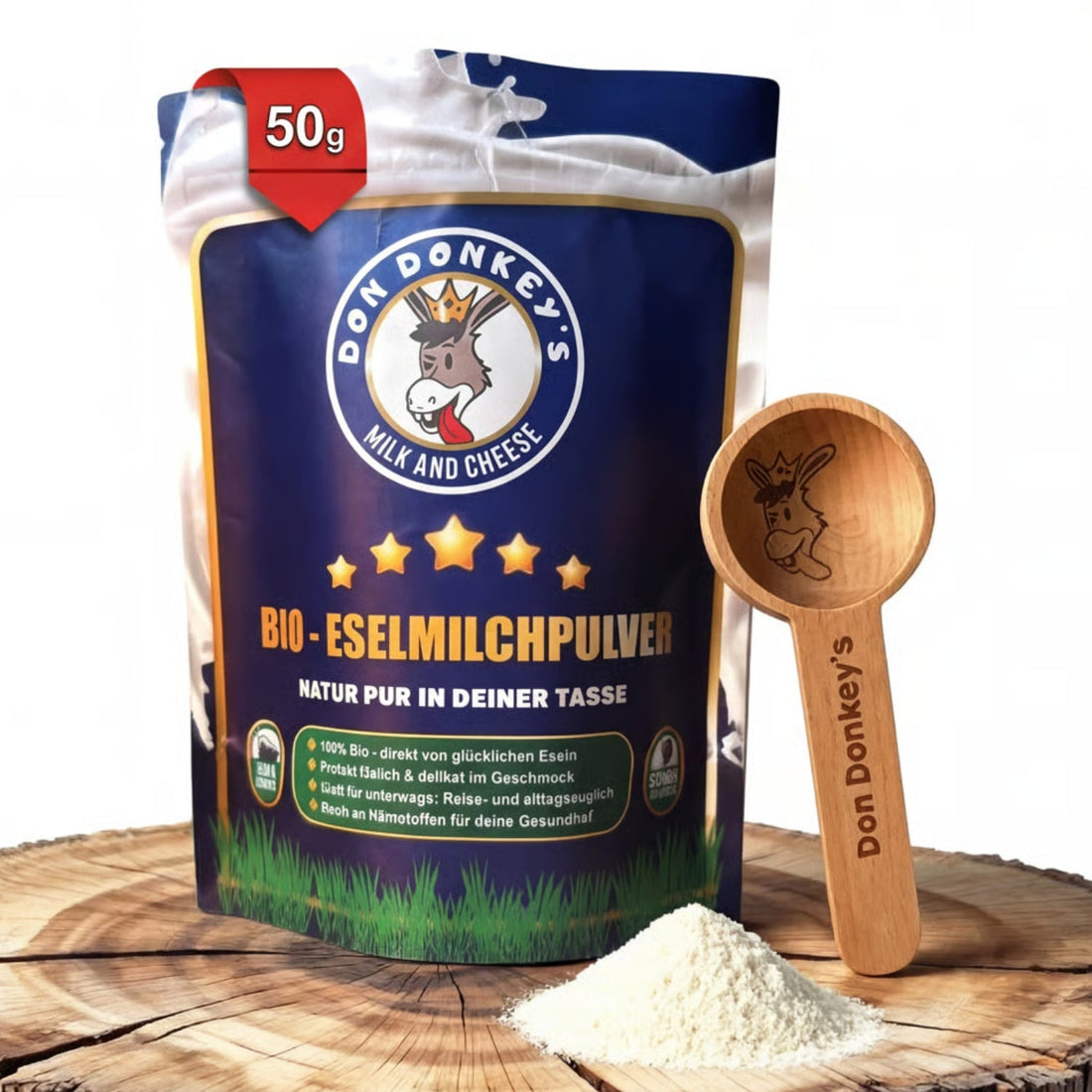
Donkey Milk Powder
Donkey milk in powder form
For anyone who prefers it longer-lasting: our donkey milk in powder form – easy to store and portion.
20g · Unit price: €1.245,00 / 1 kg · incl. VAT, plus shipping