
 Buyer protection

Research on donkey milk · Study 97
Dezhou donkey milk: composition over 180 days
In six Dezhou jennies, the fat content of the milk fell from 0.92 % on the first day to 0.09–0.20 % from day 90, while lactose rose from 3.94 % to up to 6.85 %. Hormones and blood values of the animals were recorded in parallel.
At a glance · swipe or use the arrows
The key figures
Study design
How it was studied
Six healthy multiparous Dezhou jennies (on average 5 years, 284 ± 21 kg) on a farm in Dong'e (Shandong Province, China) were sampled on days 1, 30, 60, 90, 120, 150 and 180 of lactation. All animals received the same ration of bean straw ad libitum plus 2 kg of concentrate per animal per day and were milked by hand twice a day; the foals were separated 4 hours before each milking. Fat, protein, lactose, urea, lactoferrin and dry matter were determined with an FTIR milk analyser, and the minerals Ca, P, K, Na, Mg, Zn and Se by ICP-MS. Hormones (ELISA) and clinical chemistry parameters were measured in blood serum; the analysis used one-way repeated-measures ANOVA and correlation analyses.
Interactive chart · values from the study
Fat, protein and lactose over the course of lactation
Means (n = 6) from Table 4 of the study; determined by FTIR. Day 1 corresponds to colostrum.
Second analysis
Minerals in the milk on days 1, 30 and 180
Means (n = 6) from Table 5 of the study; measured by ICP-MS.
Results
What the study measured
Fat, protein, dry matter and solids-not-fat were highest in the colostrum (day 1), followed by day 30. Fat content fell from 0.92 % to 0.43 % (day 30) and was then between 0.09 % and 0.20 %; protein content fell from 7.67 % to 1.39 % on day 180.
Lactose behaved the other way round: it was 3.94 % on day 1 and reached values of 6.69 % to 6.85 % between days 90 and 180. Lactoferrin also rose, from 0.085 g/L on day 1 to 0.091–0.094 g/L. Milk urea (12.92–15.20 mg/dL) showed no significant effect of lactation stage (p = 0.0796).
For the period from day 30 to 180, the authors gave mean contents of 9.15 % dry matter, 6.66 % lactose, 1.54 % protein, 0.20 % fat and 0.093 g/L lactoferrin.
Mineral contents were mostly highest in the colostrum: potassium 1463.82 mg/kg, magnesium 414.09 mg/kg, sodium 260.33 mg/kg and selenium 66.77 µg/kg. Calcium fell from 935.69 mg/kg (day 1) and 957.20 mg/kg (day 30) to 592.59 mg/kg on day 180; phosphorus was higher on days 1–60 than on days 90–180.
The tabulated milk yield obtained was between 1137 g and 575 g; according to the discussion, it fell from 1.137 kg/d to 0.575 kg/d, with a mean of 0.858 kg/d. The peak phase is given as days 30–60 in the abstract and days 30–90 in the discussion.
In the jennies’ blood, prolactin, IGF-1, glucose, total protein, albumin, cholesterol, triglycerides, HDL, LDL and LDH were higher at the start of lactation. Milk yield correlated positively with prolactin (r = 0.82) and IGF-1 (r = 0.83); milk fat, protein and dry matter correlated with blood glucose (r = 0.97–0.98) and triglycerides (r = 0.91–1.00), among others.
Authors’ conclusion: In the view of Zhou et al. (2025), the milk of Dezhou jennies was characterised by a high lactose content, a low dry matter and protein content and a very low fat content; fat, protein and dry matter decreased over the course of lactation. The authors saw their data as a basis for planning the feeding of lactating jennies and for describing the nutrient profile of donkey milk; effects in humans were not examined.
Critical assessment
Strengths and limitations
Small, uniform sample
Only six jennies of one breed from one farm with uniform feeding were examined. The values cannot readily be transferred to other breeds, husbandry systems or commercial products.
Unclear milk yield figures
The table row on milk yield contains only six values for seven time points and the unit “g” without a time reference; the discussion assigns 1.137 kg/d to day 60. In addition, only the amount obtained after 4 hours of foal separation was recorded, not total milk production.
Units and labels
Zinc is given in µg/kg in Table 5 and as 2.64 mg/kg in the discussion. In the abstract, the abbreviations for total cholesterol and triglycerides are swapped, and the discussion mentions iron, which according to the methods section was not measured.
Method and interpretation
The milk constituents including lactoferrin were determined by FTIR; a calibration for donkey milk is not described. Blood values are shown only as figures, correlations do not prove causation, and the interpretation of the ALP values as an indication of liver function and bone mineral loss was not tested directly.
Longitudinal design with repeated measures
The same animals were followed over seven time points up to day 180, and milk and blood were analysed in parallel. The analysis takes the repeated measures into account, and raw values with standard deviations are given in tables.
Editorial assessment: The study describes raw milk from a Chinese donkey breed under defined husbandry conditions and provides measured values on composition. No conclusions about health effects in humans or about individual commercial products can be drawn from it. To the research archive.
Research question for DON DONKEY’S®
How do milk yield, the nutrient and mineral content of the milk and the hormones and blood values of Dezhou jennies change in the first 180 days of lactation, and how are milk and blood values related?
Original publication
The Milk Compositions and Blood Parameters of Lactating Dezhou Donkeys Changes With Lactation Stages
Original title of the publication.
Zhou M., Ma Z., Du X., Wang C., Liu G.
Veterinary Medicine and Science · 2025 · 11(2), e70269
College of Agriculture and Biology, Liaocheng Research Institute of Donkey High-Efficiency Breeding and Ecological Feeding, Liaocheng University, Liaocheng, China
10.1002/vms3.70269: 10.1002/vms3.70269
Transparency: Key Technology Research and Development Program of Shandong (2021TZXD012), Shandong Provincial Natural Science Foundation (ZR2023MC149), National Key R & D Program of China (2022YFD1600103) and Open Project of Liaocheng University Animal Husbandry Discipline (319312105-5). The authors declare no conflicts of interest. No product-related statement for DON DONKEY’S®.
Summarised and reviewed by the DON DONKEY’S editorial team on the basis of the original publication · as of October 2026
The study summarised above was carried out independently of DON DONKEY’S® and does not relate to our products. It serves solely to inform about the state of research.
DON DONKEY’S® donkey milk and donkey milk powder are foods. They are not intended to prevent, treat or cure any disease and do not replace medical advice.

From our shop
DON DONKEY’S® donkey milk
100 % donkey milk · raw milk, frozen
On this page we report the findings of a published study. Independently of that, you will find our donkey milk here: 100 % donkey milk, frozen as raw milk.
100 ml bottle / 100ml · Unit price: €249,00 / 1 l · incl. VAT, plus shipping
Also in our shop
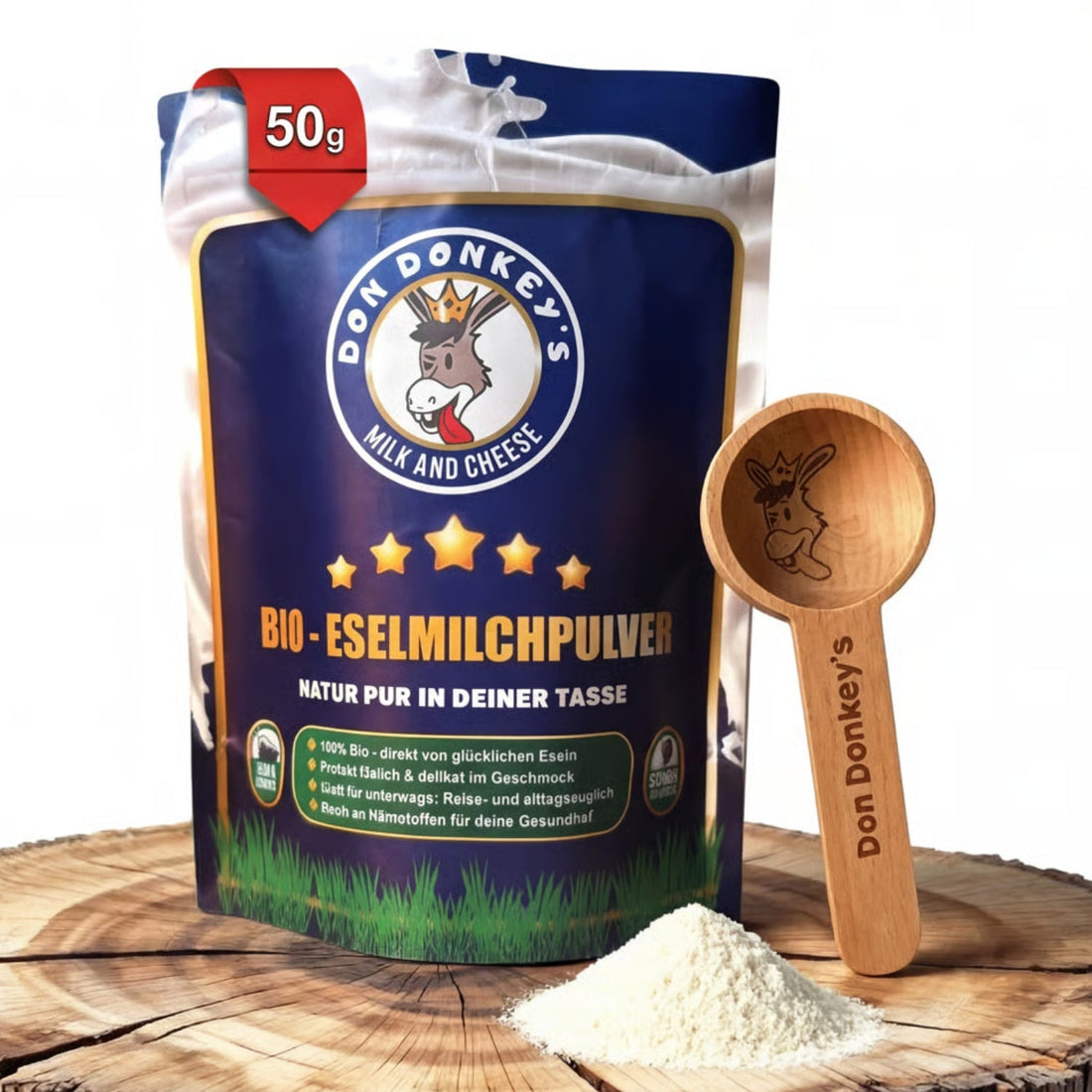
Donkey Milk Powder
Donkey milk in powder form
For anyone who prefers a longer shelf life: our donkey milk in powder form – easy to store and portion.
20g · Unit price: €1.245,00 / 1 kg · incl. VAT, plus shipping