
 Buyer protection

Research on donkey milk · Study 11
Do allergy antibodies recognise donkey milk?
In 2014 at the University of Camerino, Vincenzetti et al. examined whether antibodies from the blood of adults with cow's milk allergy bind in the laboratory to proteins from cow's, goat's and donkey milk.
What it's about
A question of proteins
In cow's milk allergy, the immune system forms IgE antibodies against certain milk proteins. Milk proteins from different animal species are partly similar – which is why many people affected also react to goat's or sheep's milk.
The protein composition of donkey milk differs considerably from that of cow's milk. The researchers wanted to know: do the antibodies of allergic people also recognise the proteins of donkey milk?
To find out, they separated the proteins of all three types of milk and tested them with blood serum from adults with and without cow's milk allergy.
What exactly was studied?
Briefly explained
The terms used in this study
Antibodies that play a central role in allergies. They recognise certain structures on proteins.
A laboratory test that shows which separated proteins antibodies from a blood sample bind to.
The two major protein groups in milk. Whey proteins include, for example, β-lactoglobulin and α-lactalbumin.
Antibodies against one protein also recognise a similar protein from another source.
The proteins from cow's, goat's and donkey milk were separated into fractions by chromatography.
Electrophoresis was used to determine which proteins the fractions contained.
The fractions were tested with serum from 3 people with (suspected) allergy and 3 control persons.
For each person and type of milk, it was recorded which proteins antibodies bound to.
Interactive · The data at a glance
Where antibodies bind
For each blood sample: which proteins from cow's, goat's and donkey milk did the antibodies bind to? And how do the types of milk differ in their protein?
Schematic illustration of the immunoblot results described in the article (selection of protein fractions). The strength of binding is shown qualitatively.
Key findings
What the researchers report
Binding in all three samples
The antibodies mainly recognised casein fractions of cow's milk, in one case also β-lactoglobulin.
Partial cross-reaction
Two sera also bound to caseins of goat's milk – an indication of similar protein structures.
No binding found
The antibodies did not bind to the protein fractions of donkey milk studied in any sample.
One of the three persons (3A) only had a suspected cow's milk allergy. Individual casein fractions of donkey milk could not be separated with the method used. The authors themselves describe the study as preliminary and consider further studies necessary.
Critical assessment
A laboratory finding, not a tolerability test
What the study shows
What it does not show
Research question for DON DONKEY’S®
What does the protein profile of our donkey milk look like?
The study shows how much depends on the individual proteins. For us, this is a reason to know the protein composition of our own milk more precisely – and to follow research on this topic.
Original publication
Hypoallergenic properties of donkey’s milk: a preliminary study
Vincenzetti S., Foghini L., Pucciarelli S., Polzonetti V., Cammertoni N., Beghelli D., Polidori P.
Veterinaria Italiana · 2014 · 50(2):99–107
University of Camerino, Italy
DOI: 10.12834/VetIt.219.125.5
Full text: PDF of the original publication
The publication describes a preliminary laboratory study. The term "hypoallergenic" in the title is a scientific classification by the authors and not a product-related statement for DON DONKEY’S®.

From our shop
DON DONKEY’S® donkey milk
100 % donkey milk · raw milk, frozen
On this page we report the findings of a published study. Independently of that, you will find our donkey milk here: 100 % donkey milk, frozen as raw milk.
100 ml bottle / 100ml · Unit price: €249,00 / 1 l · incl. VAT, plus shipping
Also in our shop
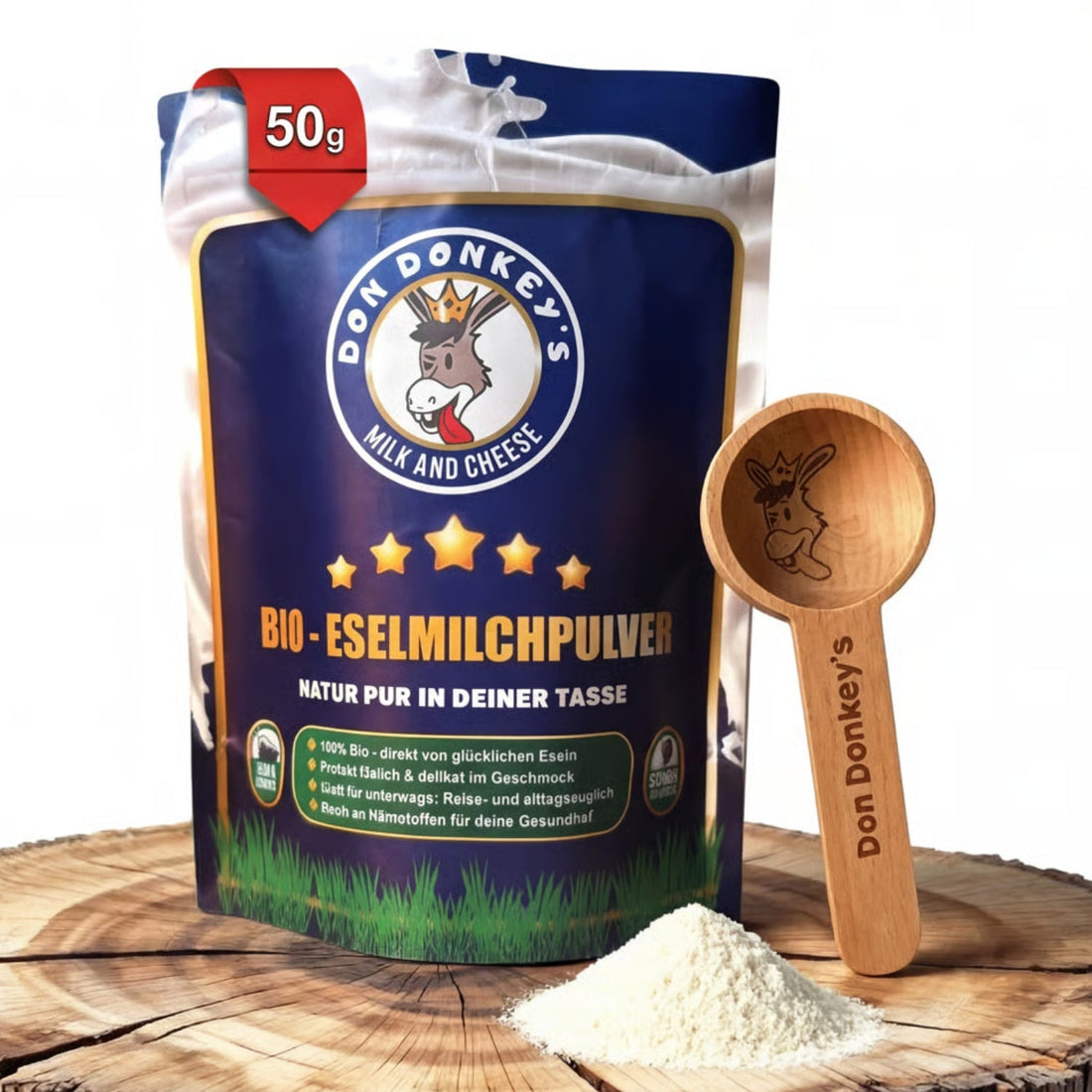
Donkey Milk Powder
Donkey milk in powder form
For anyone who prefers a longer shelf life: our donkey milk in powder form – easy to store and portion.
20g · Unit price: €1.245,00 / 1 kg · incl. VAT, plus shipping