
 Buyer protection

Research on donkey milk · Study 98
Donkey colostrum in a species comparison: 72 °C for 15 s
Laboratory comparison of milk on day 3 after birth in four species: in donkey colostrum (2.29 % protein, 1.10 % fat), 303 proteins in the soluble fraction changed after 72 °C for 15 s, but none of the 38 fatty acids measured.
At a glance · tap the cards
The key figures
Study design
How it was studied
Milk from the third day after birth (transition stage between colostrum and mature milk) from three yaks, Holstein cows, jennies and Bactrian camels each, from farms in Qinghai Province, China, was examined. Each sample was split into two subsamples: one remained untreated, the other was heated in the laboratory in a water bath to 72 °C and held for 15 s. The soluble protein fraction (after skimming and centrifugation) was analysed by DIA proteomics, and the fatty acid pattern as fatty acid methyl esters (FAME) by targeted GC-MS. Differences between species, changes due to heating within each species and the agreement between the two data sets were evaluated.
Interactive chart · values from the study
Proteins changed by 72 °C/15 s per species
Laboratory experiment with n = 3 per species. Significantly changed FAME: yak 14, Holstein cow 6, donkey 0, Bactrian camel 0.
Second analysis
Protein and fat content of the milk on day 3 (unheated)
Means (n = 3) from Table 1; protein by Kjeldahl, fat by Gerber.
Results
What the study measured
In the unheated milk from day 3, the donkey milk contained 2.29 % protein and 1.10 % fat, significantly less than yak (5.61 % / 4.24 %), Holstein cow (5.05 % / 3.97 %) and Bactrian camel (6.28 % / 3.96 %). The pH was between 6.36 and 6.59 in all four species with no significant differences.
Proteomics detected 2583 protein groups. The samples separated clearly by species; heated and unheated subsamples of the same species lay close together. Before heating, 1220 proteins differed between Holstein cow and donkey, 837 between donkey and Bactrian camel, and 1136 between yak and donkey.
After 72 °C for 15 s, 303 proteins of the soluble fraction had changed in the donkey, 65.0 % of them with lower abundance. In the yak it was 387, in the Bactrian camel 276 and in the Holstein cow 146. The authors stressed that lower abundance in the soluble fraction is not direct evidence of degradation and may also reflect aggregation or redistribution.
Most heat-responsive proteins were species-specific (donkey: 91). Only six proteins (ASL, C8B, FGB, FGG, RPLP2, TPP1) responded in all four species. Gelsolin (GSN) decreased in all species, most strongly in the donkey; CTSA showed a particularly strong decrease in the donkey.
In its fatty acid pattern, donkey milk differed clearly from the other species, among other things with relatively higher standardised proportions of methyl linoleate. Heating did not significantly change any of the 38 FAME measured in the donkey; in the yak it changed 14, in the Holstein cow 6.
Proteome and fatty acid data agreed strongly at species level (Mantel r = 0.943). The response to heating was less parallel in the two data sets; in the donkey, the mean proteome response (RMS) was 0.966 and the fatty acid response 0.105.
Authors’ conclusion: In the view of Zhao et al. (2026), it was mainly the animal source that shaped the molecular composition of early milk; heating to 72 °C for 15 s caused smaller but source-dependent changes, mainly in the soluble protein fraction and less in the fatty acid pattern. The authors saw this as a basis for further research on bioactive components and on the processing of colostrum; effects in humans were not examined.
Critical assessment
Strengths and limitations
Very small sampleClear limitation
Only three animals were examined per species. The authors therefore explicitly regarded the results as exploratory and source-specific, not as generally valid species characteristics.
Origin and husbandry confoundedClear limitation
The animals came from different farms, altitudes (2100–3473 m) and husbandry systems with different feeding. Differences between species may therefore also be due to environment and feeding.
A laboratory question, not a consumption recommendationNote
Only one condition (72 °C, 15 s) was tested on 10 mL samples in a water bath; other temperatures and times were not examined.
Soluble protein fraction onlyNote
The protein fraction after skimming and centrifugation was analysed; aggregates, cream and membrane proteins are missing. The content or activity of individual proteins such as lysozyme was not determined separately.
Minor inconsistenciesNote
In the methods section, the protein–FAME heat map is described as a Pearson correlation, in the figure legend as Spearman. The number of interaction proteins is given as 48 and 73 (different counting levels).
Paired design, two methodsStrength
Heated and unheated subsamples each came from the same animal, all species were treated identically, and proteome and fatty acid analyses were combined. The temperature was monitored with a calibrated probe inside the sample.
Editorial assessment: This is a laboratory comparison on the processing of colostrum with a very small number of samples. No statements about commercial donkey milk products or recommendations on heating milk can be derived from it. To the research archive.
Research question for DON DONKEY’S®
Is it the species or the short-time heating (72 °C, 15 s) that mainly determines the protein and fatty acid profile of early milk from yak, Holstein cow, donkey and Bactrian camel, and do the species respond differently to the same heat treatment?
Original publication
Source-Dependent Proteomic and Fatty-Acid Responses of Yak, Holstein Cow, Donkey and Bactrian Camel Colostrum to Short-Time Heat Treatment
Original title of the publication.
Zhao J., Wang J., Liu Q., Zhuang J., Chen C., Zhang Y.
Foods · 2026 · 15(20), 3609
College of Agriculture and Animal Husbandry, Qinghai University, Xining, China; Department of Nutrition and Health, China Agricultural University, Beijing, China
10.3390/foods15203609: 10.3390/foods15203609
Transparency: Science and Technology Plan Project of Haixi Prefecture, Qinghai Province, China (grant number 2025-JC-Q04). According to the acknowledgements, the publication fees were covered by a teaching-staff programme of the authors’ university (“Kunlun Talents”). The authors declare no conflicts of interest. No product-related statement for DON DONKEY’S®.
Summarised and reviewed by the DON DONKEY’S editorial team on the basis of the original publication · as of October 2026
The study summarised above was carried out independently of DON DONKEY’S® and does not relate to our products. It serves solely to inform about the state of research.
DON DONKEY’S® donkey milk and donkey milk powder are foods. They are not intended to prevent, treat or cure any disease and do not replace medical advice.

From our shop
DON DONKEY’S® donkey milk
100 % donkey milk · raw milk, frozen
On this page we report the findings of a published study. Independently of that, you will find our donkey milk here: 100 % donkey milk, frozen as raw milk.
100 ml bottle / 100ml · Unit price: €249,00 / 1 l · incl. VAT, plus shipping
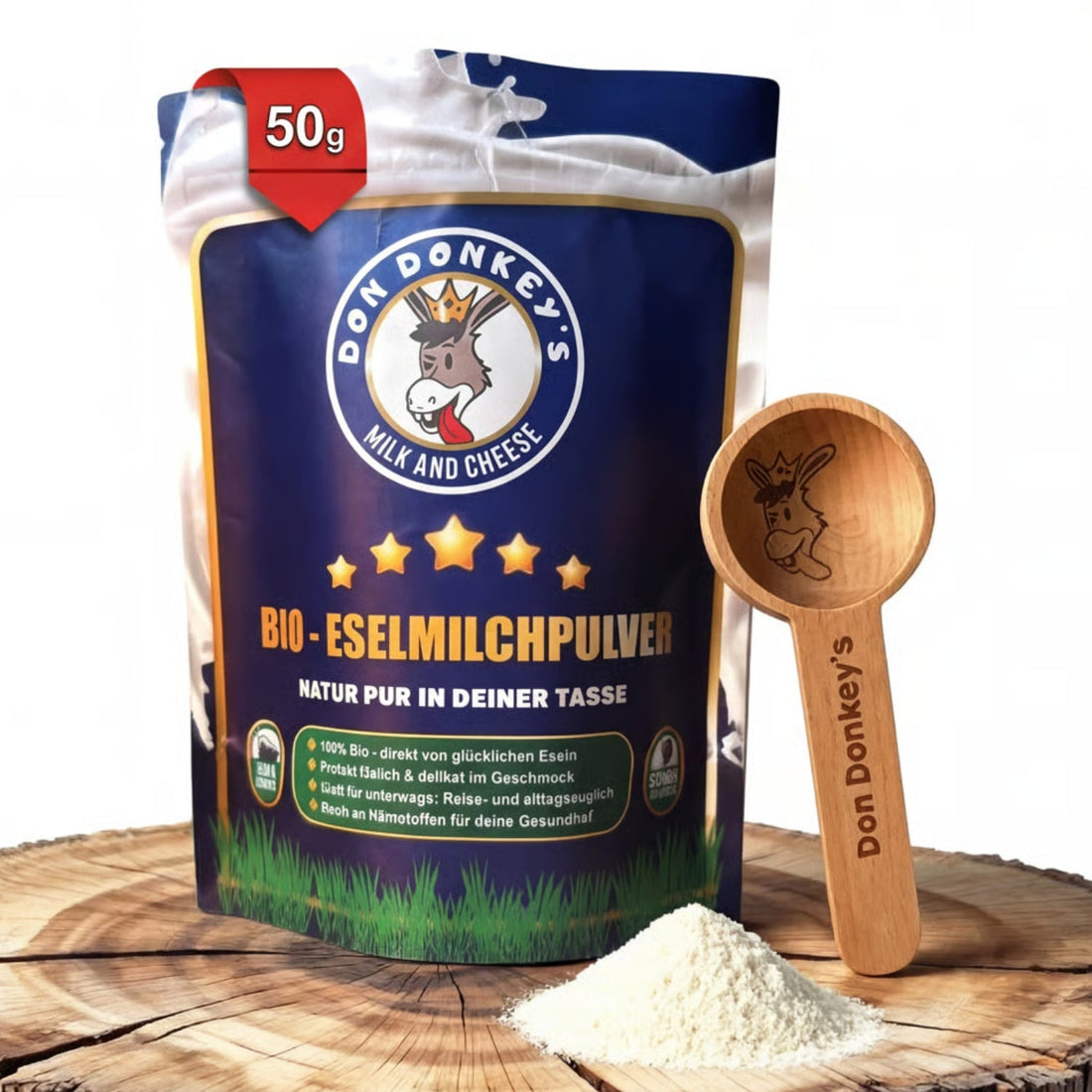
Also in our shop
Donkey Milk Powder
Donkey milk in powder form
For anyone who prefers a longer shelf life: our donkey milk in powder form – easy to store and portion.
20g · Unit price: €1.245,00 / 1 kg · incl. VAT, plus shipping