
 Buyer protection

Research on donkey milk · Study 96
Milking frequency and udder fill time in jennies
15 Nordestino jennies: after 4 h of udder fill time, an average of 312.38 g of milk was obtained per milking, after 2 h 188.76 g. Milking three times a day gave 724 g per day (median) compared with 131 g with milking once a day.
At a glance · tap the cards
The key figures
Study design
How it was studied
15 jennies of the Brazilian Nordestino ecotype (3–7 years, 185 ± 30 kg) received a controlled ration of 60 % Tifton 85 hay and 40 % concentrate. In trial 1 (days 15–75 of lactation, block design), the foals were separated from the jennies 2, 3 or 4 hours before hand milking, 20 days per interval; milk yield and ten udder and teat measurements were recorded. In trial 2 (days 76–135 of lactation), 5 jennies each were milked once, twice or three times a day; milk yield and somatic cell count (flow cytometry, at the start and end) were recorded.
Interactive chart · values from the study
Milk yield per milking by udder fill time
Means from Table 2 (n = 15, coefficient of variation 42.24 %); all three values differ significantly (Tukey, P < 0.05).
Second analysis
Daily milk yield by milking frequency (median)
Table 4 gives the values as 0.131 / 0.250 / 0.724 (column header “g”, values apparently in kg); 5 jennies per group, differences significant (Dunn, P < 0.0001).
Results
What the study measured
With longer udder fill time, the milk yield obtained rose: 188.76 g after 2 h, 249.34 g after 3 h and 312.38 g after 4 h (all significantly different). The authors described this as a 40 % increase; arithmetically, the 4 h value is about 65 % above the 2 h value.
The udder and teats changed too: udder length rose from 25.80 to 27.01 cm, the diameter of the right teat from 6.44 to 7.19 cm, of the left from 6.41 to 7.04 cm. Only udder height above the ground decreased slightly (66.65 to 66.25 cm).
Most udder and teat measurements correlated positively with milk yield. The highest coefficients were for teat length (left up to r = 0.6425) and udder length (up to r = 0.5317); udder width did not correlate significantly at any fill time.
In trial 2, the median daily milk yield was 131 g (once a day), 250 g (twice) and 724 g (three times); the authors give the increase as 457 %.
The somatic cell count was between 3.50 and 7.33 × 10³ cells/mL and did not differ between the start and end of the 60-day trial (P = 0.6657).
Per 100 kg body weight, this gave 169.19 g per milking at 4 h fill time. The authors compared this with literature values for other breeds (126.03 to 242.19 g per 100 kg).
Authors’ conclusion: The authors concluded that an udder fill time of 4 hours and milking three times a day increased milk yield in Nordestino donkeys. They saw the moderate to strong relationships between udder or teat measurements and milk yield as possible criteria for breeding programmes.
Critical assessment
Strengths and limitations
The stated “40 % more” milk does not match the table values (312.38 vs. 188.76 g ≈ +65 %). Likewise, the 9.7 % increase in teat diameter (arithmetically about 10.7 %) and 457 % (arithmetically about 453 %) differ; the statement “62.4 % higher” in the comparison with another study is also phrased the wrong way round.
Table 4 is headed “g” but apparently contains kg values; Tables 4 and 5 give n = 15, although only 5 animals per group were milked.
The cell count was compared between start and end, not directly between the milking groups. In addition, the Narsi and North African donkeys in Table 6 (242.19 g/100 kg) are above the Nordestino value, although the text claims a higher yield than for this breed.
Only 15 jennies at one site, 5 animals each in trial 2; hand milking without the foal, with residual milk remaining in the udder according to the authors. Fill times longer than 4 h were deliberately not tested.
Only milk yield, udder and teat measurements and cell count were recorded; the constituents of the milk were not analysed.
Controlled ration, randomised order of fill times in a block design, standardised milking routine, ten udder and teat measurements and ethics approval.
Editorial assessment: The study concerns milk yield and milking management in a Brazilian donkey population; it makes no statement about the composition of the milk. To the research archive.
Research question for DON DONKEY’S®
Does the composition of donkey milk change when udder fill time or milking frequency is adjusted?
Original publication
Milking frequency and the effect of fill time on the production and conformation in Nordestino ecotype donkeys
Original title of the publication.
Santana K. C., Lucena J. E. C., Pinheiro A. K. S., Pinto D. S. A., Farias I. M., Silva A. H., Maia V. N., Diniz W. J. S., Santiago J. M.
Veterinary and Animal Science · 2026 · volume 33, article 100717
Graduate Program in Animal Science and Pastures, Federal University of Agreste of Pernambuco (UFAPE), Garanhuns, Brazil; Department of Animal Science, College of Agriculture, Auburn, USA; Academic Unit of Serra Talhada, Federal Rural University of Pernambuco (UFRPE), Serra Talhada, Brazil
10.1016/j.vas.2026.100717: 10.1016/j.vas.2026.100717
Transparency: supported by the Universidade Federal Rural de Pernambuco (UFRPE), the PPGCAP graduate programme of UFAPE and the Brazilian funding agency CAPES (call No. 4/2021). The authors declare no competing financial interests or personal relationships that could have influenced the work. No product-related statement for DON DONKEY’S®.
Summarised and reviewed by the DON DONKEY’S editorial team on the basis of the original publication · as of October 2026
The study summarised above was carried out independently of DON DONKEY’S® and does not relate to our products. It serves solely to inform about the state of research.
DON DONKEY’S® donkey milk and donkey milk powder are foods. They are not intended to prevent, treat or cure any disease and do not replace medical advice.

From our shop
DON DONKEY’S® donkey milk
100 % donkey milk · raw milk, frozen
On this page we report the findings of a published study. Independently of that, you will find our donkey milk here: 100 % donkey milk, frozen as raw milk.
100 ml bottle / 100ml · Unit price: €249,00 / 1 l · incl. VAT, plus shipping
Also in our shop
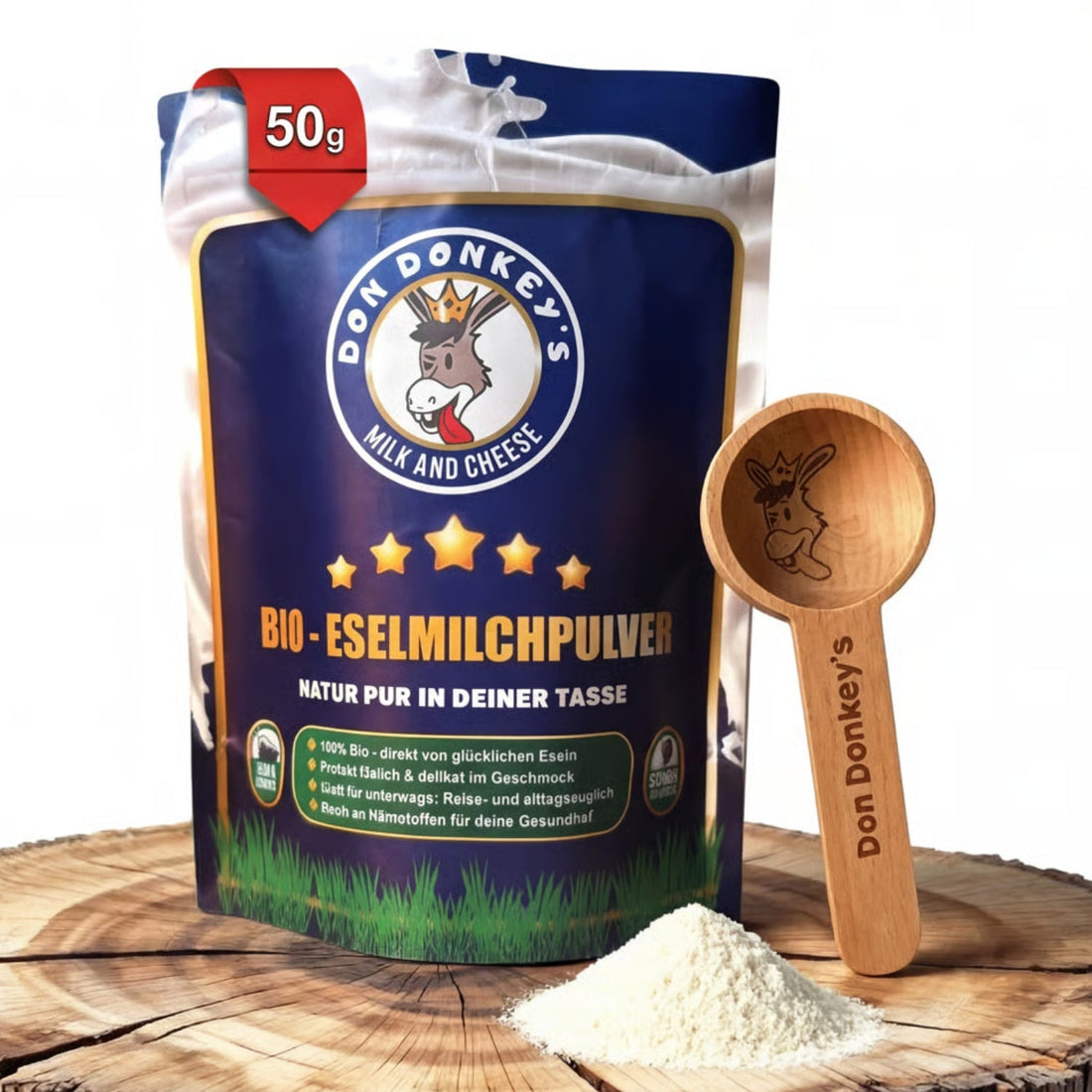
Donkey Milk Powder
Donkey milk in powder form
For anyone who prefers a longer shelf life: our donkey milk in powder form – easy to store and portion.
20g · Unit price: €1.245,00 / 1 kg · incl. VAT, plus shipping