
 Buyer protection

Research on donkey milk · Study 94
Podliveni cheese with 30 % donkey milk
Serbian fresh cheese from cow’s milk with 30 % donkey milk: coagulation took 2 h instead of 30 min, yield fell from 1.37 to 1.10 kg, and protein content rose from 13.45 to 15.75 %.
At a glance · tap the cards
The key figures
Study design
How it was studied
Two batches of the traditional Serbian fresh cheese Podliveni were made in a small dairy: one from raw cow’s milk, one from 7 L raw cow’s milk and 3 L raw donkey milk (30 %). The donkey milk was pooled milk from Balkan and Banat donkeys from the Zasavica nature reserve (morning milking, December 2024). Apart from the coagulation time, the production process was identical (40 °C, rennet, draining 12 h, dry-salting by hand). Among other things, chemical composition, minerals (ICP-MS) and acceptance by a panel of 21 people on a five-point scale were examined; there was one cheese sample per group with triplicate determination.
Interactive chart · values from the study
Minerals in Podliveni cheese
Means from Table 4 (n = 3 technical replicates of one cheese sample); all differences p < 0.05. According to the authors, sodium was influenced by salting by hand.
Second analysis
Sensory evaluation (scale 1–5)
Table 5, panel of 21 institute staff; only the difference in texture was significant (p = 0.040).
Results
What the study measured
With 30 % donkey milk, coagulation was markedly slower: 2 hours instead of 30 minutes with pure cow’s milk. Yield fell from 1.37 ± 0.05 kg to 1.10 ± 0.09 kg (p < 0.05); the cheese released more whey during storage and was softer.
The cheese with donkey milk contained less fat (20.87 vs. 22.00 %) and more protein (15.75 vs. 13.45 %) as well as slightly more dry matter (40.72 vs. 39.82 %). Ash (1.52 vs. 1.54 %) and pH (4.94 vs. 4.86) did not differ significantly.
Among the minerals, calcium (3276 vs. 3577 mg/kg), phosphorus, potassium (506 vs. 694 mg/kg), zinc and copper as well as the Ca/P ratio (1.17 vs. 1.25) were lower; sodium, magnesium (127 vs. 101 mg/kg) and iron (6.74 vs. 5.75 mg/kg) were higher.
In the sensory panel (21 people), only the texture of the cheese with donkey milk was rated significantly worse (2.67 vs. 3.38). Colour, aroma, taste and overall impression did not differ significantly but were consistently somewhat lower.
Authors’ conclusion: The authors concluded that milk from Balkan and Banat donkeys could be incorporated into traditional Podliveni cheese without substantially changing most sensory attributes. Coagulation, yield and texture, however, would need technological optimisation.
Critical assessment
Strengths and limitations
Only a single cheese was made per group; according to the authors, the triplicate determinations mainly reflect measurement precision, not the variation between production batches.
The abstract and methods speak of coagulation taking about six times longer; the values given (30 min vs. 2 h), however, correspond to four times.
According to the authors, the differences in salt and sodium may have resulted from manual salting and should therefore be interpreted with caution. In addition, the reported “fat-free dry matter” (77.13 and 74.91 %) is higher than the dry matter; the term is not explained further in the text.
The donkey milk was a pooled sample of two breeds from one reserve and one month; breed-specific statements are not possible. The milk parameters come from an earlier study by the same group. Raw milk was processed.
The 21 assessors were staff of the institute conducting the study; the rating used a simple hedonic scale.
Identical production process, standardised analytics according to ISO standards, mineral analysis by ICP-MS and complete results tables with p and F values.
Editorial assessment: This is a technological feasibility trial with one cheese batch each; the results describe composition and acceptance, not effects in humans. To the research archive.
Research question for DON DONKEY’S®
How do yield, texture and acceptance change when the share of donkey milk is varied step by step and coagulation is adjusted technologically?
Original publication
Incorporating Pooled Donkey Milk from Autochthonous Balkan and Banat Donkey Breeds into Traditional Dairy Products: Effects on Technological Properties, Nutritional Profile, and Sensory Acceptability of Podliveni Cheese
Original title of the publication.
Ljubojević Pelić D., Vidaković Knežević S., Popov N., Knežević S., Vranešević J., Pelić M., Živkov Baloš M.
Animals · 2026 · volume 16, issue 10, article 1449
Scientific Veterinary Institute “Novi Sad”, Novi Sad, Serbia; Institute of Food Technology, University of Novi Sad, Novi Sad, Serbia
10.3390/ani16101449: 10.3390/ani16101449
Transparency: funded by the Science Fund of the Republic of Serbia (No. 3535, project PROTECTDonkey on the protection of domestic donkeys in the Zasavica nature reserve) and by the Serbian Ministry of Science, Technological Development and Innovation (contracts 451-03-33/2026-03/200031 and 451-03-33/2026-03/200222). The authors declare no conflicts of interest. No product-related statement for DON DONKEY’S®.
Summarised and reviewed by the DON DONKEY’S editorial team on the basis of the original publication · as of October 2026
The study summarised above was carried out independently of DON DONKEY’S® and does not relate to our products. It serves solely to inform about the state of research.
DON DONKEY’S® donkey milk and donkey milk powder are foods. They are not intended to prevent, treat or cure any disease and do not replace medical advice.

From our shop
DON DONKEY’S® donkey milk
100 % donkey milk · raw milk, frozen
On this page we report the findings of a published study. Independently of that, you will find our donkey milk here: 100 % donkey milk, frozen as raw milk.
100 ml bottle / 100ml · Unit price: €249,00 / 1 l · incl. VAT, plus shipping
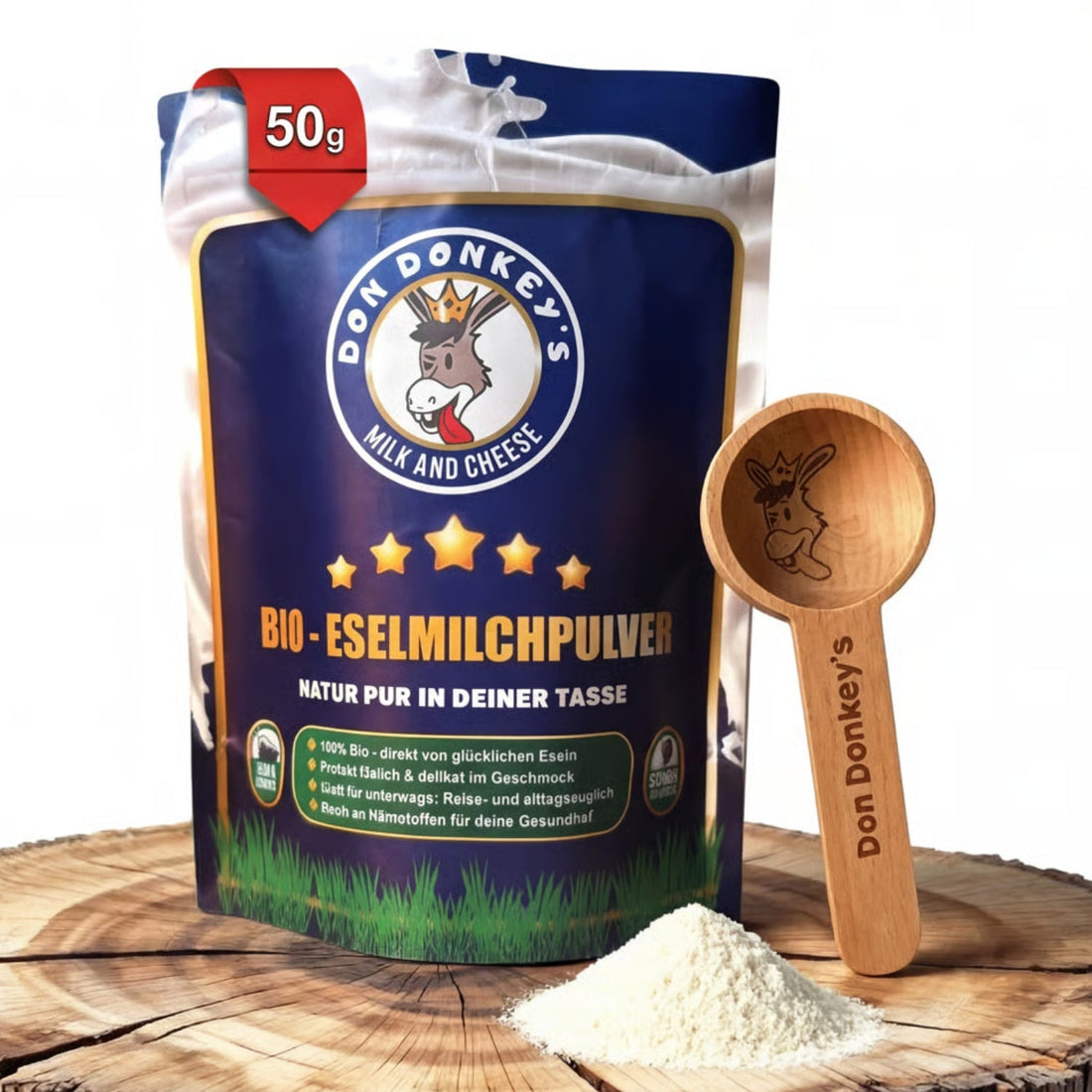
Also in our shop
Donkey Milk Powder
Donkey milk in powder form
For anyone who prefers a longer shelf life: our donkey milk in powder form – easy to store and portion.
20g · Unit price: €1.245,00 / 1 kg · incl. VAT, plus shipping