
 Buyer protection

Research on donkey milk · Study 90
Children with cow’s milk allergy: tolerance (Bari)
25 children with confirmed cow’s milk allergy were tested under medical supervision: according to the study, 24 (96 %) tolerated donkey milk in an open food challenge; follow-up over 4–6 months.
At a glance · tap the cards
The key figures
Study design
How it was studied
Prospective observational study at the paediatric allergy unit of the University of Bari: between January and July 2008, 30 children (6 months to 11 years) with suspected cow’s milk protein allergy were enrolled. The diagnosis was made after a 4-week elimination diet by double-blind, placebo-controlled food challenge (DBPCFC) with cow’s milk; skin prick tests and specific serum IgE were also determined. Children with confirmed allergy then received fresh donkey milk in an open food challenge in the clinic with emergency equipment. If tolerated, donkey milk was included in an age-appropriate balanced diet; weight, height, BMI and blood values were recorded at the start (T0) and after 4–6 months (T1). There was no control group.
Interactive chart · values from the study
Course of the study: from enrolment to tolerance
Values from the results section. Three children with confirmed allergy were not tested with donkey milk (consent refused, including two after a severe reaction to cow’s milk). All tests were carried out under medical supervision.
Second analysis
Mean body weight at the start (T0) and after 4–6 months (T1)
Means from Table 2 (p = 0.02 all; p < 0.01 boys; girls not significant). Without a control group, the gain cannot be distinguished from normal growth.
Results
What the study measured
Of 30 children enrolled, cow’s milk allergy was confirmed in 28 by double-blind, placebo-controlled challenge. 27 children (90 %) had an IgE-mediated form, 2 children (7 %) with gastrointestinal symptoms a non-IgE-mediated form.
25 children were tested with fresh donkey milk in an open food challenge under medical supervision. 24 of them (96 %) tolerated it – 22 with IgE-mediated and 2 with non-IgE-mediated allergy.
One child had a systemic reaction with skin changes, cough and vomiting. This was the only child tested with a positive skin prick test and elevated specific IgE to donkey milk; the authors see this as an indication of the predictive value of these tests.
Children with severe reactions to cow’s milk did not continue. The authors therefore explicitly limit their results to mild to moderate forms of cow’s milk allergy.
After 4–6 months, mean weight rose from 17.3 to 19.4 kg (p = 0.02) and mean height from 100.3 to 105.4 cm (p < 0.001). BMI remained unchanged at the 50th percentile at 16.1 and 16.0.
According to the authors, the blood values (including iron, calcium, proteins, cholesterol, triglycerides, glucose, folic acid) showed no relevant changes; the data are not shown. Tests for occult blood in the stool were negative.
All children were older than 6 months and were not fed exclusively on milk. According to the study, all children enrolled accepted the taste and none dropped out.
Authors’ conclusion: The authors concluded that their data confirmed a high tolerance of donkey milk in children with moderate symptoms of cow’s milk allergy and that donkey milk appeared nutritionally adequate in children on a varied diet. They considered longer follow-up necessary.
Critical assessment
Strengths and limitations
Cow’s milk allergy was confirmed by double-blind, placebo-controlled challenge; all challenges took place in the clinic with emergency equipment.
Only 25 children were tested with donkey milk; the donkey milk test was open (not blinded), and there was no control group.
Children with severe reactions to cow’s milk were excluded. The results apply only to mild to moderate forms in this group and do not replace medical assessment.
Gains in weight and height over 4–6 months are to be expected in children; without a control group, no effect of donkey milk can be inferred. The blood values are not reported in detail.
Atopic dermatitis is given as “24/20” (probably 24/30); 27 IgE-mediated plus 2 non-IgE-mediated cases add up to 29 rather than 30; age range up to 11 years according to the abstract, up to 10 according to the table. The standard deviations of height are larger for boys and girls than for the whole group.
Donkey milk was part of a varied, age-appropriate balanced diet in children over 6 months; the findings do not refer to donkey milk as the sole food.
Editorial assessment: A small, uncontrolled clinical observational study in children with medically confirmed cow’s milk allergy under medical supervision; the results apply only to this group. Donkey milk is not a substitute for medical advice – with allergies, diet should always be agreed with a doctor. To the research archive.
Research question for DON DONKEY’S®
How often do cross-reactions between cow’s milk and donkey milk proteins occur in larger, controlled studies, and what role do the skin prick test and specific IgE to donkey milk play in prediction?
Original publication
Adequacy and tolerance to ass's milk in an Italian cohort of children with cow's milk allergy
Original title of the publication.
Tesse R., Paglialunga C., Braccio S., Armenio L.
Italian Journal of Pediatrics · 2009 · volume 35, article 19
Department of Biomedicine of the Developmental Age, Paediatric Clinic “S. Maggiore”, University of Bari, Bari, Italy
10.1186/1824-7288-35-19: 10.1186/1824-7288-35-19
Transparency: funding not stated. The authors declare no competing interests. No product-related statement for DON DONKEY’S®.
Summarised and reviewed by the DON DONKEY’S editorial team on the basis of the original publication · as of October 2026
The study summarised above was carried out independently of DON DONKEY’S® and does not relate to our products. It serves solely to inform about the state of research.
DON DONKEY’S® donkey milk and donkey milk powder are foods. They are not intended to prevent, treat or cure any disease and do not replace medical advice.

From our shop
DON DONKEY’S® donkey milk
100 % donkey milk · raw milk, frozen
On this page we report the findings of a published study. Independently of that, you will find our donkey milk here: 100 % donkey milk, frozen as raw milk.
100 ml bottle / 100ml · Unit price: €249,00 / 1 l · incl. VAT, plus shipping
Also in our shop
Donkey Milk Powder
Donkey milk in powder form
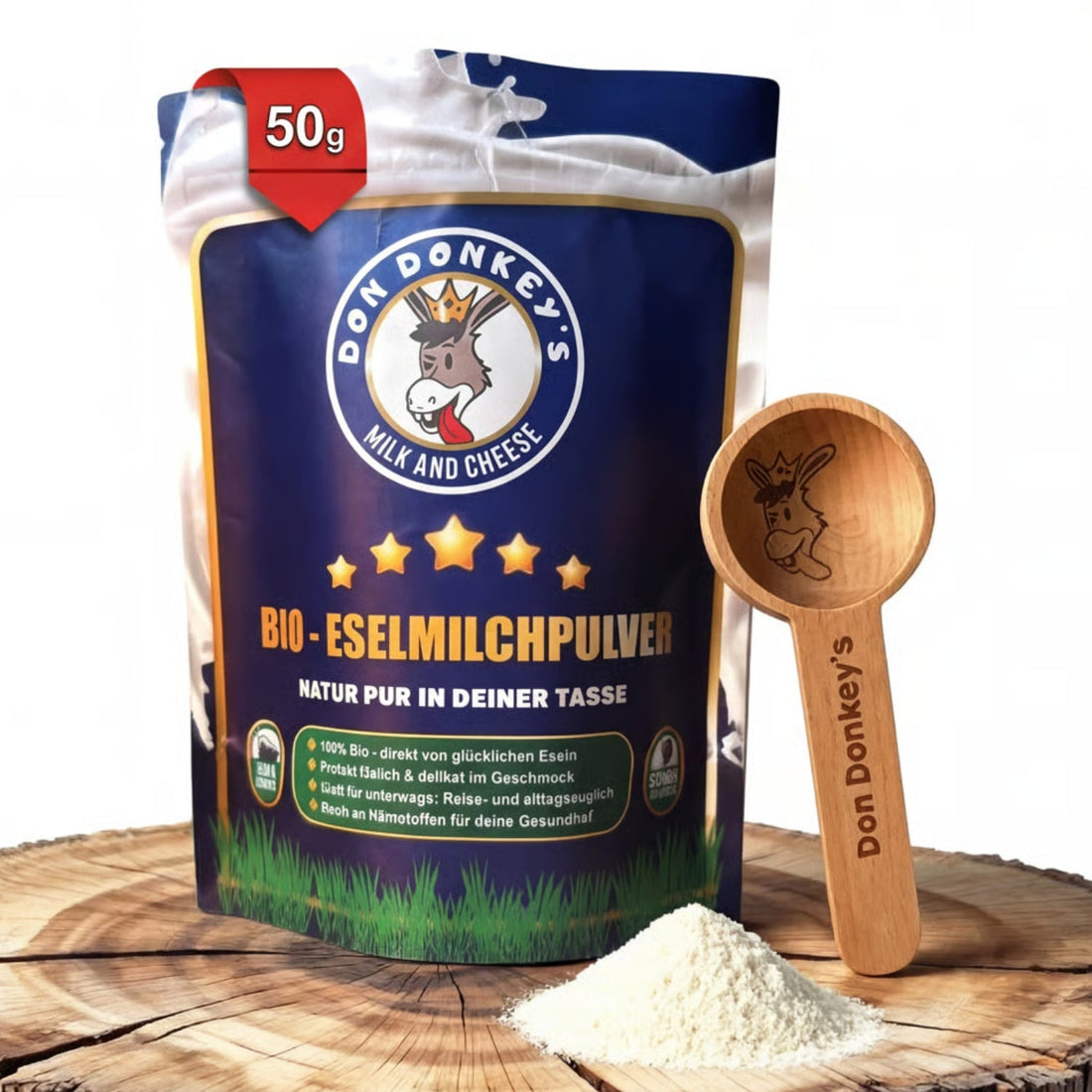
For anyone who prefers a longer shelf life: our donkey milk in powder form – easy to store and portion.
20g · Unit price: €1.245,00 / 1 kg · incl. VAT, plus shipping