
 Buyer protection

Research on donkey milk · Study 9
When hardly anything is tolerated
In 2012 in Turin, Monti et al. examined whether children with difficult-to-manage cow's milk allergy tolerated donkey milk – children for whom breast milk was not available and the usual substitute formula was not suitable.
What it's about
Children without a simple alternative
For most children with cow's milk allergy there are special substitute formulas. This study looked at children for whom that was not enough: breast milk was not available, the usual substitutes were not suitable – and almost nine out of ten also had other food allergies.
The researchers tested whether these children tolerated and accepted donkey milk and then observed weight, length and nutritional parameters.
The Regina Margherita Children's Hospital and the University of Turin, the Italian research centre CNR and the Association of Human Milk Banks were involved.
What exactly was studied?
Briefly explained
The terms used in this study
The suspected food is left out. If the symptoms improve, this points to an allergy.
Neither the child nor the medical team knows whether the food or a placebo is being given.
A skin test and a blood value that indicate sensitisation to certain proteins.
A whey protein that occurs in cow's and donkey milk and can play an important role in allergies.
The cow's milk allergy was confirmed by an elimination diet and – where possible – a double-blind challenge.
Before each challenge, skin prick tests and specific IgE values were determined.
Within three months of the cow's milk test, a challenge with donkey milk followed.
In the children who received donkey milk, weight, length and nutritional parameters were followed.
Interactive · The data at a glance
92 children, three views
How special was the group, how many tolerated donkey milk – and what was found in the children for whom it didn't work? Switch between the views.
Illustration of the figures reported in the original publication. The arrangement of the dots is schematic.
Key findings
What the researchers report
83 of 92 children tolerated donkey milk
The children tolerated donkey milk not only in the test but also during the subsequent follow-up – and accepted its taste.
Weight and length developed positively
In the children who tolerated donkey milk, the age-related values for weight and length rose and the nutritional parameters improved.
β-lactoglobulin as a key protein
In the children who reacted to donkey milk, the researchers identified the β-lactoglobulin of cow's milk as the cross-reacting protein.
The children were highly selected clinically and there was no comparison group. The 90.2 % therefore applies to this group and cannot be transferred to all children with cow's milk allergy. Without a comparison group, it cannot be said whether the growth development was due to the donkey milk.
Critical assessment
An option for many – not for all
What the study shows
What it does not show
Research question for DON DONKEY’S®
What do we know about the proteins in our milk?
The study draws attention to individual milk proteins such as β-lactoglobulin. For us, this is a reason to know the protein composition of our milk precisely and to deal with it transparently.
Original publication
Tolerability of donkey’s milk in 92 highly-problematic cow’s milk allergic children
Monti G., Viola S., Baro C., Cresi F., Tovo P. A., Moro G., Ferrero M. P., Conti A., Bertino E.
Journal of Biological Regulators and Homeostatic Agents · 2012 · 26(3 Suppl):75–82
Regina Margherita Children's Hospital Turin, University of Turin, CNR-ISPA, Italian Association of Human Milk Banks
PubMed: PMID 23158519
University of Turin: Entry in the publication database
The publication describes the use of donkey milk with children under medical supervision. It does not allow any product-related statement for DON DONKEY’S®.

From our shop
DON DONKEY’S® donkey milk
100 % donkey milk · raw milk, frozen
On this page we report the findings of a published study. Independently of that, you will find our donkey milk here: 100 % donkey milk, frozen as raw milk.
100 ml bottle / 100ml · Unit price: €249,00 / 1 l · incl. VAT, plus shipping
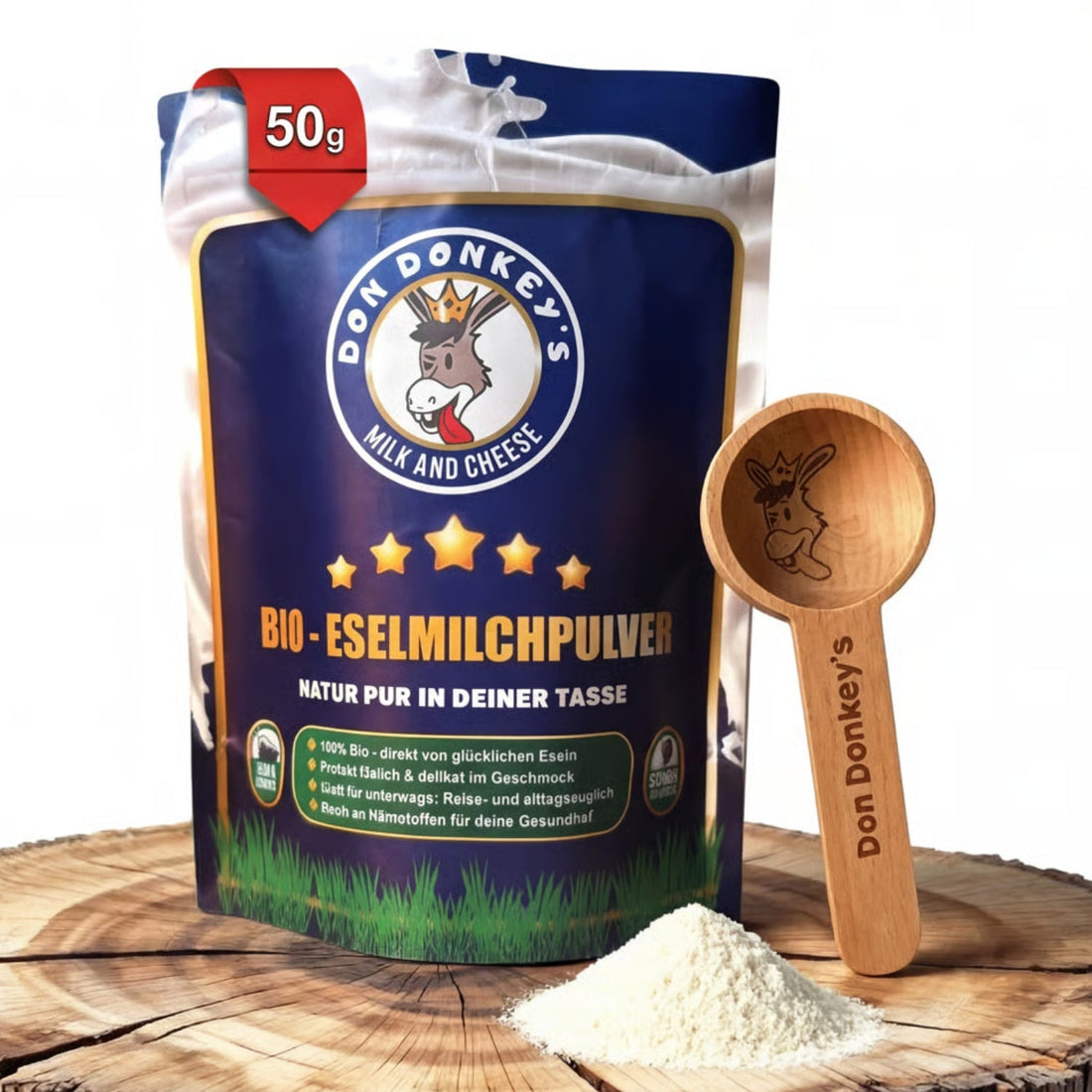
Also in our shop
Donkey Milk Powder
Donkey milk in powder form
For anyone who prefers a longer shelf life: our donkey milk in powder form – easy to store and portion.
20g · Unit price: €1.245,00 / 1 kg · incl. VAT, plus shipping