
 Buyer protection

Research on donkey milk · Study 87
Two hours before milking: separating jenny and foal
On many donkey farms, mare and foal are separated for a while before milking. A Brazilian team measured in 14 Pêga jennies how behaviour and cortisol in saliva change in the process – and how much milk was obtained per milking.
The farm · tap a plot
Pasture, stable, milking area
Schematic, not to scale. The paper does not describe how the areas are positioned relative to each other.
Milk yield
566.4 mL per milking – with a wide range
Band = mean ± one standard deviation (361.2 to 771.6 mL, calculated from the data). Scale in mL per milking.
Seven measurement days · runs automatically, tappable
Every 15 days one step
- Cortisol jennies
- Cortisol foals
Before versus after
Where something changed measurably
Columns: day of lactation 45 to 135. Each dot is a before–after comparison on a measurement day. Filled = significant (p < 0.05). The smaller the p-value, the larger the dot. For vocalisations, the paper gives a value only for day 120; the other days are described as not significant.
Critical assessment
Six slats in the pasture fence
No control group
There were no animals without separation. Before–after comparisons on the same day also capture time-of-day effects.
No true baseline
The authors themselves state that true baseline values of salivary cortisol and behavioural observations of the foals are missing.
Little milk data
Milk was recorded only once per measurement day. Values per measurement day are not reported.
Up to 3 hours
Because all 14 animals were examined at the same time, some were separated for up to three hours.
Inconsistencies
Text and Figure 2 are not clear about the abnormal behaviour on day 120. The date of ethics approval (17.11.2019) is after the data collection in 2018.
Openly stated limits
The authors name their limitations clearly; funding is public (CNPq), no conflicts of interest declared.
Editorial assessment: The study describes a single milking routine on a farm without a dairy operation. Whether separation is stressful can be inferred only to a limited extent from salivary cortisol and short behavioural observations. The authors themselves write that it is “possibly” not stressful. For milk yield over the year, compare Study 86.
Research question for DON DONKEY’S®
How can a milking routine be described transparently?
Separation time, milking times and milk yield per milking differ from farm to farm. Which details of the milking routine are meaningful and verifiable is a question we are following up.
Original publication
Two Hours of Separation Prior to Milking: Is This Strategy Stressful for Jennies and Their Foals?
Original title of the publication.
de Souza Farias S., Dierings Montechese A. C., Bernardino T., Mazza Rodrigues P. H., Albano de Araujo Oliveira C., Zanella A. J.
Animals · 2021 · volume 11, issue 1, article 178 · open access
University of São Paulo (Pirassununga) and Federal University of Bahia (Salvador), Brazil
DOI: 10.3390/ani11010178
Transparency: funded by the Brazilian research council CNPq. The authors declare no conflicts of interest. No product-related statement for DON DONKEY’S®.
Summarised and reviewed by the DON DONKEY’S editorial team on the basis of the original publication · as of October 2026
The study summarised above was carried out independently of DON DONKEY’S® and does not relate to our products. It serves solely to inform about the state of research.
DON DONKEY’S® donkey milk and donkey milk powder are foods. They are not intended to prevent, treat or cure any disease and do not replace medical advice.

From our shop
DON DONKEY’S® donkey milk
100 % donkey milk · raw milk, frozen
On this page we report the findings of a published study. Independently of that, you will find our donkey milk here: 100 % donkey milk, frozen as raw milk.
100 ml bottle / 100ml · Unit price: €249,00 / 1 l · incl. VAT, plus shipping
Also in our shop
Donkey Milk Powder
Donkey milk in powder form
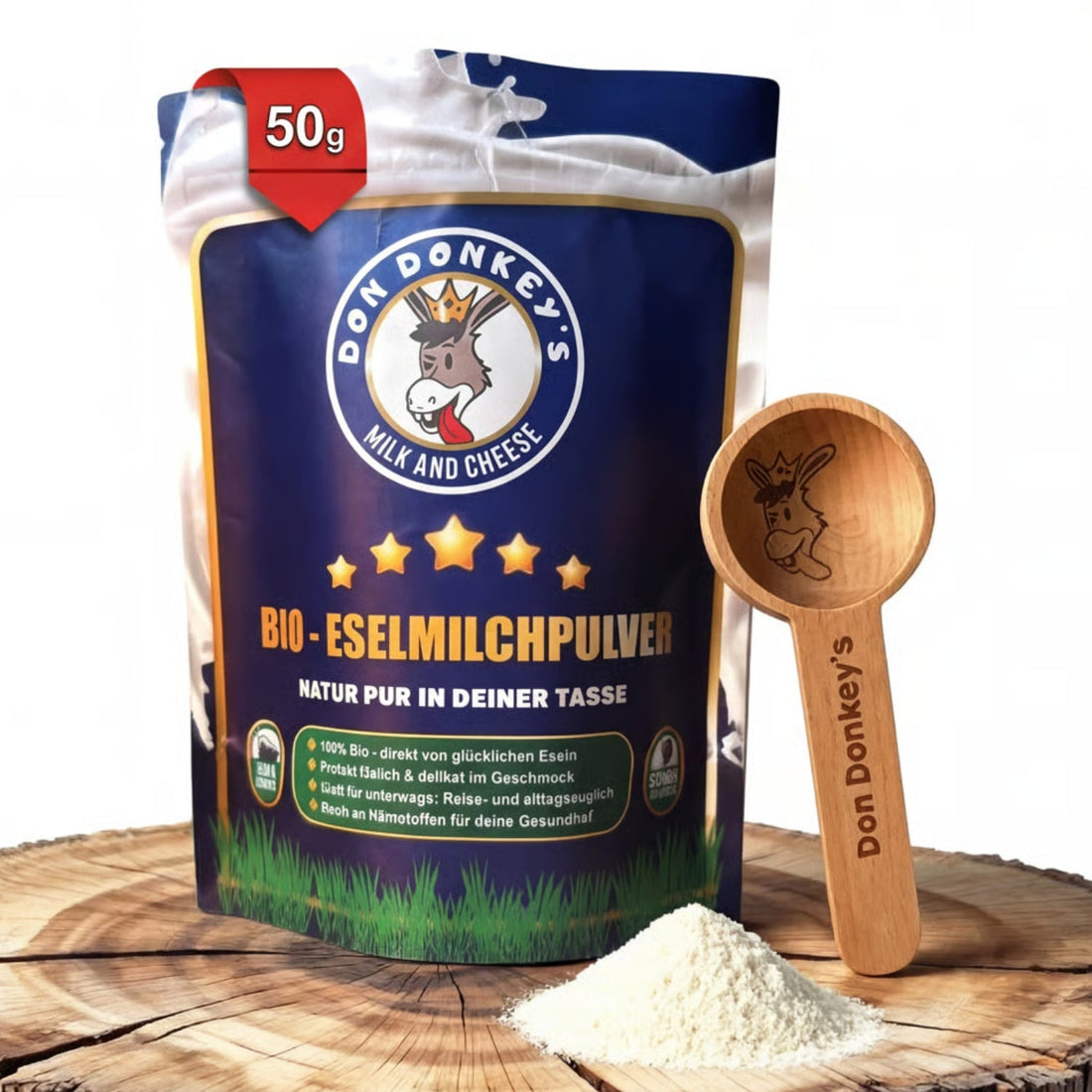
For anyone who prefers a longer shelf life: our donkey milk in powder form – easy to store and portion.
20g · Unit price: €1.245,00 / 1 kg · incl. VAT, plus shipping