
 Buyer protection

Research on donkey milk · Study 83
Donkey milk in the swimming test: what was measured in mice
A Chinese team gave mice donkey milk or a sugar fraction obtained from it for 30 days. The animals then had to swim – until exhaustion or for 90 minutes. Swimming time and blood and tissue values were measured.
Experimental setup
Seven groups, three separate pool tests
Swimming until exhaustion
Water at 25 °C, 35 cm deep, lead weight of 5 % of body weight on the tail. The time until the animal no longer came to the surface was measured.
90 minutes of swimming
Without weight at 30 °C, followed by 60 minutes of rest. Then blood, liver and calf muscle for the laboratory values.
10 minutes of swimming
Without weight at 30 °C. Blood lactate before, immediately after and after 20 minutes – from which an area under the curve was calculated.
“Fraction” = sugar fraction (called “polysaccharides” by the authors), obtained by heating and precipitation with alcohol. Administration took place 30 minutes before each test. According to the paper, the investigators did not know the group assignment.
Key measurement · runs automatically
The gauge of swimming time
Mean ± standard deviation, n = 10 per group. Only the groups for which the paper gives figures are shown; according to the text, all six treatment groups swam statistically longer than the control (p < 0.05). Body weight did not differ between the groups.
Laboratory values · tap the stars
Four constellations from twelve measurements
What is in the sugar fraction
Building blocks in mole per cent
In the test tube, donkey milk scavenged the test radical DPPH more strongly (at most 72.88 ± 0.24 % at 20 mg/ml) than the fraction (46.68 ± 3.08 % at 5 mg/ml); in the second test (FRAP) the fraction was ahead. Laboratory values in the test tube, not effects in the body.
Critical assessment
Six lanes worth knowing about
No resting comparison group
All animals swam. Whether a laboratory value changes through swimming cannot be determined this way – the authors themselves name this as a limitation.
What is the “fraction”?
Yield, purity, residual protein and milk sugar were not determined. Galactose and glucose are also the building blocks of milk sugar.
Very small amounts
Our own conversion: the highest donkey milk dose of 8.32 ml/kg corresponds to around 0.2 ml a day for a 25 g mouse.
Strikingly low variation
About 51.50 ± 1.05 min in the control – unusually uniform for an exhaustion test. Raw data have not been published.
Figures that don’t quite add up
The IL-1β values and percentages given result in two different control values (around 3.00 and 3.16 pg/ml). The abstract calls the fraction “more” antioxidant, while in the DPPH test it was the other way round.
Inconsistent patterns
The dose groups did not behave in a graded way: sometimes the lowest dose was ahead, sometimes the highest. MDA fell in only one of six groups.
Level of evidence: preclinical – animal experiment on mice in the swimming model plus test-tube tests. According to the authors themselves, the mouse model can be transferred to humans only to a limited extent.
Research question for DON DONKEY’S®
Which sugar building blocks besides milk sugar are in donkey milk?
The study speaks of “polysaccharides” without clearly separating out milk sugar. We are interested in how milk sugar and oligosaccharides in donkey milk can be reliably distinguished and measured – as information on composition.
Original publication
Anti-Fatigue Effects of Donkey Milk and Its Polysaccharides in a Mouse Swimming Model
Original title; the term “anti-fatigue effects” is the authors’ assessment.
Wang T., Sun Y., Wang K., Ji C., Huang G., Xiao J., Zhang M., Zhou J., Tang X., Chen X., Hu B., Yu J., Wang Z.
Foods · 2026 · volume 15, issue 14, article 2568 · open access
Jiangnan University Wuxi; Dong’e Ejiao Co., Ltd., Liaocheng (China)
Transparency: three authors employed by a Chinese manufacturer of donkey-hide products, donkey milk from the same company. Animal experiment approved by the ethics committee of Jiangnan University. No product-related statement for DON DONKEY’S®.
Summarised and reviewed by the DON DONKEY’S editorial team on the basis of the original publication · as of October 2026
The study summarised above was carried out independently of DON DONKEY’S® and does not relate to our products. It serves solely to inform about the state of research.
DON DONKEY’S® donkey milk and donkey milk powder are foods. They are not intended to prevent, treat or cure any disease and do not replace medical advice.

From our shop
DON DONKEY’S® donkey milk
100 % donkey milk · raw milk, frozen
On this page we report the findings of a published study. Independently of that, you will find our donkey milk here: 100 % donkey milk, frozen as raw milk.
100 ml bottle / 100ml · Unit price: €249,00 / 1 l · incl. VAT, plus shipping
Also in our shop
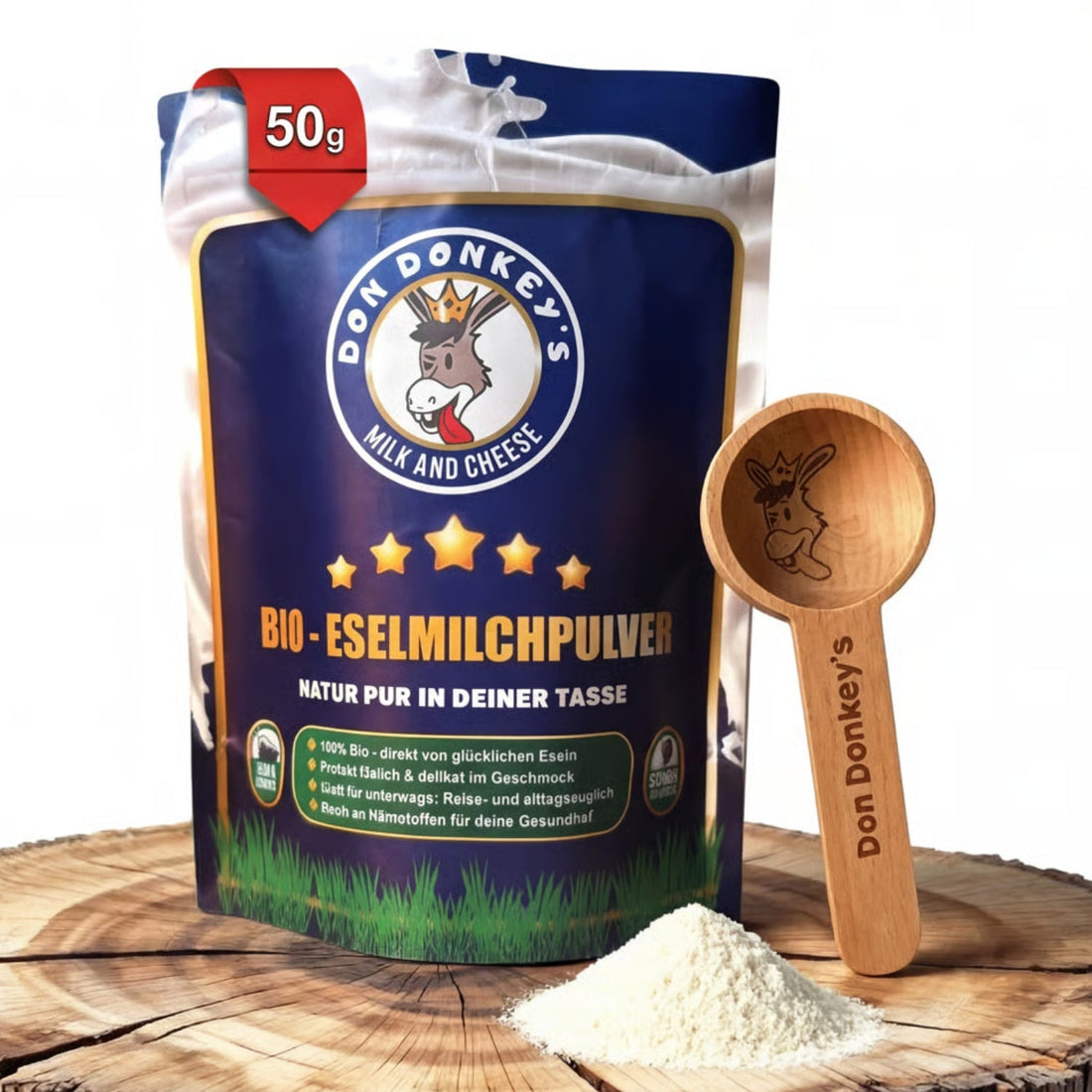
Donkey Milk Powder
Donkey milk in powder form
For anyone who prefers a longer shelf life: our donkey milk in powder form – easy to store and portion.
20g · Unit price: €1.245,00 / 1 kg · incl. VAT, plus shipping