
 Buyer protection

Research on donkey milk · Study 82
Three types of milk in rat feed: what was measured in heart tissue
A team from Naples and Cagliari gave healthy rats cow’s, donkey or human milk in addition to their feed for four weeks – each with the same amount of energy. The researchers then examined the mitochondria, the “power plants” of heart muscle cells, as well as redox values and fatty acids in the heart tissue.
Trial procedure · runs automatically
28 trial days on the calendar
One row = one week (W1–W4). Pink = completed trial day, dark = milestone.
Interactive · tap a group
Four groups, seven animals per group
The glass shows the daily amount of milk to scale (21, 48 and 22 ml). Same energy here means: of the more watery donkey milk, the animals drank more than twice as much.
What the researchers report
Six areas of measurement, four groups compared
Energy & body
All milk groups took in similar amounts of usable energy – more than the control (p < 0.001). Only in the cow’s milk group were weight gain, body energy and body fat percentage above the control (p < 0.001).
Messenger substances
In the donkey and human milk groups, TNF-α and IL-1α were lower than in the other groups – in serum (p < 0.01) and in heart tissue (p < 0.001); IL-10 was higher. Concentrations in rats, not effects in humans.
Mitochondrial respiration
Oxygen consumption of isolated heart mitochondria was lower in the cow’s milk group than in the control and donkey milk groups (p < 0.01) – regardless of substrate.
Redox values
The H₂O₂ release of the mitochondria was lower in the donkey milk group than with cow’s and human milk (p < 0.05). The lipid peroxidation marker MDA was highest with cow’s milk and lowest with donkey and human milk.
Gene expression
Several genes of the respiratory chain and of mitochondrial biogenesis were increased only in the cow’s milk group. mRNA amount (n = 3 per group), not effects.
Tissue sections
Heart muscle fibres of the control, donkey and human milk groups appeared unremarkable; with donkey milk, fat cells between the fibres were noticeable. In the cow’s milk group, the authors described enlarged heart muscle cells. Purely descriptive, without measurement.
Figures from the tables · choose a measurement
Fatty acids and messengers in heart tissue
Dot = mean, line = ± standard error, n = 7 per group. Groups without a common letter differ statistically according to the paper (p < 0.05). Axis starts at zero.
Critical assessment · tap the spikes
Six spikes on the test strip
Funding & interests
According to the paper, no external funding and no conflicts of interest. All authors work at universities, hospitals or a state research institute in Italy.
Level of evidence
Preclinical: animal experiment on healthy rats. Describes laboratory values in heart tissue, does not permit any statement about humans.
Research question for DON DONKEY’S®
How stable is the fatty acid pattern from batch to batch?
The authors suspect that differences between the types of milk are related to their fatty acids. We would like to document transparently how much the fatty acid pattern of donkey milk differs between seasons and farms – as composition, not as a promise of effect.
Original publication
Heart Mitochondrial Metabolic Flexibility and Redox Status Are Improved by Donkey and Human Milk Intake
Original title; the judgement “improved” comes from the authors.
Trinchese G., Cimmino F., Cavaliere G., Rosati L., Catapano A., Sorriento D., Murru E., Bernardo L., Pagani L., Bergamo P., Scudiero R., Iaccarino G., Greco L., Banni S., Crispino M., Mollica M. P.
Antioxidants · 2021 · volume 10, issue 11, article 1807 · open access
University of Naples Federico II, University of Cagliari, Fatebenefratelli-Sacco hospital group Milan, National Research Council CNR (Italy)
Transparency: according to the paper, no external funding, no conflicts of interest. Animal experiment approved by the Italian Ministry of Health (97/2019-PR). No product-related statement for DON DONKEY’S®.
Summarised and reviewed by the DON DONKEY’S editorial team on the basis of the original publication · as of October 2026
The study summarised above was carried out independently of DON DONKEY’S® and does not relate to our products. It serves solely to inform about the state of research.
DON DONKEY’S® donkey milk and donkey milk powder are foods. They are not intended to prevent, treat or cure any disease and do not replace medical advice.

From our shop
DON DONKEY’S® donkey milk
100 % donkey milk · raw milk, frozen
On this page we report the findings of a published study. Independently of that, you will find our donkey milk here: 100 % donkey milk, frozen as raw milk.
100 ml bottle / 100ml · Unit price: €249,00 / 1 l · incl. VAT, plus shipping
Also in our shop
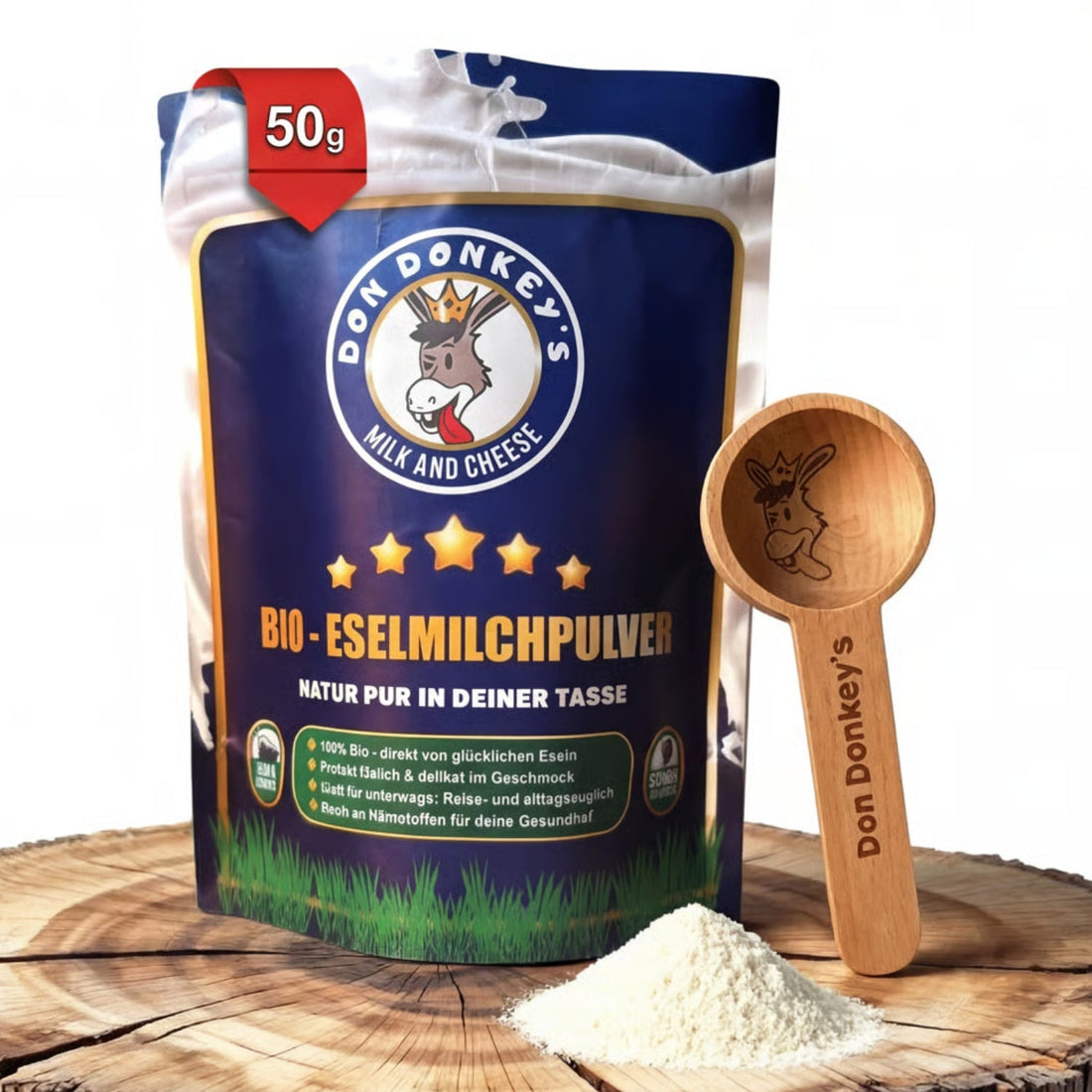
Donkey Milk Powder
Donkey milk in powder form
For anyone who prefers a longer shelf life: our donkey milk in powder form – easy to store and portion.
20g · Unit price: €1.245,00 / 1 kg · incl. VAT, plus shipping