
 Buyer protection

Research on donkey milk · Study 80
Protein in a tiny bubble: donkey milk in nanoliposomes
A Serbian-Slovenian team tested in the laboratory how much protein from skimmed donkey milk can be encapsulated in tiny fat bubbles, so-called nanoliposomes.
Three terms first
What was measured here?
Experimental protocol · runs automatically
Four steps against the clock
- DissolveSkimmed donkey milk was made up in water into 1, 2, 5 and 10 per cent solutions.
- Mix 1 : 2Each solution was added in a ratio of 1 : 2 to a 1 per cent nanoliposome solution. The paper does not say which part is the 1 and which the 2.
- 2 hours in the ultrasonic bathLeft to swell at room temperature so that the bubbles load up with the solution.
- Centrifuge & measurement6,500 revolutions per minute at 4 °C – the paper does not state the duration. Then protein in the supernatant determined according to Lowry.
Result · choose a concentration
Where does the protein go?
Encapsulation rate per concentration
For 1, 2 and 5 %, the paper gives a common value (“about 83.5 %”). According to the figure, 10 % differed from this with p < 0.001. Standard deviations and the number of replicates are not given. The supernatant share is calculated (100 % minus encapsulation rate).
Critical assessment · tap the layers
Six filter layers: what the study does not show
Possible conclusions rain down from above. Each layer holds back one that the paper does not support. What arrives at the bottom is what was actually measured.
Research question for DON DONKEY’S®
Which proteins from donkey milk end up in the bubble – and which stay outside?
The Lowry method measures only the total amount. Whether lysozyme, lactoferrin or caseins are encapsulated differently remains open. We are watching whether follow-up studies record the individual proteins separately and describe their methods completely.
Original publication
Nanoliposome Encapsulation with Donkey Milk Bioactive Proteins and Its Possible Application in Dermatology and Cosmetics
Original title. The applications named were not examined in the study.
Kocić H., Stanković M., Arsić I.
Acta Facultatis Medicae Naissensis · 2017 · volume 34, issue 3, pp. 199–204 · open access
Faculty of Medicine, University of Maribor (Slovenia); Faculty of Medicine, University of Niš, Department of Pharmacy (Serbia)
Transparency: the paper contains no information on funding or conflicts of interest. No product-related statement for DON DONKEY’S®.
Summarised and reviewed by the DON DONKEY’S editorial team on the basis of the original publication · as of October 2026
The study summarised above was carried out independently of DON DONKEY’S® and does not relate to our products. It serves solely to inform about the state of research.
DON DONKEY’S® donkey milk and donkey milk powder are foods. They are not intended to prevent, treat or cure any disease and do not replace medical advice.

From our shop
DON DONKEY’S® donkey milk
100 % donkey milk · raw milk, frozen
On this page we report the findings of a published study. Independently of that, you will find our donkey milk here: 100 % donkey milk, frozen as raw milk.
100 ml bottle / 100ml · Unit price: €249,00 / 1 l · incl. VAT, plus shipping
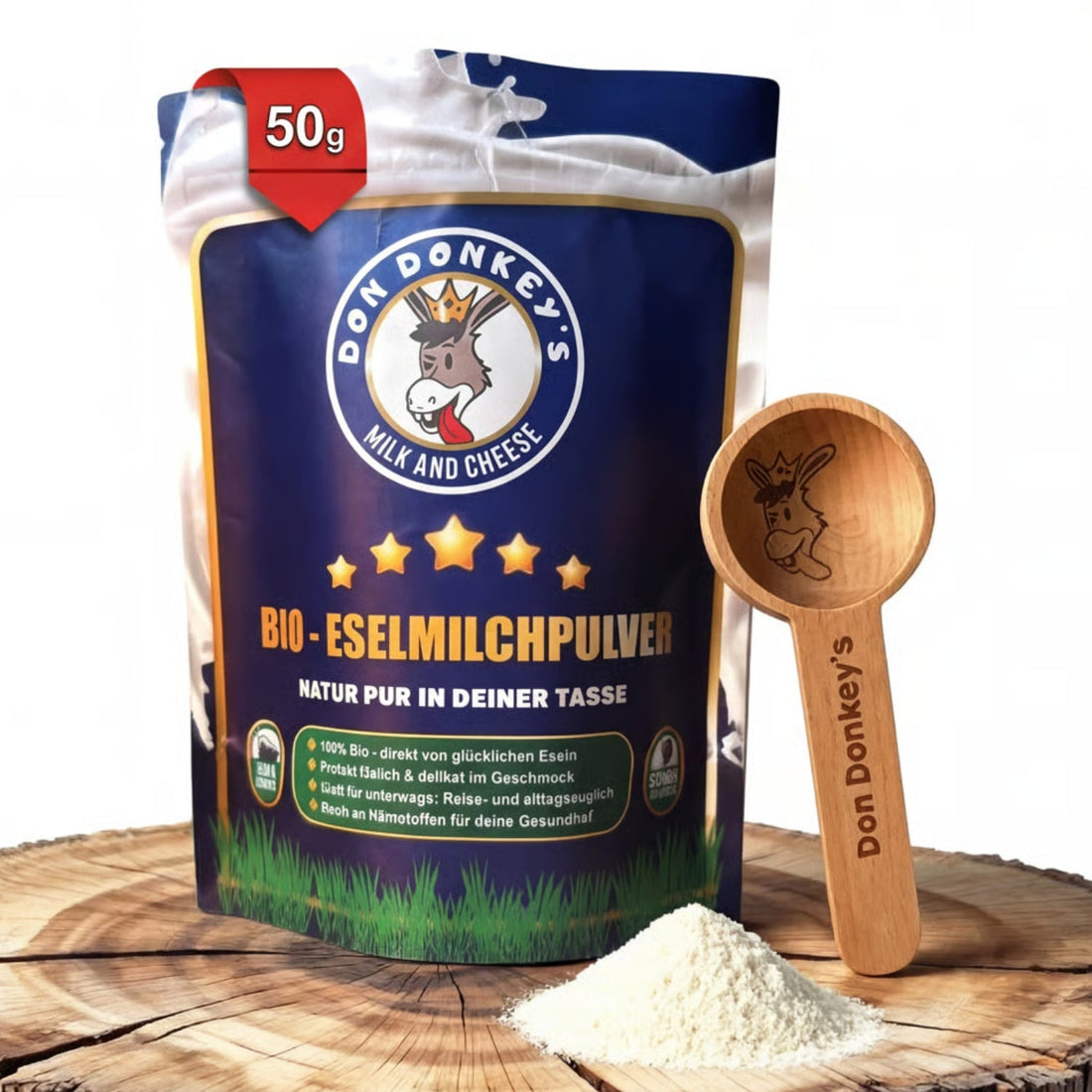
Also in our shop
Donkey Milk Powder
Donkey milk in powder form
For anyone who prefers a longer shelf life: our donkey milk in powder form – easy to store and portion.
20g · Unit price: €1.245,00 / 1 kg · incl. VAT, plus shipping