
 Buyer protection

Research on donkey milk · Study 8
Donkey milk for children without an alternative
In 2007 in Turin, Monti et al. examined whether children with cow's milk protein allergy, for whom no usual substitute formula was suitable, tolerated donkey milk – and tested in the laboratory how strongly their antibodies react to donkey milk proteins.
What it's about
The first Turin study
Some children with cow's milk protein allergy tolerate neither the usual substitute formulas nor the alternatives otherwise recommended. For exactly these children, a team in Turin examined whether donkey milk could be an option.
The study combined two perspectives: tolerability in the children's everyday lives – in vivo – and the reaction of their antibodies to donkey milk proteins in the laboratory – in vitro.
It was the starting point for a larger follow-up study with 92 children from 2012.
What exactly was studied?
Briefly explained
The terms used in this study
A reaction of the immune system to proteins in cow's milk – with or without the involvement of IgE antibodies.
In vivo means "in the living person", in vitro "in the test tube". The study used both approaches.
Antibodies against cow's milk protein also recognise similar proteins from other milk.
Children who are behind in weight or length move back towards the typical course for their age.
46 children with cow's milk protein allergy for whom no usual substitute formula could be used.
The children received donkey milk in a controlled challenge.
Tolerability, acceptance and growth were followed further.
In the laboratory, it was tested how strongly the children's antibodies bind to donkey milk proteins.
Interactive · The data at a glance
46 children, laboratory and debate
How many children tolerated donkey milk, what did the laboratory show – and how was the study received by experts? Switch between the views.
Laboratory analysis · in vitroIgE binding to donkey milk proteins
Illustration of the findings reported in the abstract of the original publication. The arrangement of the dots is schematic.
Key findings
What the researchers report
38 of 46 children tolerated donkey milk
The children tolerated donkey milk in the challenge and during follow-up – and accepted its taste.
Catch-up growth in children who were behind
All children who had previously been behind in growth showed catch-up growth during the study.
Hardly any cross-reactivity measured
In the laboratory, the children's antibodies reacted only very weakly and non-specifically to donkey milk proteins.
The children were selected and there was no comparison group; it therefore cannot be said whether the catch-up growth was due to the donkey milk. The abstract does not give exact growth figures or the duration of follow-up. A critical expert commentary on the study was published, to which the authors replied.
Critical assessment
Promising – and controversially discussed
What the study shows
What it does not show
Research question for DON DONKEY’S®
How is a reliable overall picture formed?
Individual studies say little – only the combination of several works and the expert discussion about them produces an honest picture. That is the standard we set for our research pages.
Original publication
Efficacy of donkey’s milk in treating highly problematic cow’s milk allergic children: an in vivo and in vitro study
Monti G., Bertino E., Muratore M. C., Coscia A., Cresi F., Silvestro L., Fabris C., Fortunato D., Giuffrida M. G., Conti A.
Pediatric Allergy and Immunology · 2007 · 18(3):258–264
Regina Margherita Children's Hospital Turin, University of Turin, CNR-ISPA
DOI: 10.1111/j.1399-3038.2007.00521.x · PubMed: PMID 17433003
Commentary: Alessandri & Mari 2007 · Reply: Monti et al. 2008
The publication describes the use of donkey milk with children under medical supervision. It does not allow any product-related statement for DON DONKEY’S®.

From our shop
DON DONKEY’S® donkey milk
100 % donkey milk · raw milk, frozen
On this page we report the findings of a published study. Independently of that, you will find our donkey milk here: 100 % donkey milk, frozen as raw milk.
100 ml bottle / 100ml · Unit price: €249,00 / 1 l · incl. VAT, plus shipping
Also in our shop
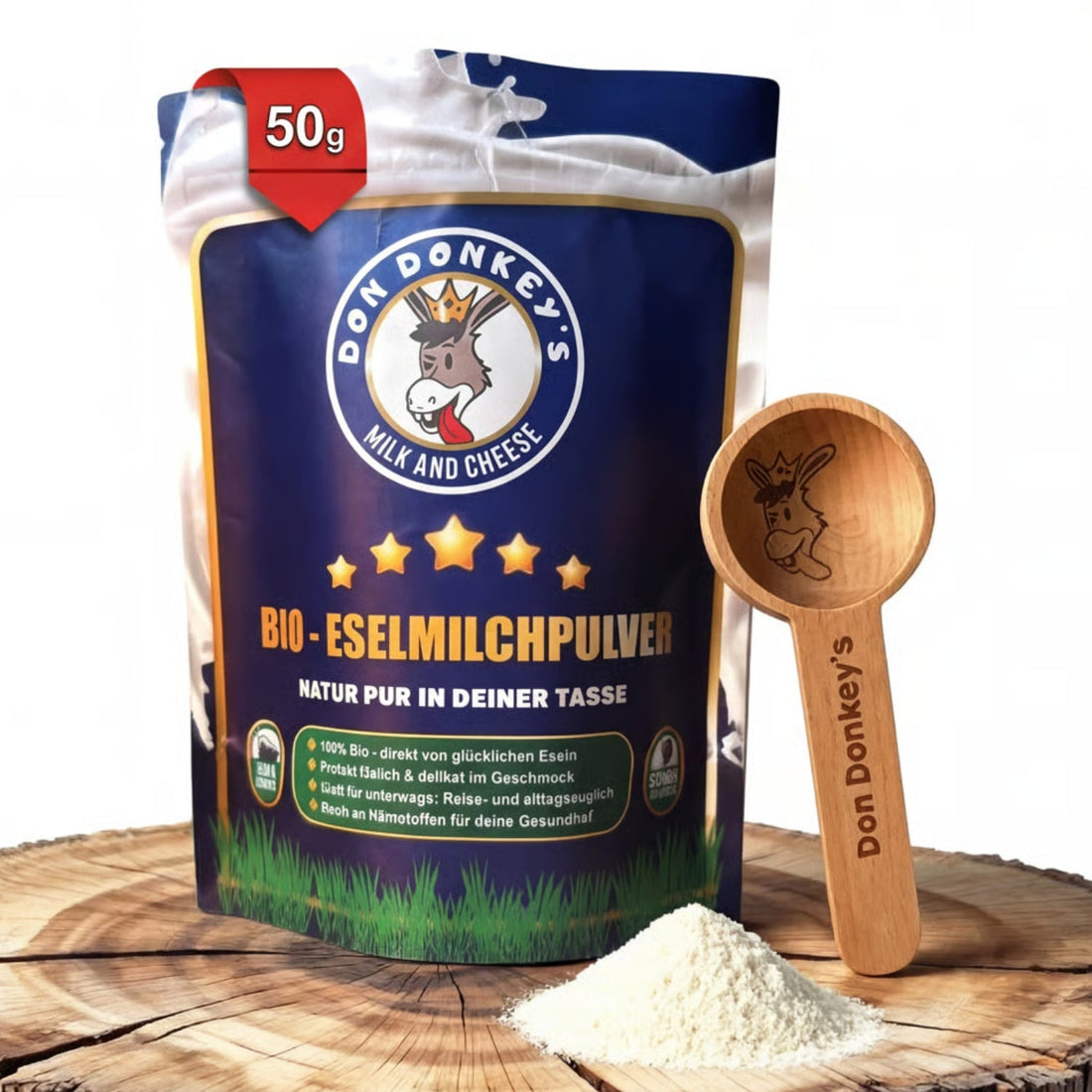
Donkey Milk Powder
Donkey milk in powder form
For anyone who prefers a longer shelf life: our donkey milk in powder form – easy to store and portion.
20g · Unit price: €1.245,00 / 1 kg · incl. VAT, plus shipping