
 Buyer protection

Research on donkey milk · Study 79
A year of lysozyme in the laboratory: lactation, age and pasteurisation
Lysozyme is an enzyme that occurs naturally in donkey milk. A team from the University of Pisa measured for a year how active it is in the milk of a Tuscan herd – raw and gently pasteurised.
How lysozyme is measured
Light in, light out
Lysozyme can cleave certain building blocks of bacterial cell walls. In the test, such cell wall material serves as the measurement substrate. It is labelled with a dye that only glows when the enzyme breaks down the material.
Raw or pasteurised · runs automatically
The pendulum comes to rest in the middle
In the pooled milk, lysozyme activity was 1,340.82 ± 371.078 U/mL raw and 1,402.50 ± 294.722 U/mL after gentle pasteurisation (65 °C, 30 minutes). The difference was not statistically significant.
no significant differenceLines = mean ± standard deviation over 12 monthly samples; SEM according to the paper 154.295. The pendulum is an illustration. Only this one heating method was examined – we do not derive a recommendation from it.
Individual samples · tap the dots
When and in whom was activity higher?
Means from Table 2 (U/mL, n = 12 jennies). Values without a common letter differ according to the paper (P < 0.05). The same SEM is given for both factors (446.058). The y-axis starts at 1,200 to make the differences visible.
Relationships in the 3rd month of lactation · tap the lines
20 spectral lines: what went along with activity?
Each line is a significant correlation from Table 3 – its position shows the correlation coefficient r between −1 and +1, its height the significance level. Correlation means: occurring together, not cause.
Reported only for the 3rd month; the paper gives no values for months 6 and 9. With 12 animals and many components tested at the same time, individual relationships may also occur by chance.
Critical assessment
Our review of the study
Sample
One herd, one breed. Individual samples only from 12 jennies; the age groups are correspondingly small.
limitedMethod
Established fluorescence test with calibration curve, samples refrigerated and analysed within 24 hours.
solidStatistics
No F or P values for the group comparisons; identical SEM for lactation and age. Many correlations with a small sample.
limitedAnomaly
Linoleic acid (C18:2 c9,c12): Table 3 shows r = +0.884, while the text lists it among the negatively associated fatty acids. Total n-6 also appears with −0.884.
contradictionComparability
The mean of the individual samples (1,670.11 U/mL) and that of the pooled milk (around 1,341–1,403 U/mL) come from different types of sample and are not directly comparable.
noteTransferability
Only one heating method (65 °C, 30 minutes). Statements about other methods, freezing or drying are not possible.
limitFunding · interests
Funded by a research programme of the University of Pisa (PRA 2017). A declaration of conflicts of interest is missing from the version available to us.
openResearch question for DON DONKEY’S®
How much lysozyme activity remains measurable after blast freezing?
The study tests raw and gently pasteurised milk. Comparable long-term measurements are lacking for frozen donkey milk. We are interested in how activity behaves at −40 °C over storage time – and how this can be documented traceably.
Original publication
Lysozyme activity in donkey milk
Original title of the publication.
Martini M., Salari F., Licitra R., La Motta C., Altomonte I.
International Dairy Journal · 2019 · volume 96, pp. 98–101 · author version freely available in the University of Pisa repository
University of Pisa, Departments of Veterinary Sciences and Pharmacy, Nutrafood Research Centre (Italy)
DOI: 10.1016/j.idairyj.2019.04.009
Transparency: funded by PRA 2017 (University of Pisa research project). No declaration of conflicts of interest in the author version. No product-related statement for DON DONKEY’S®.
Summarised and reviewed by the DON DONKEY’S editorial team on the basis of the original publication · as of October 2026
The study summarised above was carried out independently of DON DONKEY’S® and does not relate to our products. It serves solely to inform about the state of research.
DON DONKEY’S® donkey milk and donkey milk powder are foods. They are not intended to prevent, treat or cure any disease and do not replace medical advice.

From our shop
DON DONKEY’S® donkey milk
100 % donkey milk · raw milk, frozen
On this page we report the findings of a published study. Independently of that, you will find our donkey milk here: 100 % donkey milk, frozen as raw milk.
100 ml bottle / 100ml · Unit price: €249,00 / 1 l · incl. VAT, plus shipping
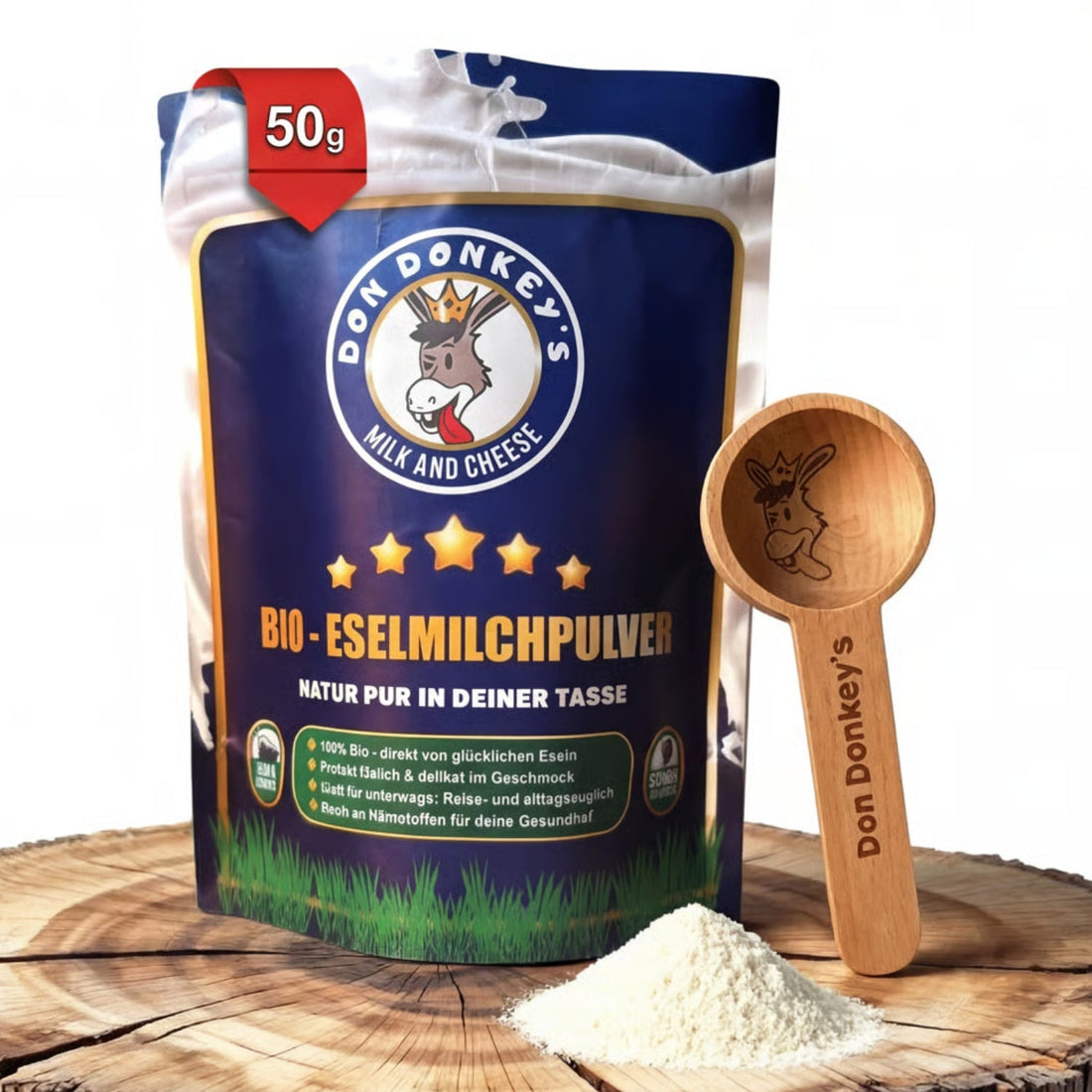
Also in our shop
Donkey Milk Powder
Donkey milk in powder form
For anyone who prefers a longer shelf life: our donkey milk in powder form – easy to store and portion.
20g · Unit price: €1.245,00 / 1 kg · incl. VAT, plus shipping