
 Buyer protection

Research on donkey milk · Study 78
Protein digested in the test tube: what the fragments showed in laboratory tests
A Turkish laboratory study subjected casein and whey from donkey and camel milk to simulated digestion. The resulting protein fragments (peptides) were then put through five chemical tests.
What it's about
Four samples, five laboratory tests
Milk protein consists roughly of two groups: casein and whey proteins. During digestion, enzymes break both down into short chains. The study asked how such fragments from donkey and camel milk behave in chemical laboratory tests. Abbreviations on this page: DC = digested donkey casein, DW = digested donkey whey, CC and CW = the same for camel milk.
Trial procedure · runs automatically
From milk to the measuring plate
Origin of the milk according to the paper: one donkey milk farm and one camel milk farm each in Turkey. The number of animals, breeds and number of milk samples are not stated.
Measurements after digestion
How much was broken down?
Each lamp is a mean from Table 1 of the paper. Whey was cleaved more than casein – yet the most peptides were measured from donkey casein.
According to the paper, DC (highest peptide concentration) and CC (lowest) differed significantly from the other samples (P < 0.05); for degree of hydrolysis, both whey samples were significantly above both casein samples.
Key findings · tap the wells
The results plate: 20 wells, 5 tests
Colour intensity = ranking according to the paper’s text, schematic. Numbers appear only where the paper explicitly states them; many individual values appear only in figures or are marked as “data not shown”. DPP-IV and α-glucosidase are enzymes – what was measured was their inhibition in the test tube, not an effect in the body.
Critical assessment
Seven test strips for this study
Unknown samples
Neither the number of animals nor breeds nor the number of milk samples are stated. For each type of milk, the milk comes from one farm.
clearContradictions
α-glucosidase for CW/DW: “not determined”, then 32.84 and 89.38 %. Best DPP-IV value: DC in the results section, CC in the conclusion.
clearHidden data
Several key values only in figures or “data not shown”. Concentrations of the samples in the tests are missing.
mediumDigestion briefly described
Only a reference to a standard protocol; pH values, times and enzyme amounts are not in the text.
mediumPeptides not identified
Which peptides were formed was not determined – only total amount and HPLC profile.
mediumTest tube only
Chemical tests and isolated enzymes say nothing about what happens in the body. The author herself calls for further studies.
limit of the designTransparency
Recognised digestion protocol, five different test methods. No funding, no conflicts of interest declared.
goodEditorial assessment: The author sees the peptides as possible candidates in connection with type 2 diabetes. This was not examined and cannot be derived from enzyme tests in the test tube – we expressly do not adopt this interpretation.
Research question for DON DONKEY’S®
Which peptides are formed from donkey casein – and how robust is the result?
The study measures totals but does not identify individual peptides. We are interested in whether other research groups, with openly described conditions and more milk samples, arrive at similar rankings – and whether freezing or freeze-drying changes the peptide pattern.
Original publication
An evaluation of the in vitro antioxidant and antidiabetic potentials of camel and donkey milk peptides released from casein and whey proteins
Original title; “antidiabetic” is the author’s choice of words for enzyme tests in the test tube.
Akan E.
Journal of Food Science and Technology · 2021 · volume 58, issue 10, pp. 3743–3751 · online since 12 October 2020 · freely available via PubMed Central (PMC8357899)
Turkey
DOI: 10.1007/s13197-020-04832-5
Transparency: according to the paper, no funding; no conflicts of interest declared. A correction to the article was published (2021). No product-related statement for DON DONKEY’S®.
Summarised and reviewed by the DON DONKEY’S editorial team on the basis of the original publication · as of October 2026
The study summarised above was carried out independently of DON DONKEY’S® and does not relate to our products. It serves solely to inform about the state of research.
DON DONKEY’S® donkey milk and donkey milk powder are foods. They are not intended to prevent, treat or cure any disease and do not replace medical advice.

From our shop
DON DONKEY’S® donkey milk
100 % donkey milk · raw milk, frozen
On this page we report the findings of a published study. Independently of that, you will find our donkey milk here: 100 % donkey milk, frozen as raw milk.
100 ml bottle / 100ml · Unit price: €249,00 / 1 l · incl. VAT, plus shipping
Also in our shop
Donkey Milk Powder
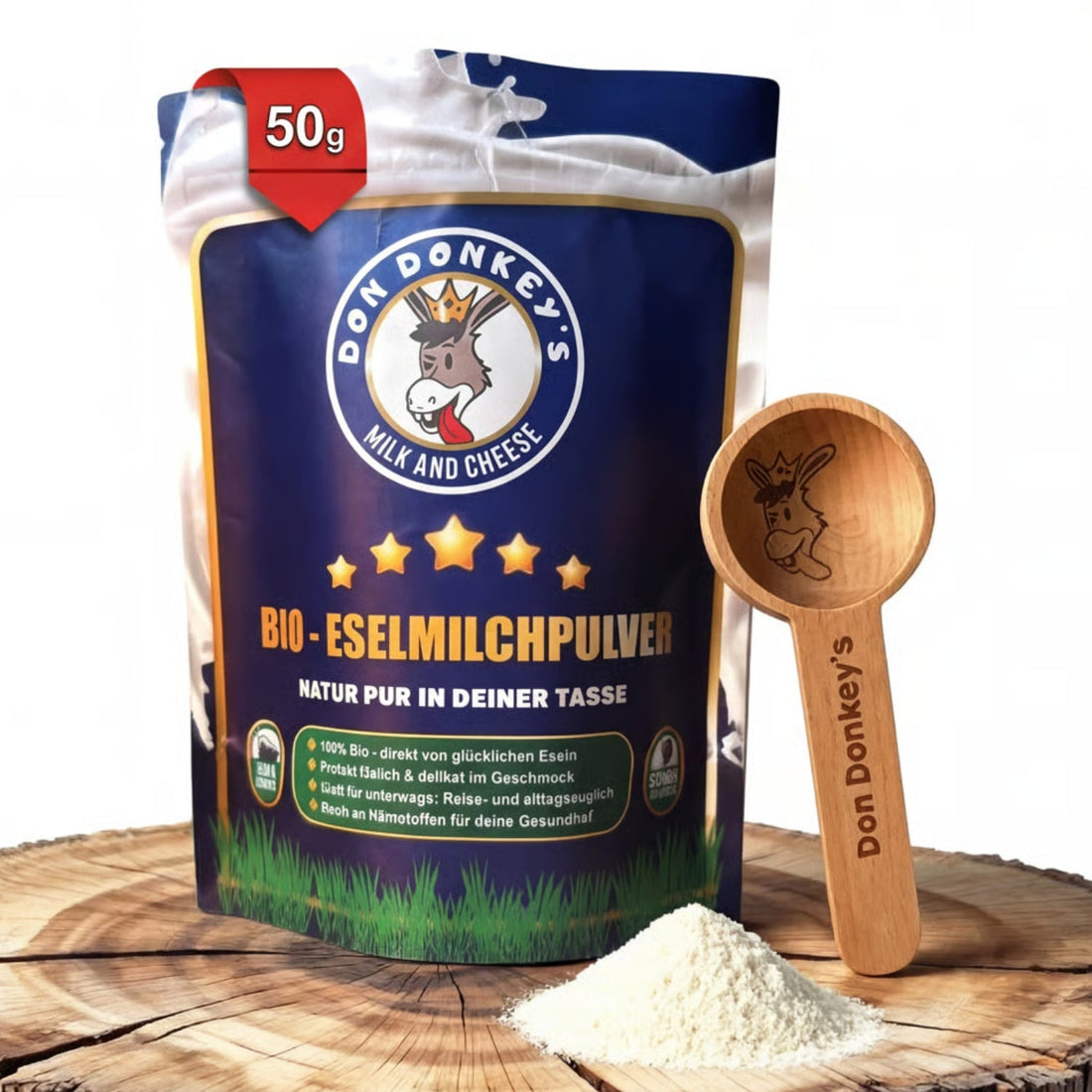
Donkey milk in powder form
For anyone who prefers a longer shelf life: our donkey milk in powder form – easy to store and portion.
20g · Unit price: €1.245,00 / 1 kg · incl. VAT, plus shipping