
 Buyer protection

Research on donkey milk · Study 72
805 proteins, seven stages: how the protein profile of donkey milk shifts
A team from Liaocheng University examined the milk of Dezhou jennies from the first to the 180th day of lactation – with a method that captures hundreds of proteins at once.
identified
Sampling plan · runs automatically
From 84 jennies to 805 proteins
Schematic. A protein counted as “differentially abundant” at p < 0.05 and at least a 1.5-fold change compared with colostrum (day 1).
Result 2 · tap a spike
The largest spikes in the seismogram
Main proteins over time (according to the text)
- ↗Lactoferrin – relative amount rose from day 1 to day 180.
- ↗→Albumin, lysozyme, β-lactoglobulin, α-lactalbumin – increase until day 60, then a plateau.
- ↗→β-casein – increase until day 30, then stable.
- ↗↘↗αs1-casein – higher early, lower in mid and late lactation, higher again on day 180.
- ↗↘αs2- and κ-casein – first an increase, then a decrease.
Height of the spike = minimum change named in the text (“FC > x”), logarithmic. Upwards: more abundant in mature milk (days 30–180); downwards: more abundant in colostrum (for these five the text only states “FC > 5”). Relative amounts, not concentrations and not effects.
Critical assessment · tap a compass point
A compass rose for the findings
Editorial assessment: From database assignments, the authors derive benefits for infants, sick people, older people and cosmetics. This was not examined. Donkey milk is not a substitute for breast milk or infant formula. Same research group as Study 62 (lipids over 180 days).
Research question for DON DONKEY’S®
How much does the milk depend on the day of lactation?
If the protein profile shifts between day 30 and day 180, the lactation stage is an important piece of information for any milk. We want to clarify how we can document this point in time traceably.
Original publication
Analysis of the Differentially Expressed Proteins in Donkey Milk in Different Lactation Stages
Original title of the publication.
Zhou M., Huang F., Du X., Liu G., Wang C.
Foods · 2023 · volume 12, issue 24, article 4466 · open access
School of Agricultural Science and Engineering, Liaocheng University (China)
Transparency: funded by the National Key R&D Program of China, a technology programme of Shandong Province and the Shandong Natural Science Foundation. According to the paper, no conflicts of interest. No product-related statement for DON DONKEY’S®.
Summarised and reviewed by the DON DONKEY’S editorial team on the basis of the original publication · as of October 2026
The study summarised above was carried out independently of DON DONKEY’S® and does not relate to our products. It serves solely to inform about the state of research.
DON DONKEY’S® donkey milk and donkey milk powder are foods. They are not intended to prevent, treat or cure any disease and do not replace medical advice.

From our shop
DON DONKEY’S® donkey milk
100 % donkey milk · raw milk, frozen
On this page we report the findings of a published study. Independently of that, you will find our donkey milk here: 100 % donkey milk, frozen as raw milk.
100 ml bottle / 100ml · Unit price: €249,00 / 1 l · incl. VAT, plus shipping
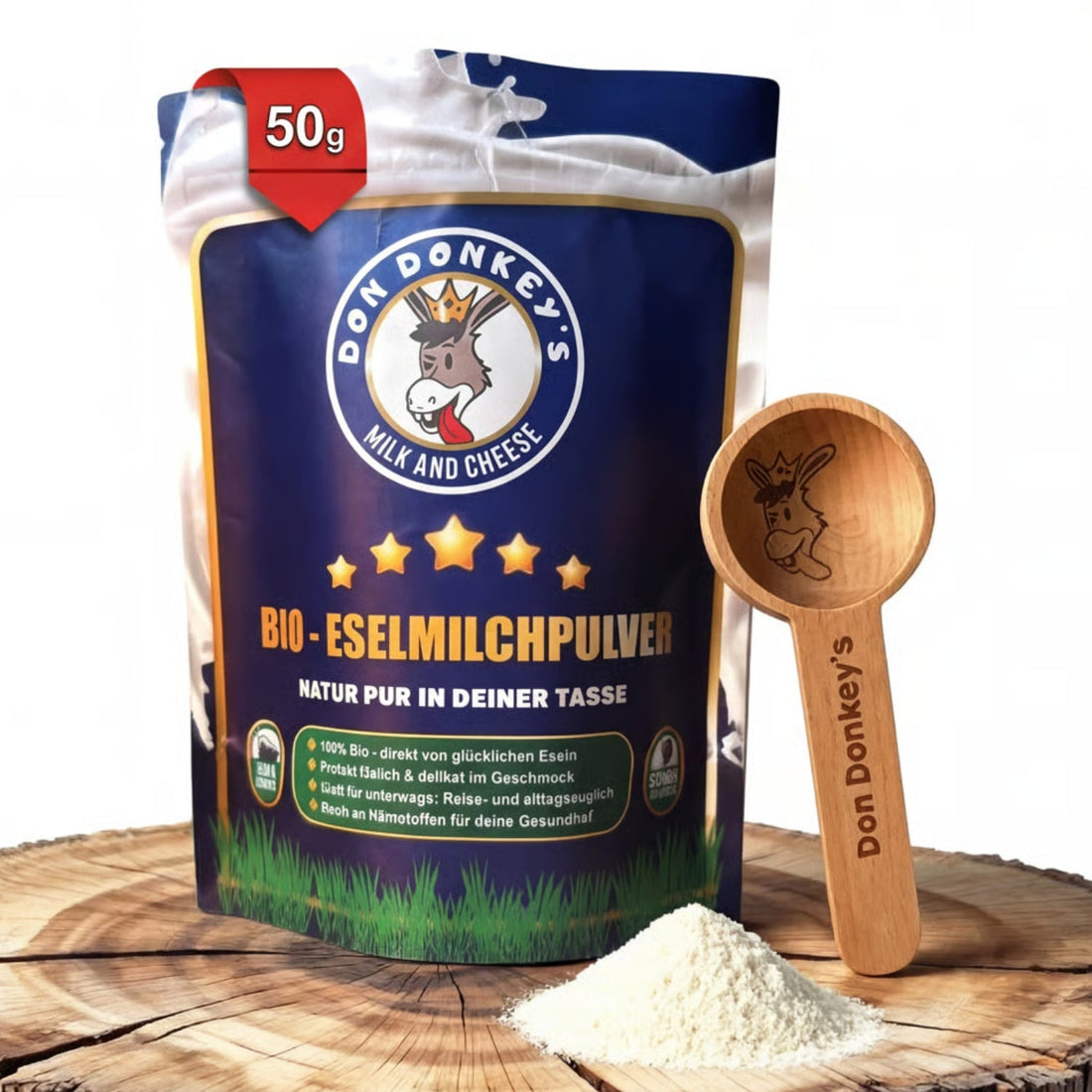
Also in our shop
Donkey Milk Powder
Donkey milk in powder form
For anyone who prefers a longer shelf life: our donkey milk in powder form – easy to store and portion.
20g · Unit price: €1.245,00 / 1 kg · incl. VAT, plus shipping