
 Buyer protection

Research on donkey milk · Study 7
Lysozyme from donkey milk in the cowshed
In 2019 in southern Italy, Adduci et al. tested whether a teat-care mixture containing condensed donkey milk reduces the clostridial load on the teats of dairy cows – in the laboratory and on 48 cows.
What it's about
An enzyme as a helper in the barn?
Donkey milk contains a notably large amount of lysozyme – a natural enzyme that can attack the cell wall of certain bacteria. Researchers from the universities of Basilicata and Bari wanted to know whether this property can be used in dairy farming.
Their target: clostridia. Their spores get into cow's milk via dirty teats and can, for example, cause faulty fermentation in hard cheese. That's why teats are treated with a pre-dipping agent before milking.
A mixture with 15 % condensed donkey milk was tested – first in the laboratory, then in the barn in comparison with a commercial product.
What exactly was studied?
Briefly explained
The terms used in this study
A natural enzyme that can break down the cell wall of certain bacteria. Donkey milk contains a particularly large amount of it.
Spore-forming bacteria from soil and feed. In cheese-making they are considered a typical cause of faulty fermentation.
Dipping or spraying the teats with a care product before milking.
A zone around a test disc in which bacteria do not grow on a culture plate.
A care mixture with 15 % condensed donkey milk was prepared.
The mixture was tested against four bacterial species and compared with reference agents.
48 cows in two groups received either the mixture or a standard product before milking.
The clostridial load was determined on the teat skin and in the bulk milk.
Interactive · The data at a glance
From the lab to the barn
How was the experiment set up, what did the lab test show – and how much did the clostridial load on the teats and in the milk fall? Switch between the views.
Donkey milk mixture24 cows
Comparison product24 cows
Illustration of the values reported in the original publication. The arrangement of the dots is schematic.
Key findings
What the researchers report
All four bacteria inhibited
According to the authors, the inhibitory effect in the laboratory was stronger than that of the comparison product and comparable to the antibiotics tested.
Around twice as large a reduction
The clostridial load on the teat skin fell considerably more with the donkey milk mixture.
Fewer clostridia in the milk too
The clostridial load in the cows' bulk milk had also fallen more.
The mixture was not pure lysozyme – other components and the way it was applied may have contributed to the effect. The percentages describe a reduction in microbial load, not complete elimination. Laboratory comparisons with antibiotics do not mean clinical equivalence.
Critical assessment
A finding from the barn – not a health promise
What the study shows
What it does not show
Research question for DON DONKEY’S®
How much lysozyme is in our milk?
Lysozyme is one of the components that distinguish donkey milk from cow's milk. For us, this is a reason to know the lysozyme content of our own milk – and to understand how it behaves during storage and processing.
Original publication
Abatement of the clostridial load in the teats of lactating cows with lysozyme derived from donkey milk
Adduci F., Elshafie H. S., Labella C., Musto M., Freschi P., Paolino R., Ragni M., Cosentino C.
Journal of Dairy Science · 2019 · 102(8):6750–6755
University of Basilicata (Potenza), University of Bari Aldo Moro
DOI: 10.3168/jds.2019-16311 · PubMed: PMID 31155256
Full text: PDF in the University of Bari repository
The publication describes an application in dairy cattle farming. It does not allow any statement about donkey milk as a food or any product-related statement for DON DONKEY’S®.

From our shop
DON DONKEY’S® donkey milk
100 % donkey milk · raw milk, frozen
On this page we report the findings of a published study. Independently of that, you will find our donkey milk here: 100 % donkey milk, frozen as raw milk.
100 ml bottle / 100ml · Unit price: €249,00 / 1 l · incl. VAT, plus shipping
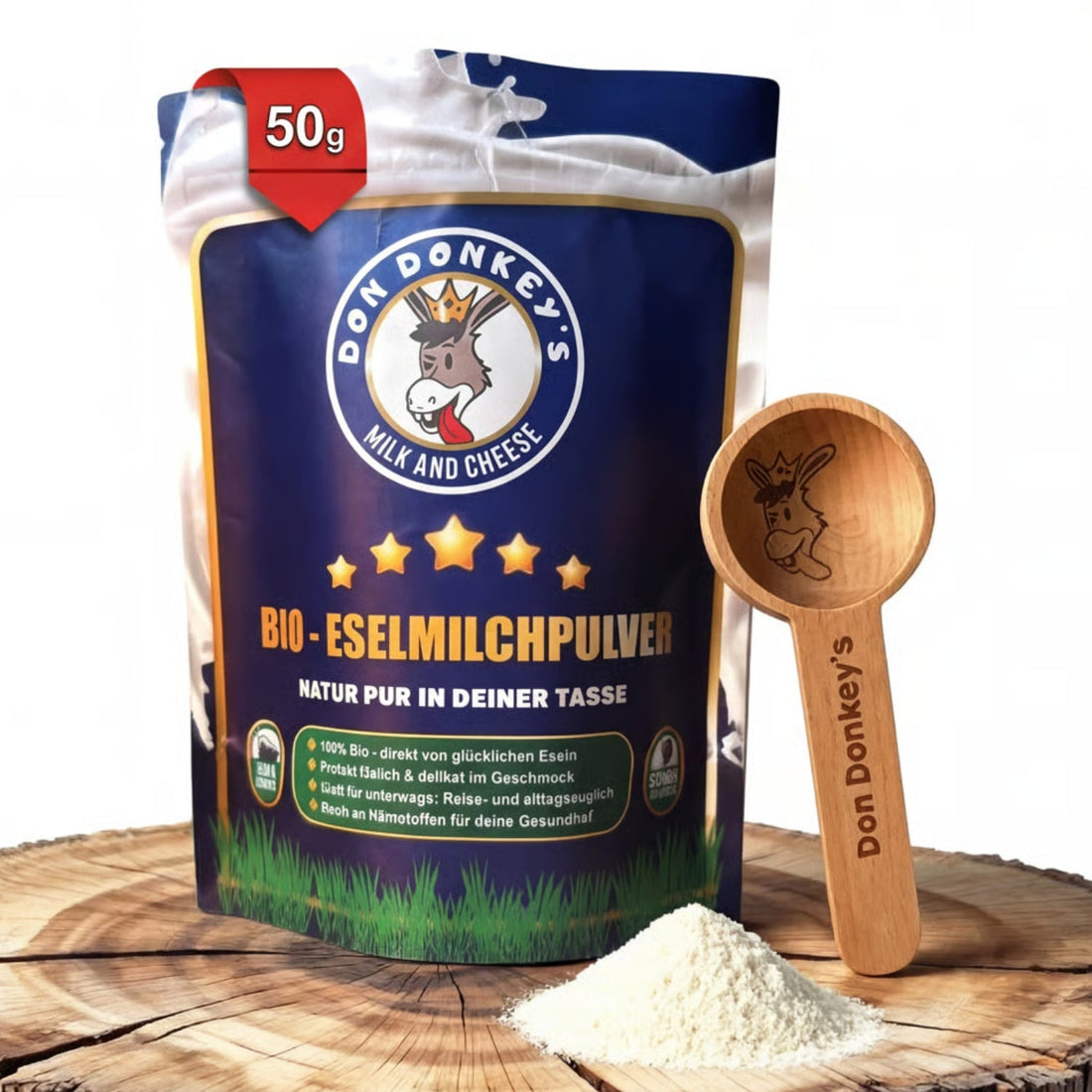
Also in our shop
Donkey Milk Powder
Donkey milk in powder form
For anyone who prefers a longer shelf life: our donkey milk in powder form – easy to store and portion.
20g · Unit price: €1.245,00 / 1 kg · incl. VAT, plus shipping