
 Buyer protection

Research on donkey milk · Study 69
Nine months in the gel: protein bands in donkey and human milk
A team from Trakia University in Bulgaria separated proteins from donkey and human milk in a gel over nine months of lactation – and compared which bands appear when.
Sampling plan · fills automatically
One cryobox, 18 pooled samples
For each month of lactation, one pooled sample per type of milk was examined, stored at −80 °C.
Method · SDS-PAGE
Proteins sorted by size
In an electric field, small proteins travel further through the gel than large ones. Each band stands for a molecular size in kilodaltons (kDa).
The paper gives no quantification of total protein. The evaluation focused mainly on the position and occurrence of the bands.
The gel · tap a lane
Each lane one month
Redrawn from the study’s tables: position of each band by its size (logarithmic). On the right, the ranges the authors assign to the proteins.
Shown are the bands that can be clearly assigned to a month in the tables (human milk 7, donkey milk 10 per month); some small bands below 18 kDa cannot be assigned to a month with certainty. The paper only gives a size range for which band is which protein – the assignment is therefore schematic.
When which protein appears
In the jenny, caseins are initially missing
According to the authors’ text: in months 1 and 2 they found neither α- and β-casein nor β-lactoglobulin in the donkey milk. Lactoferrin and serum albumin were detectable throughout in both types of milk.
Filled dot = detected according to the text, empty dot = not detected according to the text. The authors name β-lactoglobulin only for donkey milk. For human milk, the paper names β-casein from month 2. Lysozyme was found in donkey milk mainly from month 3. Within the caseins, the authors estimated 49.5 % β-casein and 31.5 % α-casein for donkey milk.
Statistics
“Similar” – measured with a tape measure
The authors report correlation coefficients between human and donkey milk. 1 would mean a perfect relationship, 0 none. All values are close to zero.
For casein, the table says “<0.001” – a notation for p-values, not for correlation coefficients. The paper does not explain exactly which values were correlated.
Critical assessment
The bridge does not reach the other side
What was measured were band patterns in the gel. In their conclusion, the authors speak of allergies, infants and “pharmafood” – none of which was examined.
For parents: donkey milk is not a substitute for breast milk or infant formula. The study examined neither children nor allergies nor tolerability. Questions about infant nutrition belong in the hands of a doctor.
Editorial assessment: The study describes which protein bands appear in donkey and human milk over nine months – a pattern, not quantities. We expressly do not adopt the authors’ conclusions on allergies and infant nutrition.
Research question for DON DONKEY’S®
How does the protein pattern of our milk change over the year?
Several studies show that proteins in donkey milk shift with the month of lactation. For us, this is a reason to know the lactation stage of the animals and to document measurements properly.
Original publication
Comparative Electrophoretic Analysis Between the Protein Content in Human and Donkey Milk Samples—A Study Covering the Long-Term Lactation Period
Original title of the publication.
Georgieva A. S., Naydenova N., Ivanova D.
Foods · 2025 · volume 14, article 3083 · open access
Trakia University, Stara Zagora, Bulgaria
Transparency: publication costs funded by the Bulgarian Recovery and Resilience Plan. According to the publication, no conflicts of interest. No product-related statement for DON DONKEY’S®.
Summarised and reviewed by the DON DONKEY’S editorial team on the basis of the original publication · as of October 2026
The study summarised above was carried out independently of DON DONKEY’S® and does not relate to our products. It serves solely to inform about the state of research.
DON DONKEY’S® donkey milk and donkey milk powder are foods. They are not intended to prevent, treat or cure diseases and do not replace medical advice. They are not a substitute for breast milk or infant formula.

From our shop
DON DONKEY’S® donkey milk
100 % donkey milk · raw milk, frozen
On this page we report the findings of a published study. Independently of that, you will find our donkey milk here: 100 % donkey milk, frozen as raw milk.
100 ml bottle / 100ml · Unit price: €249,00 / 1 l · incl. VAT, plus shipping
Also in our shop
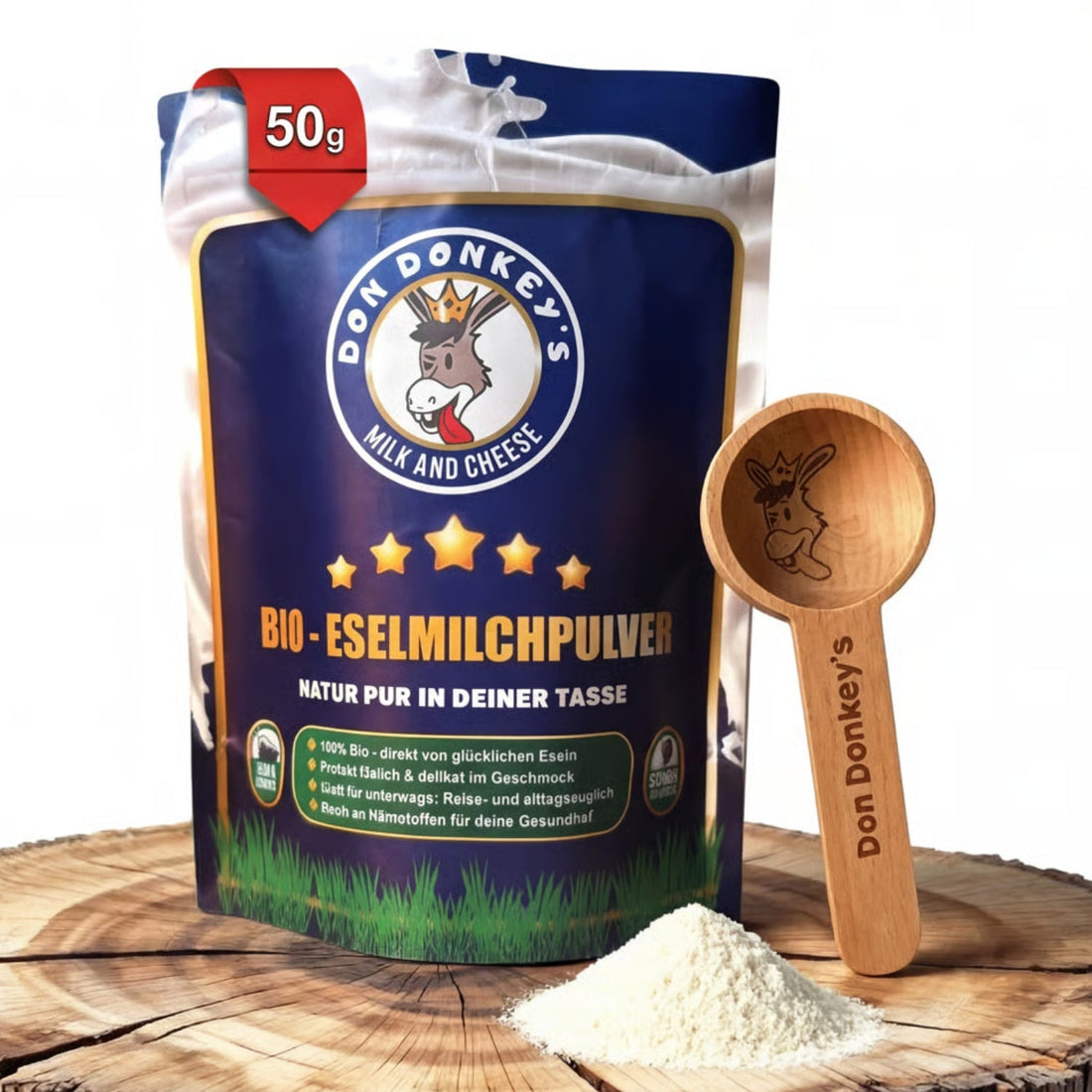
Donkey Milk Powder
Donkey milk in powder form
For anyone who prefers a longer shelf life: our donkey milk in powder form – easy to store and portion.
20g · Unit price: €1.245,00 / 1 kg · incl. VAT, plus shipping