
 Buyer protection

Research on donkey milk · Study 67
Yeast in the feed trough: what a yeast polysaccharide changed in milk, blood and gut flora
A team from Liaocheng University gave Dezhou jennies and their foals a supplement of yeast sugar compounds for 23 days and measured milk, blood values, metabolites and gut bacteria.
Trial procedure · runs automatically
23 days in time-lapse
12 jennies with foals around 45 days old, two groups of 6 pairs each. Same basic ration twice a day; one group additionally received the yeast polysaccharide.
Basic ration of both groups
Layer by layer: what was in the trough
Shares according to Table 1; ration with 6.5 % crude protein. The polysaccharide came from a Chinese yeast manufacturer; the paper does not state its composition.
Milk of the jennies · tap a row
Nothing measurable changed in the milk
Control = 100. The bars show the standard error (SEM). No milk value differed significantly.
Immune values in the blood · changes automatically
In the jennies’ blood, IgA and IgG rose
Antibodies (IgA, IgG, IgM) and complement factors (C3, C4) in serum, measured on day 23. Logarithmic scale; the paper gives no units. Red = significant (p < 0.05).
Blood values of the animals, not milk values. According to the paper, the immune values in the milk did not differ significantly. The interpretation as “improved immune function” is that of the authors; a benefit was not examined.
Metabolites in the blood · tap a book
388 molecules, sorted onto the shelf by class
Detected in blood serum by mass spectrometry and assigned to chemical classes. Book width = number.
Gut bacteria from faecal samples
Much in common, some things shifted
Bacterial types (OTU) per group; light = in both groups.
jennies
Foals
Jennies with supplement
Terrisporobacter ↑Cellulosilyticum ↑Howardella ↑Dorea ↑Saccharimonadaceae ↑Oscillospirales ↓Diversity (Shannon, Chao, Simpson etc.): no significant difference.
Foals with supplement
15 genera ↑, incl.LactobacillusPrevotellaStreptococcusEscherichia-ShigellaDiversity: Shannon and Ace index higher, Simpson index lower.
16S sequencing. Which of groups 1 and 2 is the yeast group is not clear from the text. What was measured was composition, not the health of the animals.
Critical assessment
Text versus table: our cross-check
Editorial assessment: For the milk, the result is a null finding – amount and composition remained the same within measurement accuracy. The other findings concern the blood and gut of the animals and should be read with caution because of the small groups and the contradictions in the paper.
Research question for DON DONKEY’S®
What does a feed additive change in the milk – and what not?
Sometimes an additive changes the amount or fat pattern of the milk, sometimes nothing. For us, this means recording additives on the partner farms and reading studies by what they actually measured in the milk itself.
Original publication
Yeast polysaccharide supplementation: impact on lactation, growth, immunity, and gut microbiota in Dezhou donkeys
Original title of the publication.
Huang B., Khan M. Z., Chen Y., Liang H., Kou X., Wang X., Ren W., Wang C., Zhang Z.
Frontiers in Microbiology · 2023 · volume 14, article 1289371 · open access
Liaocheng University, China; University of Agriculture Dera Ismail Khan, Pakistan
DOI: 10.3389/fmicb.2023.1289371
Transparency: public funding (China, Shandong Province). According to the publication, no conflicts of interest; the polysaccharide came from a yeast manufacturer. No product-related statement for DON DONKEY’S®.
Summarised and reviewed by the DON DONKEY’S editorial team on the basis of the original publication · as of October 2026
The study summarised above was carried out independently of DON DONKEY’S® and does not relate to our products. It serves solely to inform about the state of research.
DON DONKEY’S® donkey milk and donkey milk powder are foods. They are not intended to prevent, treat or cure any disease and do not replace medical advice.

From our shop
DON DONKEY’S® donkey milk
100 % donkey milk · raw milk, frozen
On this page we report the findings of a published study. Independently of that, you will find our donkey milk here: 100 % donkey milk, frozen as raw milk.
100 ml bottle / 100ml · Unit price: €249,00 / 1 l · incl. VAT, plus shipping
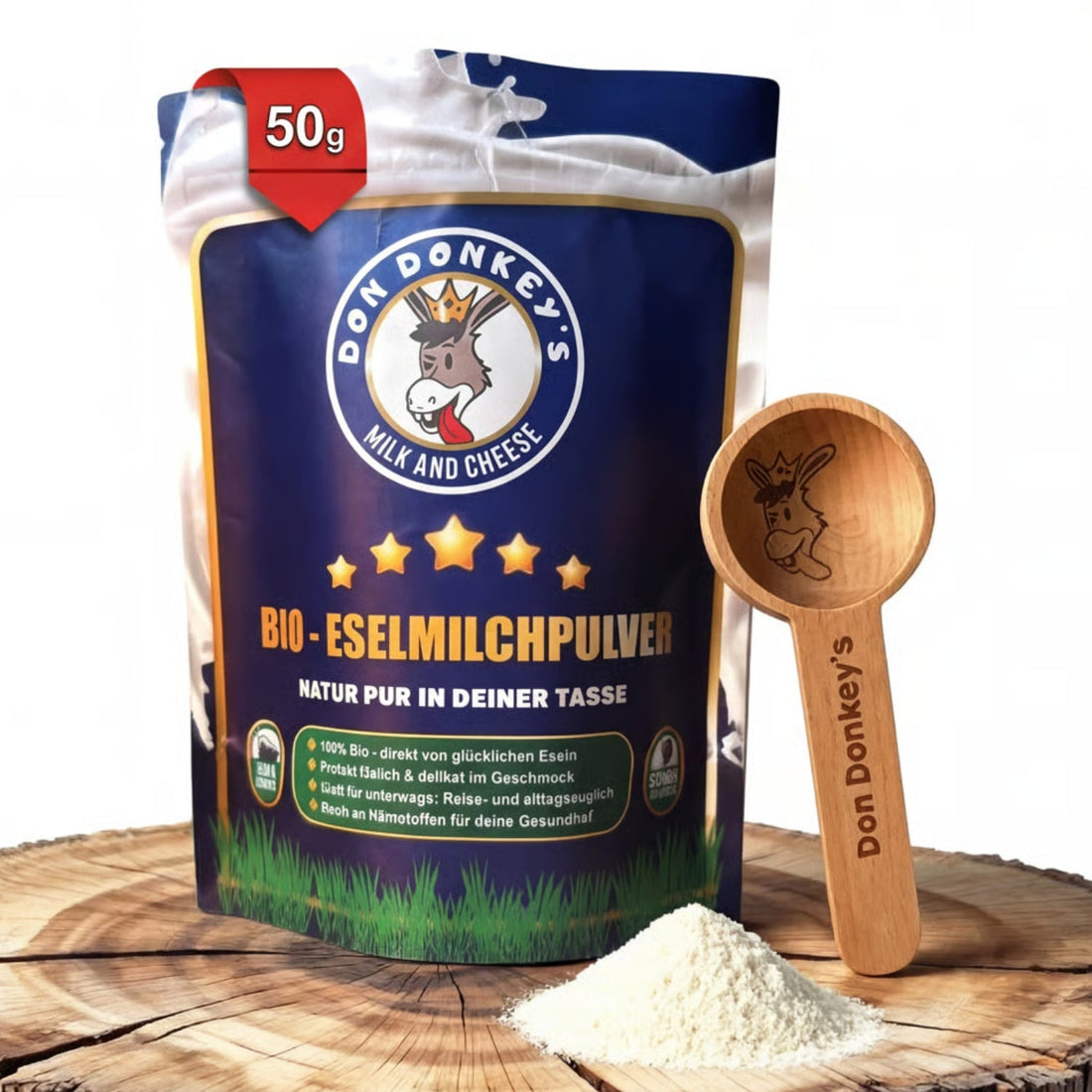
Also in our shop
Donkey Milk Powder
Donkey milk in powder form
For anyone who prefers a longer shelf life: our donkey milk in powder form – easy to store and portion.
20g · Unit price: €1.245,00 / 1 kg · incl. VAT, plus shipping