
 Buyer protection

Research on donkey milk · Study 66
A steppe shrub in the feed trough: wormwood polysaccharides, milk and gut flora
Ordos wormwood grows in the dry steppes of Inner Mongolia. A team from Hohhot fed jennies an extract from it for ten weeks – and measured milk yield, fatty acids, digestion and gut bacteria.
From shrub to additive · runs automatically
How the feed additive was made
- 1HarvestAbove-ground parts of Artemisia ordosica, collected in Ordos (Inner Mongolia).
- 2Water extractionThe soluble components are dissolved out with water.
- 3Ethanol precipitationWith alcohol, the long-chain sugar compounds (polysaccharides) precipitate.
- 4Crude extractPolysaccharide content: 52.65 % – a crude extract, not a pure substance.
- 5Amount0.5 g per kg dry matter of the ration, daily, for 7 of the 14 jennies.
Experimental setup
The basic ration of both groups
Shares of dry matter, rounded. Plus 8.6 % soybean meal and smaller shares of minerals and additives. Concentrate to roughage 3 : 7. 14 Dezhou jennies with foals, on average 6 years old, around 39 days into lactation, randomly assigned to two groups; 2 weeks of adaptation, 8 weeks of measurement.
Interactive · Control → wormwood group
What shifted
Grey dot = control, arrow = wormwood group. Grey arrow = no significant difference. Milk yield was measured over 6 hours after separation from the foal (0.86 vs. 0.90 kg); extrapolated to the day, 3.46 vs. 3.61 kg.
Fatty acid pattern of the milk
Inside control, outside wormwood
- Saturated fatty acids57.8 → 53.8 %
- Monounsaturated20.8 → 23.3 %
- Polyunsaturated21.4 → 22.8 %
All differences mentioned are significant. Individually, oleic acid (18.1 → 20.0 %), linoleic acid (17.4 → 18.8 %) and palmitic acid (18.5 → 20.1 %) rose; myristic acid fell. The indices are calculated values for comparing fats and say nothing about an effect in humans.
Gut bacteria of the jennies · changes automatically
The gut flora shifted
Control
Samples from the rectum, 16S sequencing. Diversity (Shannon index) rose slightly from 5.56 to 5.69. What was measured was composition, not the health of the animals. Tap a column to switch.
Key findings
The authors’ explanation
Better digestion
Dry matter, fat and fibre (NDF, ADF) were digested better; feed intake rose from 7.58 to 8.00 kg.
More fatty acids in the gut
Acetate rose from 6.10 to 6.65 and butyrate from 0.82 to 0.87 mmol/l – short-chain fatty acids formed by bacteria.
Enzymes in the blood
The enzyme SCD rose (117.6 → 149.3 U/l), while HSL and ACC fell. SCD converts saturated into monounsaturated fatty acids.
Different milk fat
More unsaturated fatty acids and more milk fat per day (12.9 → 14.4 g).
Critical assessment
Our margin notes on the paper
The trial ran with 7 jennies per group and a single dose.Small sample – named by the authors themselves.
The differences in milk yield are statistically clear but small in absolute terms: 0.04 kg in six hours.Extrapolated, around 0.15 kg per day.
In the abstract, “norank_f_Lachnospiraceae” decreases, while in the table a different Lachnospiraceae group increases.Inconsistent naming.
The “c-index” mentioned in the abstract cannot be found in the tables.Not verifiable.
For the correlations, the methods section names Spearman, the figure Pearson.Minor inconsistency.
Editorial assessment: The study shows that feeding can measurably change the fatty acid pattern of donkey milk. No statement about a benefit for humans follows from this.
Research question for DON DONKEY’S®
How strongly does the ration shape the fat of our milk?
Several feeding trials show: what is in the trough changes the amount and composition of donkey milk. For us, this means knowing and documenting rations and additives on the partner farms.
Original publication
Optimization of Artemisia ordosica crude polysaccharides on milk fatty acid composition in lactating donkeys and their effects on rectal microbiome and lactation performance
Original title; the interpretation of effects in the title is that of the authors.
Meng F., Zhao Y., Guo Y., Guo X., Zhang Q., Li S., Chi Y., Li L., Hui F., Tong M., Yan S.
Frontiers in Microbiology · 2025 · volume 16, article 1682805 · open access
Inner Mongolia Agricultural University, Hohhot, China
DOI: 10.3389/fmicb.2025.1682805
Transparency: funded by research programmes of the university and the Inner Mongolia Autonomous Region. According to the publication, no conflicts of interest. No product-related statement for DON DONKEY’S®.
Summarised and reviewed by the DON DONKEY’S editorial team on the basis of the original publication · as of October 2026
The study summarised above was carried out independently of DON DONKEY’S® and does not relate to our products. It serves solely to inform about the state of research.
DON DONKEY’S® donkey milk and donkey milk powder are foods. They are not intended to prevent, treat or cure any disease and do not replace medical advice.

From our shop
DON DONKEY’S® donkey milk
100 % donkey milk · raw milk, frozen
On this page we report the findings of a published study. Independently of that, you will find our donkey milk here: 100 % donkey milk, frozen as raw milk.
100 ml bottle / 100ml · Unit price: €249,00 / 1 l · incl. VAT, plus shipping
Also in our shop
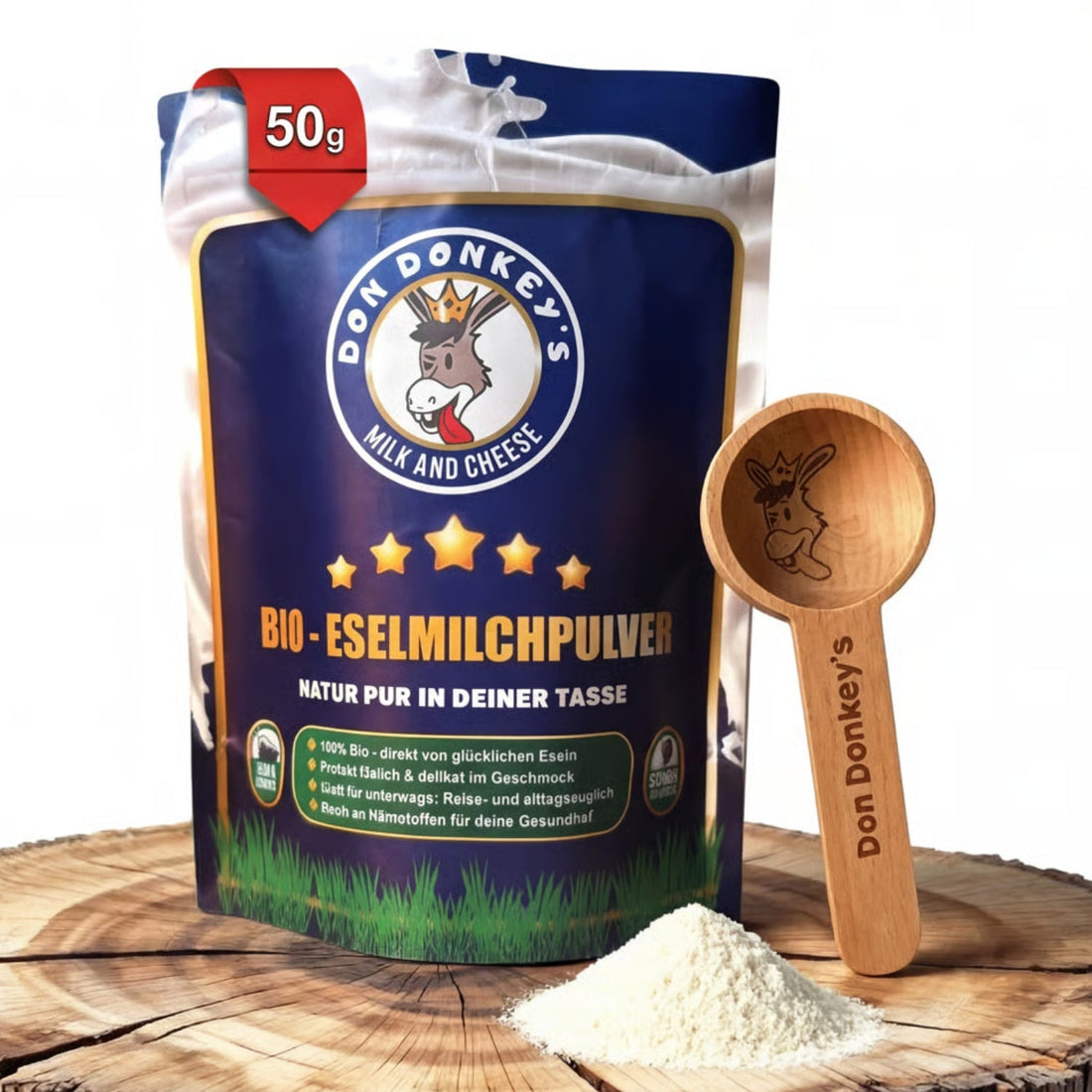
Donkey Milk Powder
Donkey milk in powder form
For anyone who prefers a longer shelf life: our donkey milk in powder form – easy to store and portion.
20g · Unit price: €1.245,00 / 1 kg · incl. VAT, plus shipping