
 Buyer protection

Research on donkey milk · Study 64
Donkey, human, cow: the whey proteins of three milks compared
Whey is the liquid part of milk that remains after casein has been precipitated. A Chinese team compared its proteins in donkey, human and cow’s milk – including those that occur only in traces.
Experimental setup · runs automatically
From 36 samples to three comparison groups
- 12 samples each: Dezhou jennies from one farm, women in the 6th to 8th month of breastfeeding, cows from one farm (“about 12” pooled samples).
- Combined into four pooled samples per type of milk, cream and casein removed.
- Each group measured in triplicate – by mass spectrometry without labelling (label-free).
Interactive · Two comparisons
Donkey milk versus
out of 375 detected
Selection of the proteins highlighted by the authors. ↑ = more abundant in donkey milk, ↓ = less abundant.
The largest single difference
The J chain, 18 times more abundant
The J chain (joining chain) is a small connecting piece that holds antibodies of the IgA and IgM type together in larger units. In the whey of donkey milk it was found to be 18 times more abundant than in human milk and 3.3 times more abundant than in cow’s milk.
What was measured was the relative amount of the protein, not its function. Also more abundant in donkey milk: the polymeric immunoglobulin receptor (pIgR).
Key findings · tap the tiles
Eight proteins, briefly explained
Tags show compared with which milk the protein was more (↑) or less (↓) abundant in donkey milk.
Critical assessment
Five points for the record
The authors’ employer
Six of the nine authors worked for a large Chinese manufacturer of donkey-hide products. Funding came from Heze University.
Pooled samples
Four pooled samples per type of milk, measured in triplicate. How many animals or women are actually behind them remains partly unclear.
Paired test
A paired t-test was used for independent groups – unusual and not justified.
Stage of lactation
Given for human milk (6th–8th month), not for donkey and cow’s milk. Milk proteins change over the course of lactation.
Untested benefits
The authors’ references to infants or hardening of the arteries were not examined in this study.
Editorial assessment: A similar protein profile does not make donkey milk a substitute for breast milk or infant formula. We present the findings as basic research.
Research question for DON DONKEY’S®
Who funds research on donkey milk?
Many studies are carried out in the context of companies. That does not make them wrong – but transparency is part of it. We therefore name funders and interests for every study.
Original publication
Comparative Whey Proteome Profiling of Donkey Milk With Human and Cow Milk
Original title of the publication.
Zhang X., Jiang G., Ji C., Fan Z., Ge S., Li H., Wang Y., Lv X., Zhao F.
Frontiers in Nutrition · 2022 · volume 9, article 911454 · open access
Heze University and Dong-E E-Jiao Co., Ltd., China
Transparency: funded by the doctoral fund of Heze University. Six authors were employed by a Chinese manufacturer of donkey-hide products; the others declare no conflicts of interest. No product-related statement for DON DONKEY’S®.
Summarised and reviewed by the DON DONKEY’S editorial team on the basis of the original publication · as of October 2026
The study summarised above was carried out independently of DON DONKEY’S® and does not relate to our products. It serves solely to inform about the state of research.
DON DONKEY’S® donkey milk and donkey milk powder are foods. They are not intended to prevent, treat or cure any disease and do not replace medical advice.

From our shop
DON DONKEY’S® donkey milk
100 % donkey milk · raw milk, frozen
On this page we report the findings of a published study. Independently of that, you will find our donkey milk here: 100 % donkey milk, frozen as raw milk.
100 ml bottle / 100ml · Unit price: €249,00 / 1 l · incl. VAT, plus shipping
Also in our shop
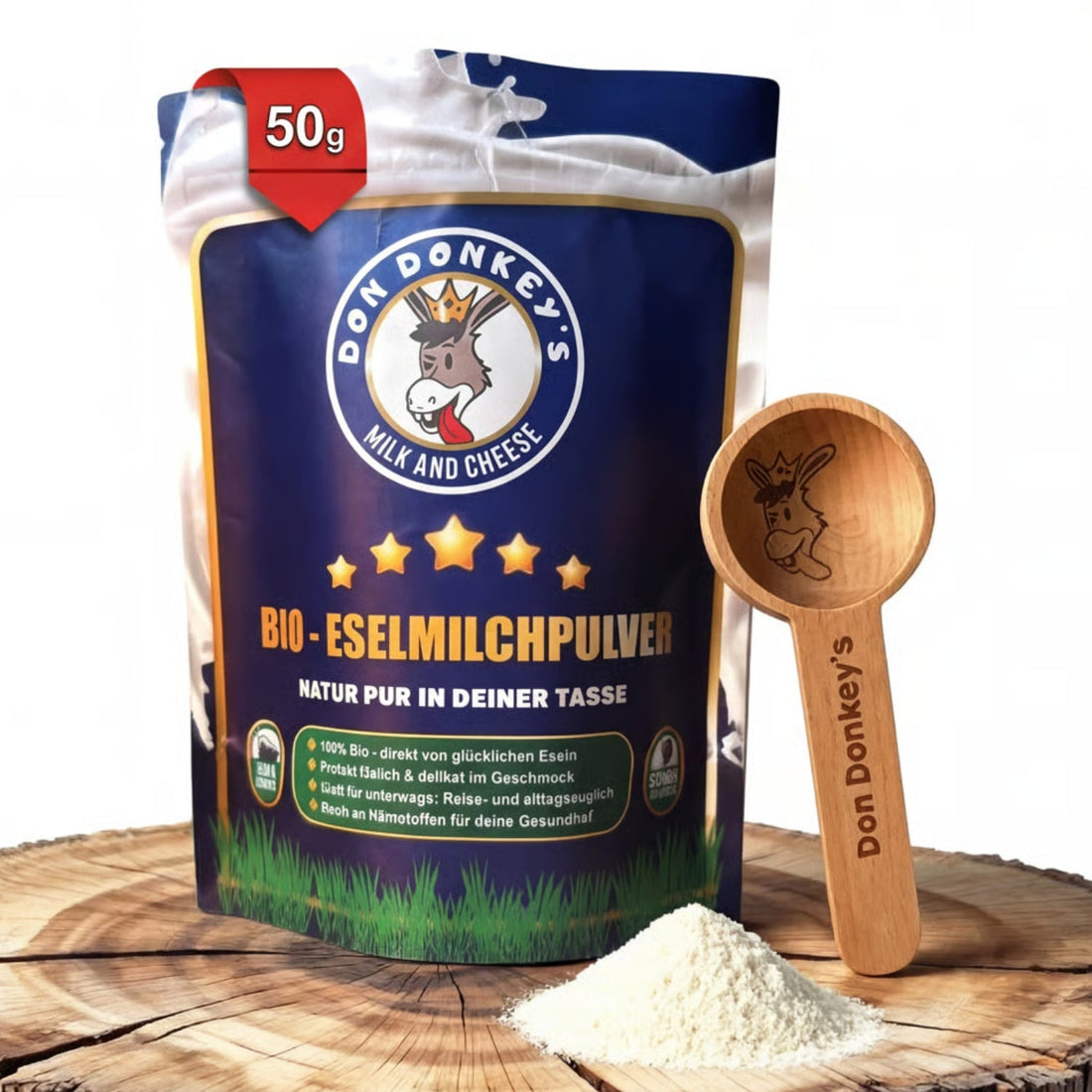
Donkey Milk Powder
Donkey milk in powder form
For anyone who prefers a longer shelf life: our donkey milk in powder form – easy to store and portion.
20g · Unit price: €1.245,00 / 1 kg · incl. VAT, plus shipping