
 Buyer protection

Research on donkey milk · Study 61
More milk, same content: a fermented feed additive put to the test
Twelve Dezhou jennies in China, five weeks, two groups. Half received 200 g of fermented residue of the plant Codonopsis pilosula in their feed each day. Milk yield, composition, blood values and foal growth were measured.
Experimental setup
Twelve jennies, randomly assigned
- AnimalsDezhou jennies, 3–5 years, several previous foalings, around 70 days into lactation
- FeedHay ad libitum plus 2.5 kg concentrate; trial group additionally 200 g additive per day
- AdditiveCodonopsis residue, fermented with Bacillus and Lactobacillus plantarum
- MilkingBy hand, twice a day; foals separated 4 hours beforehand
- Duration5 weeks, milk and blood samples at the end
Interactive · The decisive difference
More milk – not richer milk
Control = 100. Dot = mean of the trial group, line = ± standard deviation, relative to the control mean. Filled = significant.
Weight over 5 weeks
The foals gained markedly
The foals in the trial group gained 19.83 kg on average, those in the control group 11.75 kg (p = 0.049). As the foals stayed with their mothers, this fits the higher milk yield.
The mares in the trial group also tended to gain weight (+13.3 kg versus −0.7 kg), but this difference was not significant. Feed intake did not differ.
Blood values of the jennies
One profile, at a glance
Grey ring = control (1.0). Red area = trial group in relation. Measured in the mares' blood, not in the milk.
Metabolic profile of the milk
568 substances, 21 differences
In the milk of the trial group, 21 metabolites differed, including higher levels of scopoletin – a plant compound – and acetylcarnitine. In the blood it was 86 of 753.
One signalling pathway (renin secretion) was computationally enriched. Such analyses show patterns, not what they do in the body.
Critical assessment
Our checklist for this trial
- ✓
Control group and random assignment
Two groups of equal size, randomly assigned, same basic ration.
- ✕
Sample size
Only 6 animals per group. Several effects lie just below the significance threshold (p between 0.02 and 0.05).
- ✕
Duration
5 weeks – whether the effects last over a whole lactation remains open.
- !
Interests
The additive was provided by a biotech company. The authors declare no conflicts of interest.
- !
The authors' interpretation
They speak of an “activated immune system” – yet among the immune values only C4 changed. Blood glucose remained unchanged.
Small inconsistencies: For MDA the text states p < 0.01, the table p = 0.0191. Milk yield is given in ml in the table and in kg in the methods section.
Research question for DON DONKEY’S®
More milk for foals and milking – at what cost?
Additives that increase milk yield are of interest to farms. What matters to us: the foal stays with its mother, and changes in feeding must be well documented.
- 01Disclose feeding and additives per partner farm
- 02Consider milk yield and foal development together
- 03Compare with Studies 54 and 57 (feeding trials)
Original publication
Fermented Codonopsis pilosula residue improved milk performance of lactating donkeys by enhancing antioxidant capacity and regulating metabolism
Original title; the interpretation of effects in the title is that of the authors.
Zhou M., Huang F., Du X., Liu G., Wang C.
Frontiers in Veterinary Science · 2024 · volume 11, article 1489480 · open access
Liaocheng University, China
DOI: 10.3389/fvets.2024.1489480
Transparency: funded among others by the Shandong Natural Science Foundation and China's National Key R&D Programme. Feed additive provided by a Chinese biotechnology company. According to the publication, no conflicts of interest. No product-related statement for DON DONKEY’S®.
Summarised and reviewed by the DON DONKEY’S editorial team on the basis of the original publication · as of October 2026
The study summarised above was carried out independently of DON DONKEY’S® and does not relate to our products. It serves solely to inform about the state of research.
DON DONKEY’S® donkey milk and donkey milk powder are foods. They are not intended to prevent, treat or cure any disease and do not replace medical advice.

From our shop
DON DONKEY’S® donkey milk
100 % donkey milk · raw milk, frozen
On this page we report the findings of a published study. Independently of that, you will find our donkey milk here: 100 % donkey milk, frozen as raw milk.
100 ml bottle / 100ml · Unit price: €249,00 / 1 l · incl. VAT, plus shipping
Also in our shop
Donkey Milk Powder
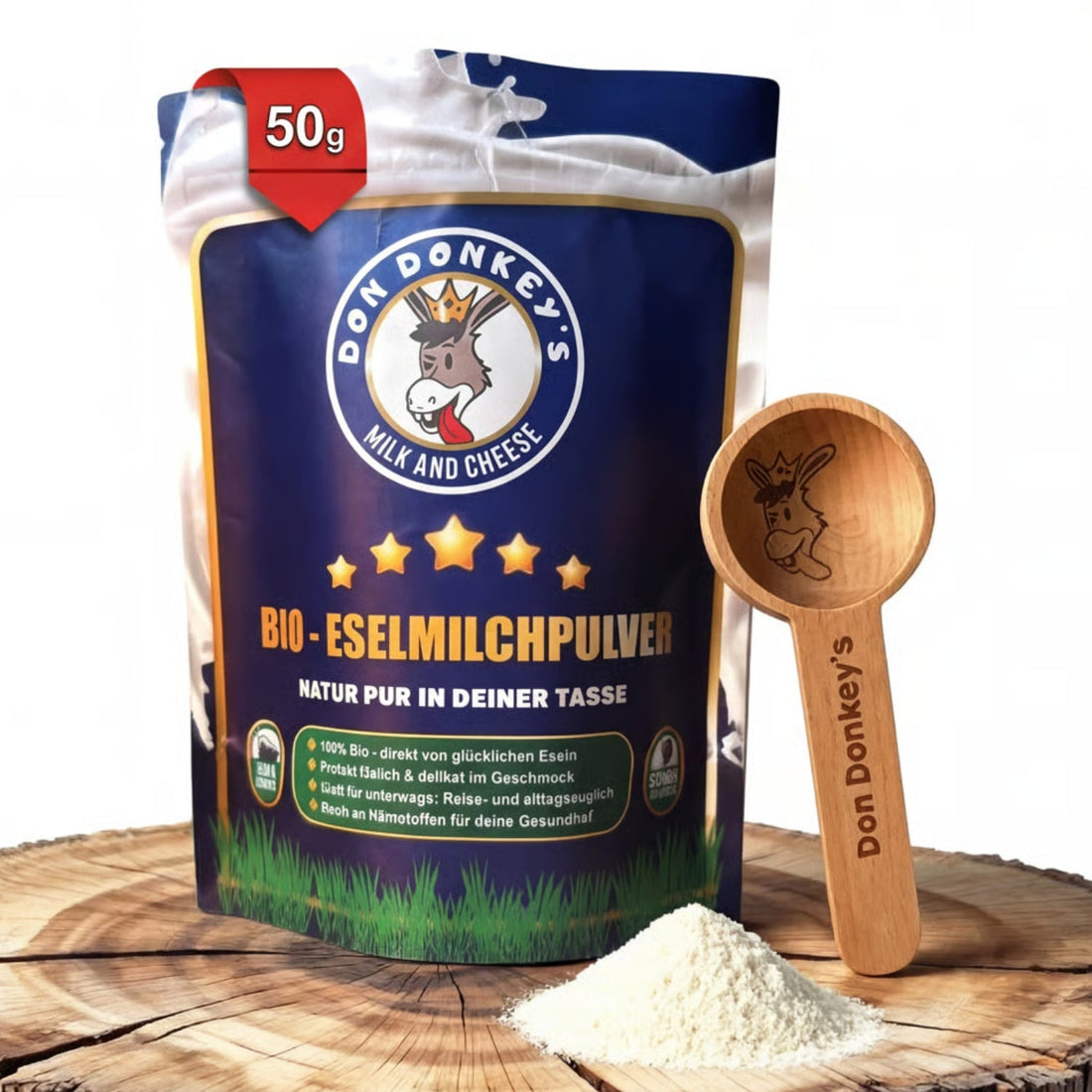
Donkey milk in powder form
For anyone who prefers a longer shelf life: our donkey milk in powder form – easy to store and portion.
20g · Unit price: €1.245,00 / 1 kg · incl. VAT, plus shipping