
 Buyer protection

Research on donkey milk · Study 60
Donkey or sheep? How intestinal cells in the laboratory responded to digested milk
A Serbian-Italian team "digested" donkey and sheep milk in the test tube and applied it to intestinal cell cultures. Gene activity, cell compatibility and hundreds of metabolites were measured.
Schematic: a layer of differentiated Caco-2 cells
Starting material
Two milks, two worlds
Pooled milk from 35 Balkan donkeys and 30 sheep of the White Metohija Pramenka breed, obtained in April 2024. Values per type of milk from one pooled sample, measured in three technical replicates – without a statistical comparison. Somatic cells: 13,000 versus 247,000 per ml.
Experimental setup
Five samples, from pure donkey to pure sheep
The path of a sample
From the milk glass to the cell culture
Simulated digestion
According to the internationally used INFOGEST protocol: oral phase, 120 minutes stomach, 120 minutes small intestine – with enzymes, in the test tube.
Same amount of protein
All digestion products were adjusted to 100 µg protein per ml so that the samples are comparable.
Four hours on intestinal cells
Caco-2 cells, differentiated for 21 days, received the samples for 4 hours. Controls: untreated cells and digestion fluid alone.
Three measurements
Cell damage (LDH test), activity of 13 genes (RT-qPCR) and a broad metabolite profile by high-resolution mass spectrometry.
Interactive · gene activity
13 genes, two response patterns
↑ higher, ↓ lower mRNA level than in untreated cells; – not reported as changed in the text. Gene activity was measured, not the amount or function of the proteins. For sheep milk, the results section speaks of "most", the discussion of "all" autophagy genes. According to the text, the 50 : 50 and 30 : 70 mixtures behaved more like sheep milk.
Metabolite profile
From thousands of signals a few hundred substances
Positive measurement mode
Negative measurement mode
The cells after pure donkey milk were compared with those after pure sheep milk. With donkey milk there were more polar peptides and, among other things, hippuric acid; with sheep milk rather fat-soluble peptides and fat metabolism products. Untargeted profiles show differences – not which metabolic pathways are actually active.
No measurable cell damage
None of the samples released significantly more LDH than the untreated cells. LDH leaks out when cell membranes are damaged.
Applies to this cell line, this concentration and 4 hours of exposure.
Critical assessment
Where this study stands
- Only one cell line, one concentration and 4 hours of exposure.
- One pooled sample per type of milk – the replicates are technical, not biological.
- Gene activity without evidence at protein or functional level; barrier measurements are missing.
- The ethics approval is dated June 2026, the milk dates from April 2024 – the publication does not explain this.
Research question for DON DONKEY’S®
What do laboratory studies reveal – and what not?
Cell experiments show differences between types of milk, but no effect in humans. For us, this means classifying such findings and honestly stating where the limits lie.
Original publication
Insight into the Effects of In Vitro-Digested Donkey and Sheep Milk on Differentiated Human Intestinal Caco-2 Cells
Original title of the publication.
Bogdanović M., Stevanović D., Čobanović K., Panseri S., Nobile M., Savić Radovanović R., Golić N., Popović N.
Dairy · 2026 · volume 7, issue 4, article 59 · open access
University of Belgrade, University of Novi Sad (Serbia) and University of Milan (Italy)
DOI: 10.3390/dairy7040059
Transparency: funded by the Serbian Ministry of Science, Technological Development and Innovation. According to the publication, no conflicts of interest. No product-related statement for DON DONKEY’S®.
Summarised and reviewed by the DON DONKEY’S editorial team on the basis of the original publication · as of October 2026
The study summarised above was carried out independently of DON DONKEY’S® and does not relate to our products. It serves solely to inform about the state of research.
DON DONKEY’S® donkey milk and donkey milk powder are foods. They are not intended to prevent, treat or cure any disease and do not replace medical advice.

From our shop
DON DONKEY’S® donkey milk
100 % donkey milk · raw milk, frozen
On this page we report the findings of a published study. Independently of that, you will find our donkey milk here: 100 % donkey milk, frozen as raw milk.
100 ml bottle / 100ml · Unit price: €249,00 / 1 l · incl. VAT, plus shipping
Also in our shop
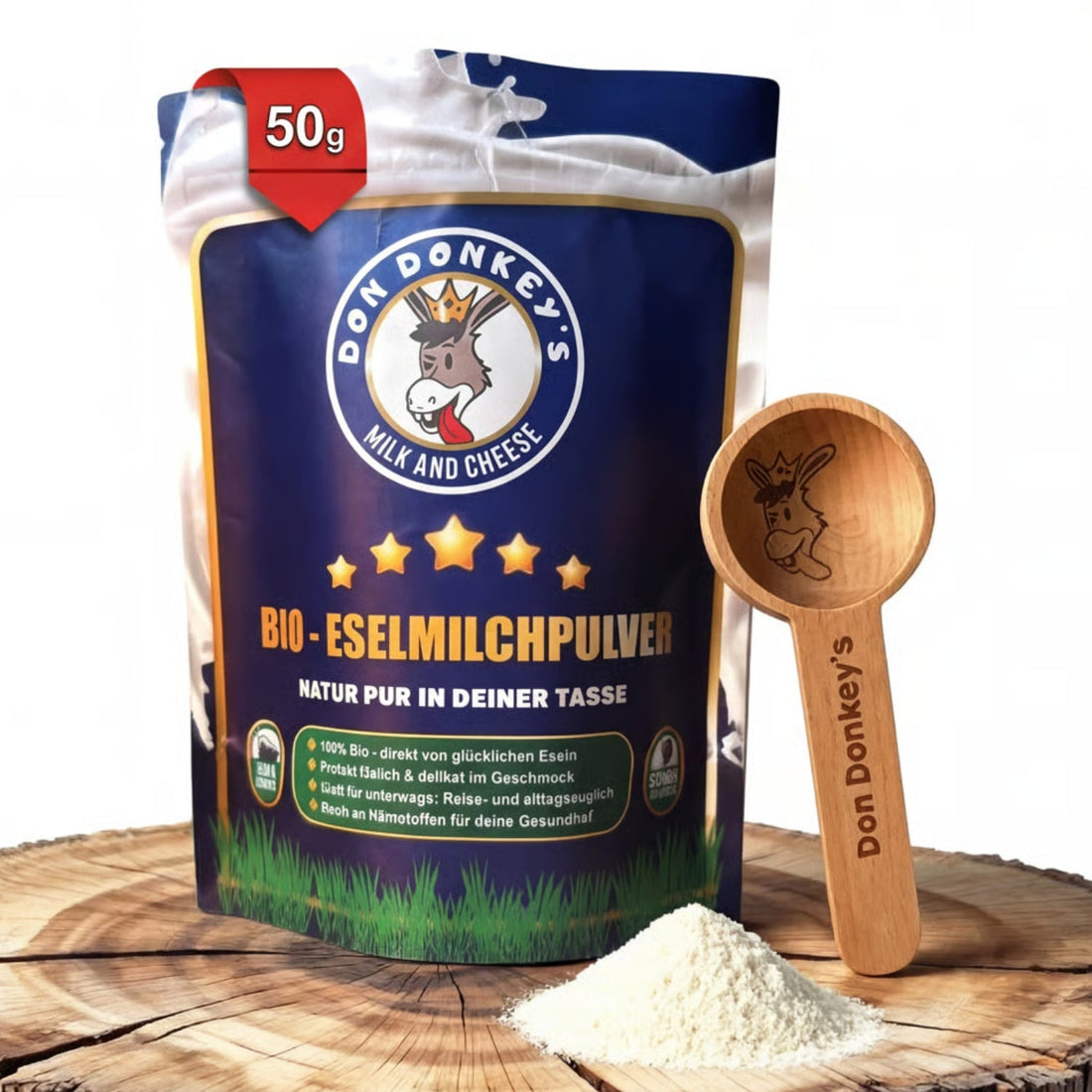
Donkey Milk Powder
Donkey milk in powder form
For anyone who prefers a longer shelf life: our donkey milk in powder form – easy to store and portion.
20g · Unit price: €1.245,00 / 1 kg · incl. VAT, plus shipping