
 Buyer protection

Research on donkey milk · Study 6
Donkey and cow's milk in a laboratory test
In 2020, Daminelli et al. compared how two well-known foodborne bacteria – Listeria and Staphylococcus aureus – develop in raw donkey milk and raw cow's milk under defined laboratory conditions.
What it's about
A question of food safety
Donkey milk contains a lot of lysozyme and other components to which antibacterial properties are attributed. Researchers from the IZSLER institute in Brescia and the University of Bari tested whether this results in a difference from cow's milk in practice.
In the laboratory, they inoculated raw donkey milk and raw cow's milk with Listeria monocytogenes and Staphylococcus aureus and followed how the bacteria developed over eleven days. They also measured lactic acid bacteria and the pH value.
The result turned out differently than one might expect given the lysozyme – and that is exactly why it belongs on this page.
What exactly was studied?
Briefly explained
The terms used in this study
A food is deliberately inoculated with bacteria in the laboratory to observe whether and how strongly they multiply in it.
Listeria monocytogenes is a bacterium that can grow even at refrigerator temperature and receives particular attention in food safety.
Bacteria naturally occurring in milk that produce lactic acid and thereby lower the pH value.
Bacterial counts are given logarithmically: one step more means ten times as many bacteria.
Raw donkey milk and raw cow's milk were provided as test samples.
The samples were deliberately inoculated with Listeria or Staphylococcus aureus.
The samples were kept for eleven days at 8 °C – a defined test condition.
Bacterial counts, lactic acid bacteria and pH value were determined over time.
Interactive · The data at a glance
Eleven days in the laboratory
How was the experiment set up, how did the Listeria develop – and what was found for Staphylococcus aureus, lactic acid bacteria and pH value? Switch between the views.
Illustration of the mean values reported in the original publication. Lines connect the start and end values and do not represent a measured course.
Key findings
What the researchers report
Stronger growth in donkey milk
With the same starting amount, the Listeria count after eleven days was arithmetically about 50 times higher in raw donkey milk than in raw cow's milk.
No significant difference
For Staphylococcus aureus, the authors report no statistically significant difference between the two types of milk.
Fewer lactic acid bacteria, higher pH
Donkey milk contained fewer lactic acid bacteria and had a higher pH value. The authors see this as a possible explanation for the stronger growth of Listeria.
The study is described as preliminary. The milk was deliberately inoculated with bacteria and stored under fixed conditions (11 days, 8 °C). The final value for cow's milk varied widely (± 1.04 log10). The CFU comparisons are converted from the published mean values. Whether lactic acid bacteria or pH value actually caused the difference was not demonstrated.
Critical assessment
An honest result – even if it doesn't favour donkey milk
What the study shows
What it does not show
Research question for DON DONKEY’S®
What does this mean for our work?
The study shows: the quality of donkey milk does not depend on its natural components alone, but on care during milking, chilling and processing. That is the standard we set for our own milk.
Original publication
Raw donkey milk versus raw cow’s milk. A preliminary study to compare the growth of Listeria monocytogenes and Staphylococcus aureus
Daminelli P., Dalzini E., Cosciani-Cunico E., Barrasso R., Bozzo G., Zanardi G.
Veterinaria Italiana · 2020 · 56(2):115–121
IZSLER Brescia, University of Bari Aldo Moro
DOI: 10.12834/VetIt.2140.13666.1 · PubMed: PMID 33305560
Full text: PDF of the original publication
The publication describes a laboratory experiment with deliberately inoculated milk. It does not allow any product-related statement for DON DONKEY’S®.

From our shop
DON DONKEY’S® donkey milk
100 % donkey milk · raw milk, frozen
On this page we report the findings of a published study. Independently of that, you will find our donkey milk here: 100 % donkey milk, frozen as raw milk.
100 ml bottle / 100ml · Unit price: €249,00 / 1 l · incl. VAT, plus shipping
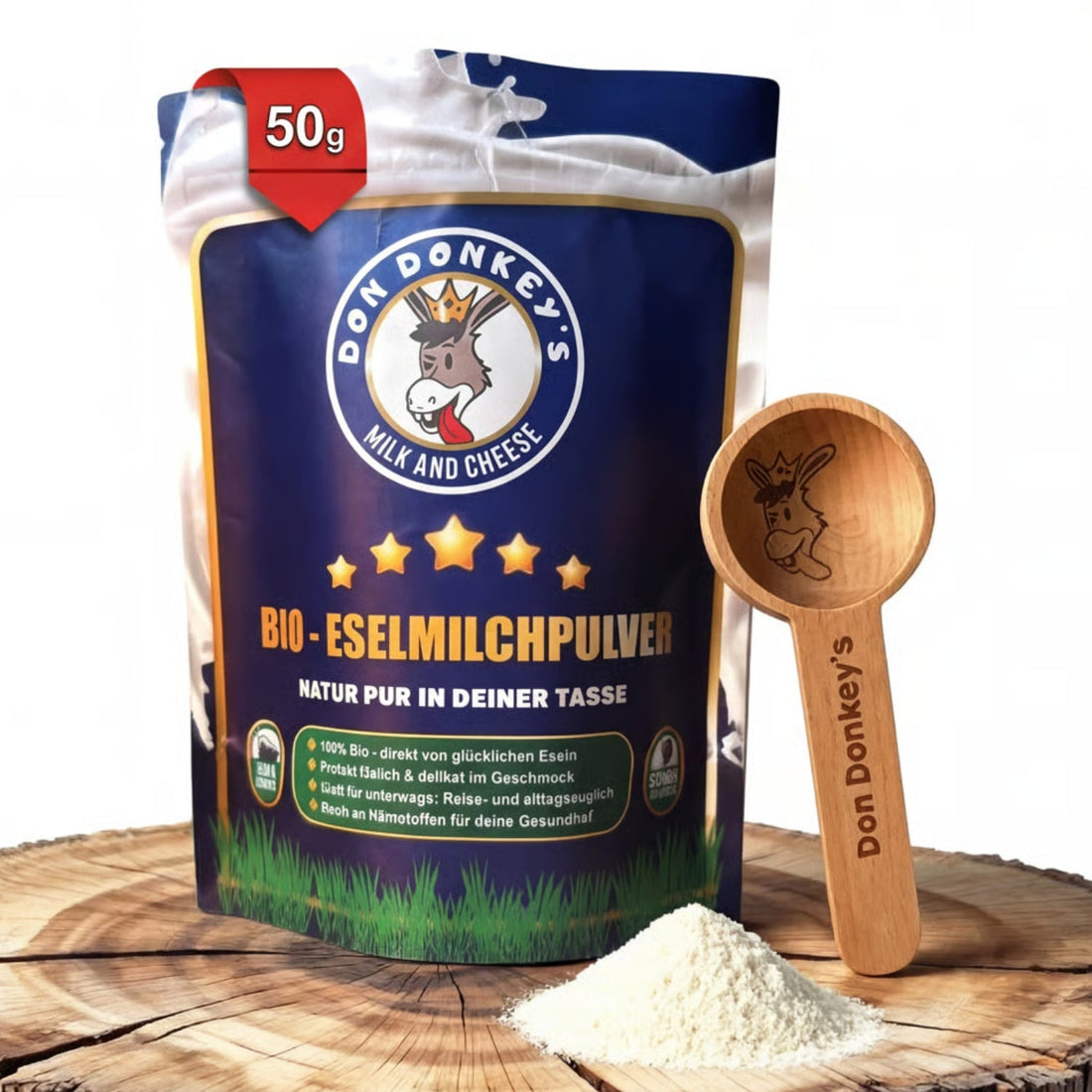
Also in our shop
Donkey Milk Powder
Donkey milk in powder form
For anyone who prefers a longer shelf life: our donkey milk in powder form – easy to store and portion.
20g · Unit price: €1.245,00 / 1 kg · incl. VAT, plus shipping