
 Buyer protection

Research on donkey milk · Study 57
Three feed groups, three results: what an herbal supplement changed in jennies
On a small farm in western Romania, 30 jennies received different supplementary feed for eight weeks. Milk yield, composition, digestibility and the bacterial count of the milk were compared.
What it's about
Can supplementary feed improve milk production?
Jennies give little milk, and every milking counts. The team from Timișoara wanted to know whether a concentrate pellet – with or without an herbal mixture – influences milk yield, feed utilisation and milk hygiene.
The authors classify the herbal mixture as promoting lactation. Whether an effect really comes from the herbs can only be tested by comparison – which is why there were three groups.
- 30 jennies of the Romanian native breed, 2nd to 6th lactation
- 3 groups of 10 animals each, all with pasture grass
- 2 weeks of adaptation, 8 weeks of trial
- Milking by hand, once a day in the morning
- Milk yield weekly, bacterial count on the first and last day
- Digestibility via feed and faecal samples
Interactive · Choose a group
What was in each feed trough – and what came of it
Milk hygiene
Total bacterial count before and after the trial
Only in the herbal group did the total bacterial count fall clearly – from 2.85 to 1.90 log10 CFU/ml. This corresponds to about a tenth of the initial count. In the other two groups it remained practically the same.
Comparisons were made within each group. The publication does not contain a direct statistical comparison of bacterial counts between groups. Individual bacterial species were not determined.
Feed utilisation
How much feed protein the animals utilised
Control
apparent protein digestibility
Group 1 · herbs
significantly higher than control
Group 2 · pellets
no significant difference from group 1
Fairness check: which comparison holds?
The control group was already further into lactation (around 110 instead of 80 days) and received completely different feed. The fact that its milk yield fell may therefore also be due to the stage of lactation.
The most meaningful comparison is between the two pellet groups. Here the herbal group had more milk and a lower bacterial count at the end; there was no significant difference in protein digestibility.
Key findings
What the researchers report
More milk with concentrate
Both pellet groups gave considerably more milk than the control. The herbal group reached an average of 1,177 ml in week 7, while the control fell to 507 ml by week 8.
Better feed utilisation
Apparent protein digestibility was around 56 to 58 % in the pellet groups and 45 % in the control. Fat digestibility was the same in all groups at around 79 %.
Lower bacterial count only with herbs
Only in the herbal group did the total bacterial count of the milk fall significantly. The authors suspect an influence of the herbs, but the mechanism was not investigated.
Critical assessment
Proven, plausible, open
- ProvenIn this trial, concentrate pellets were associated with more milk and better protein digestibility than maize.
- PlausibleThe herbal supplement might additionally influence milk yield and milk hygiene – the difference from the pellet group without herbs points to this, but is based on 10 animals each.
- OpenUdder health was not measured (e.g. via cell counts), nor were individual bacterial species. How the herbs work remains unclear.
- Not the topicAn effect of the milk on humans – only animals and milk hygiene were studied.
Research question for DON DONKEY’S®
What do the jennies on our partner farms receive?
Feeding shapes milk yield and milk quality. For us, this means knowing the rations on our partner farms and documenting laboratory values of the milk regularly.
Original publication
Phytogenic and Nutritional Strategies to Improve Milk Production and Microbiological Quality in Lactating Donkeys
Original title of the publication.
Plotuna A.-M., Hotea I., Nichita I., Popa I., Imre K., Herman V., Tîrziu E.
Animals · 2025 · volume 15, issue 20, article 3060 · open access
University of Life Sciences “King Mihai I”, Timișoara, Romania
DOI: 10.3390/ani15203060
Transparency: according to the publication, the herbal mixture came from a Romanian manufacturer; no role of the company in planning or funding is described. According to the publication, no conflicts of interest. Same research group as studies 45 and 55. No product-related statement for DON DONKEY’S®.
Summarised and reviewed by the DON DONKEY’S editorial team on the basis of the original publication · as of October 2026
The study summarised above was carried out independently of DON DONKEY’S® and does not relate to our products. It serves solely to inform about the state of research.
DON DONKEY’S® donkey milk and donkey milk powder are foods. They are not intended to prevent, treat or cure any disease and do not replace medical advice.

From our shop
DON DONKEY’S® donkey milk
100 % donkey milk · raw milk, frozen
On this page we report the findings of a published study. Independently of that, you will find our donkey milk here: 100 % donkey milk, frozen as raw milk.
100 ml bottle / 100ml · Unit price: €249,00 / 1 l · incl. VAT, plus shipping
Also in our shop
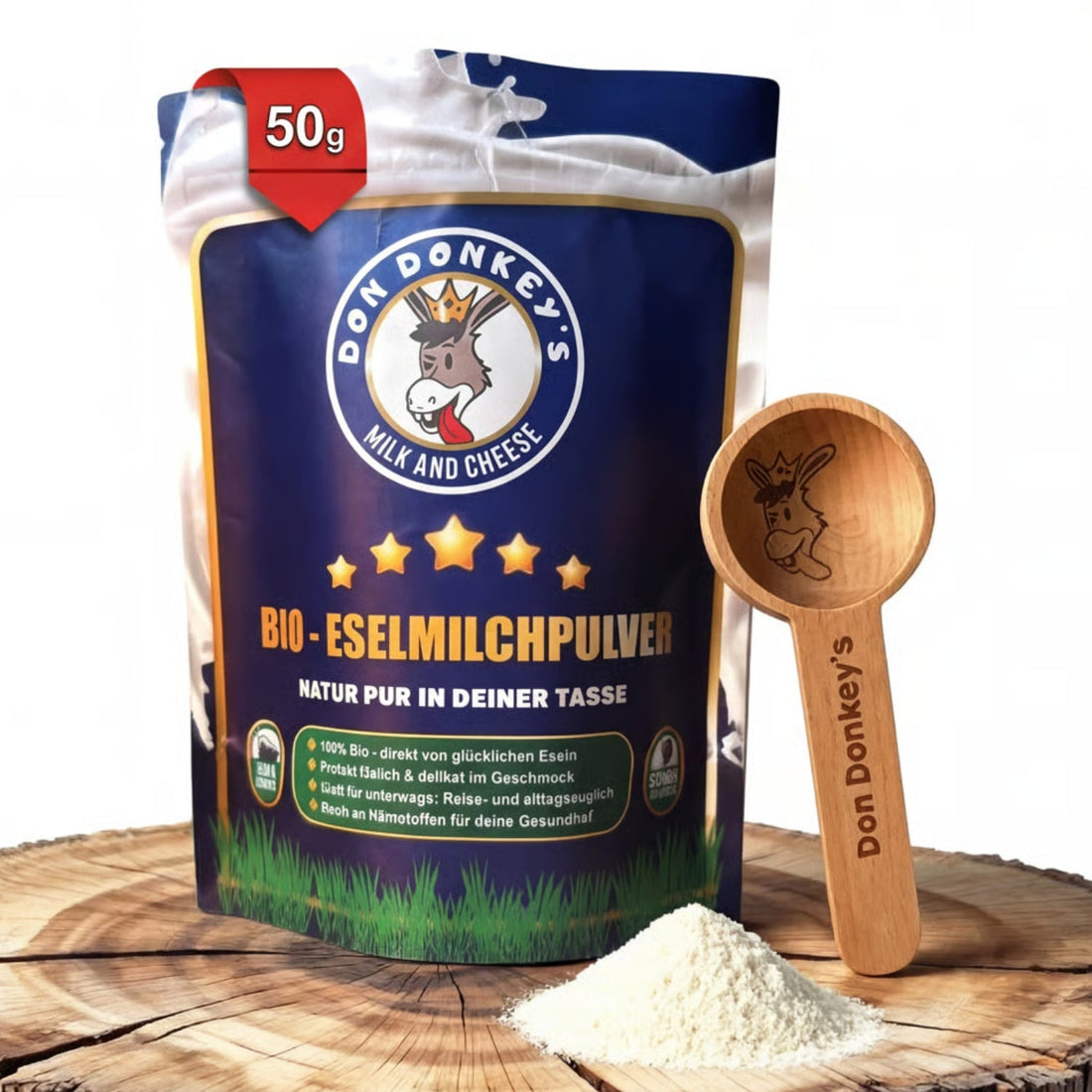
Donkey Milk Powder
Donkey milk in powder form
For anyone who prefers a longer shelf life: our donkey milk in powder form – easy to store and portion.
20g · Unit price: €1.245,00 / 1 kg · incl. VAT, plus shipping