
 Buyer protection

Research on donkey milk · Study 56
A year in the nature reserve: minerals and contaminants in donkey milk
Around 300 donkeys of the Banat and Balkan breeds live in the Zasavica nature reserve in Serbia. A veterinary institute from Novi Sad tested their milk every month for twelve months for twelve elements – from calcium to lead.
Sampling plan · July 2023 to June 2024
What it's about
What does it contain – and does it change with the season?
Milk supplies minerals such as calcium and trace elements such as zinc or selenium. At the same time, heavy metals can also enter milk via feed, water and the environment. For donkey milk, there have hardly been any data covering a whole year.
The team therefore examined eight beneficial and four potentially harmful elements – and tested whether the values differ between seasons.
- Farm
- Zasavica nature reserve, northern Serbia – a large donkey milk farm in south-eastern Europe
- Husbandry
- around nine months of grazing on unfertilised meadows, in winter housed with maize and triticale
- Samples
- three pooled samples from the milk tank per month, 16 to 30 animals milked
- Method
- Mass spectrometry (ICP-MS) with certified reference material
Interactive · The twelve elements
Tap an element
- Range
- Season
The authors' assessment
Donkey milk compared
Ring = comparison milk (factor 1), golden dots = multiple in donkey milk. Factors according to the authors' discussion based on literature values; not compared directly in this study.
Limit check · lead
Two samples in April were above the limit
In the EU, a maximum level of 0.020 mg lead per kg applies to raw milk. Two of the three pooled samples from April exceeded it at 0.032 and 0.041 mg/kg. In May, all samples were below the detection limit, in June clearly below the limit.
Cadmium, mercury and arsenic were mostly not detectable or present only in traces. The authors call for ongoing monitoring, especially with regard to children.
Key findings
What the researchers report
Minerals & trace elements
- Calcium was between 589 and 744 mg/kg, highest in autumn.
- Phosphorus, potassium, sodium and magnesium reached their highest values in spring.
- Calcium, phosphorus, potassium and copper differed significantly between the seasons, sodium, magnesium, zinc and selenium did not.
Contaminants
- Lead exceeded the EU maximum level for raw milk in two April samples, but not in any other month.
- Cadmium was not detectable in most samples, mercury at most in traces.
- Arsenic was found only in autumn and winter in very small amounts.
The authors regard donkey milk as a good source of minerals, but stress that it does not cover requirements on its own and should be part of a balanced diet. The publication does not give a cause for the elevated lead values in April.
Critical assessment
One year of data from one farm
| What the study shows | What it does not show |
|---|---|
| Mineral contents of donkey milk fluctuate with the season. | Whether this applies to other farms, regions or feeding regimes – one farm was studied. |
| Contaminants were mostly not or hardly detectable. | Where the elevated lead values in April come from. |
| According to a literature comparison, selenium and copper are higher than in human milk. | An effect in humans or coverage of daily requirements. |
| Continuous monitoring makes outliers visible. | Differences between the Banat and Balkan breeds – the milk was mixed. |
Research question for DON DONKEY’S®
What is in our milk – all year round?
The study shows why one-off measurements are not enough. A single month can be out of line. For us, this is a clear mandate for regular testing.
Original publication
Seasonal Variation in Essential Minerals, Trace Elements, and Potentially Toxic Elements in Donkey Milk from Banat and Balkan Breeds in the Zasavica Nature Reserve
Original title of the publication.
Ljubojević Pelić D., Popov N., Gardić E., Vidaković Knežević S., Žekić M., Gajdov V., Živkov Baloš M.
Animals · 2025 · volume 15, issue 6, article 791 · open access
Scientific Veterinary Institute "Novi Sad", Serbia
DOI: 10.3390/ani15060791
Transparency: funded by the Science Fund of the Republic of Serbia (project PROTECTDonkey) and the Serbian Ministry of Science; according to the publication, no conflicts of interest. No product-related statement for DON DONKEY’S®.
Summarised and reviewed by the DON DONKEY’S editorial team on the basis of the original publication · as of October 2026
The study summarised above was carried out independently of DON DONKEY’S® and does not relate to our products. It serves solely to inform about the state of research.
DON DONKEY’S® donkey milk and donkey milk powder are foods. They are not intended to prevent, treat or cure any disease and do not replace medical advice.

From our shop
DON DONKEY’S® donkey milk
100 % donkey milk · raw milk, frozen
On this page we report the findings of a published study. Independently of that, you will find our donkey milk here: 100 % donkey milk, frozen as raw milk.
100 ml bottle / 100ml · Unit price: €249,00 / 1 l · incl. VAT, plus shipping
Also in our shop
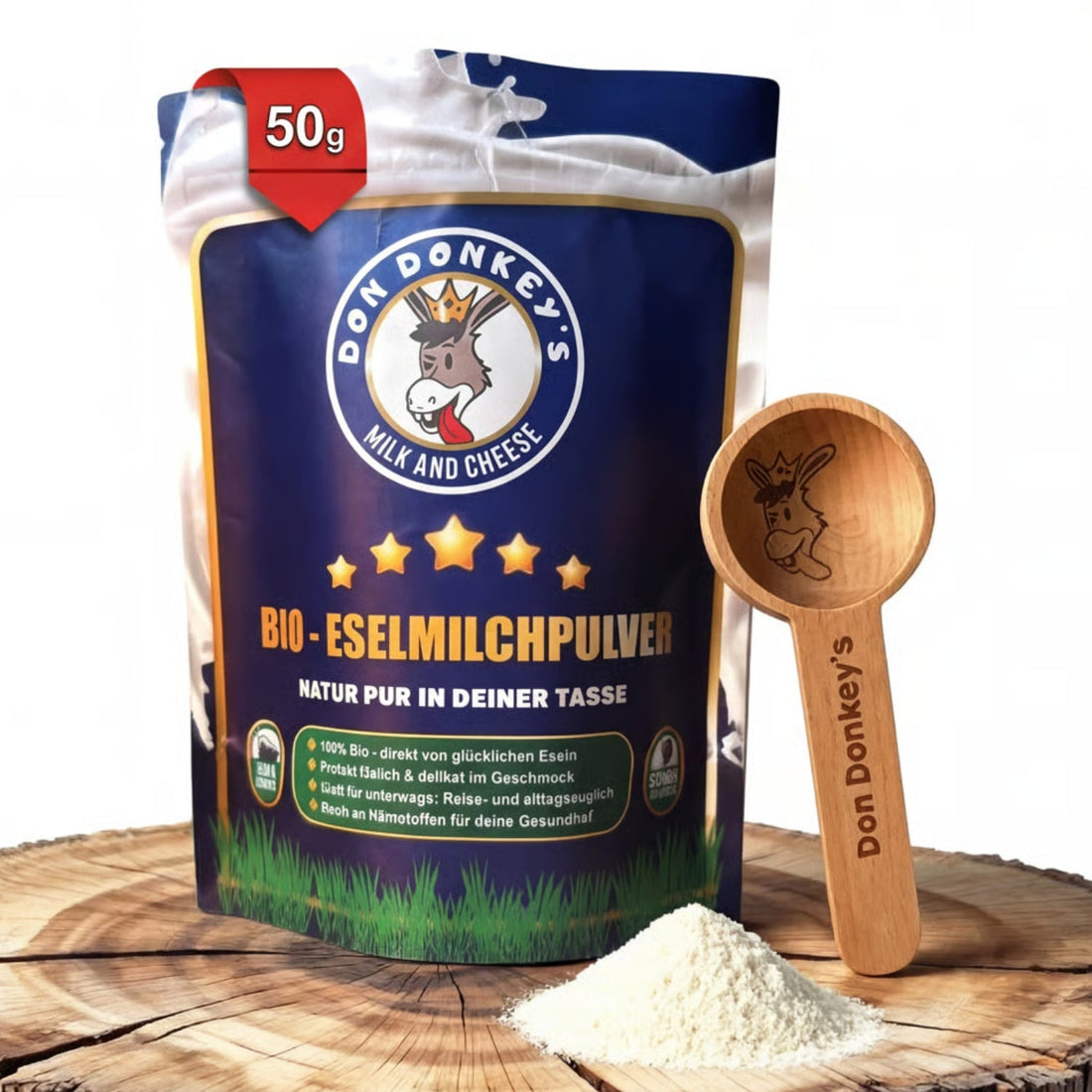
Donkey Milk Powder
Donkey milk in powder form
For anyone who prefers a longer shelf life: our donkey milk in powder form – easy to store and portion.
20g · Unit price: €1.245,00 / 1 kg · incl. VAT, plus shipping