
 Buyer protection

Research on donkey milk · Study 48
Five types of milk under the mass spectrometer: a study put to the test
A team from Shenyang (China) compared fats, metabolites and proteins in donkey, mare, camel, human and pig milk. We summarise what the data show – and explain why we do not adopt one of the authors' central conclusions.
What it's about
Three measurement methods, five types of milk
"Omics" methods capture not individual substances in a sample but hundreds to thousands at once. The study combined three of them: lipidomics for fats, metabolomics for small metabolites and proteomics for proteins.
The donkey milk came from a breeding station in Fuxin (Liaoning province). It was compared with milk from Mongolian mares, Bactrian camels, pigs and with donated human milk – each as a reference point for the other types of milk.
What exactly was studied?
Briefly explained
Terms from the study
Captures as many of the fat molecules in a sample as possible, such as triglycerides and phospholipids.
Captures metabolites such as sugars, amino acids or vitamins.
Captures the proteins in a sample and compares their amounts.
Assigning a measurement signal to a substance name via a database – error-prone without confirmation.
6 samples per type of milk, stored frozen.
Three mass spectrometry methods in parallel.
Conspicuous differences selected statistically.
Proteins, metabolites and fats related to each other computationally.
Interactive · The data at a glance
What the measurements show
Fat profile, conspicuous substances, proteins – and our critical review. Switch between the views.
0816
06001.200
All values from the text and tables of the freely available original publication. The metabolite values are relative signal intensities, not concentrations.
Key findings & assessment
What is robust – and what isn't
Donkey milk resembles mare's milk
0 different fat moleculesCompared with human and pig milk, donkey milk showed no significantly different fat molecules. In its pattern it resembled mare's milk. Triglycerides dominated in all five types of milk.
One clearly conspicuous substance
lysophosphatidic acid 18:0The most distinctive feature of donkey milk was a fat building block from the group of lysophosphatidic acids: a signal around 150 times stronger than in human milk, with low variation. What this means was not investigated by the study.
Health statement not supported
not adoptedFrom the xanthurenic acid, the authors derive a possible effect on mental illness. The data are not sufficient for this: the value varies extremely, the assignment is contradictory, and an effect was never tested.
The authors themselves state as a limitation that the substances found were not checked for their function. We therefore report the study in full but critically – as an example of why a single publication is not yet proof.
Critical assessment
Why we look closely
What the study shows
What it does not show
Research question for DON DONKEY’S®
What is really in our donkey milk?
Broad analyses are valuable when they are properly confirmed. For us, this means having components measured specifically with validated methods rather than adopting individual findings.
Original publication
Comprehensive analysis through multi-omics integration to compare and elucidate the specific substances in milk of donkey, horse, camel, human and pig
Original title of the publication.
Zhang Q., Li Q., Wang X., Wu Y., Chen R., Sun Y., Pan Y., Li S., Wang Z.
Food Chemistry: X · 2025 · volume 28, article 102592 · open access
Shenyang Agricultural University, China
DOI: 10.1016/j.fochx.2025.102592
Transparency: funded by the China Postdoctoral Science Foundation; the donkey milk came from a breeding station of a Chinese donkey industry company in Fuxin. No product-related statement for DON DONKEY’S®.
Summarised and critically reviewed by the DON DONKEY’S editorial team on the basis of the original publication · as of October 2026
The study summarised above was carried out independently of DON DONKEY’S® and does not relate to our products. It serves solely to inform about the state of research.
DON DONKEY’S® donkey milk and donkey milk powder are foods. They are not intended to prevent, treat or cure any disease and do not replace medical advice.

From our shop
DON DONKEY’S® donkey milk
100 % donkey milk · raw milk, frozen
On this page we report the findings of a published study. Independently of that, you will find our donkey milk here: 100 % donkey milk, frozen as raw milk.
100 ml bottle / 100ml · Unit price: €249,00 / 1 l · incl. VAT, plus shipping
Also in our shop
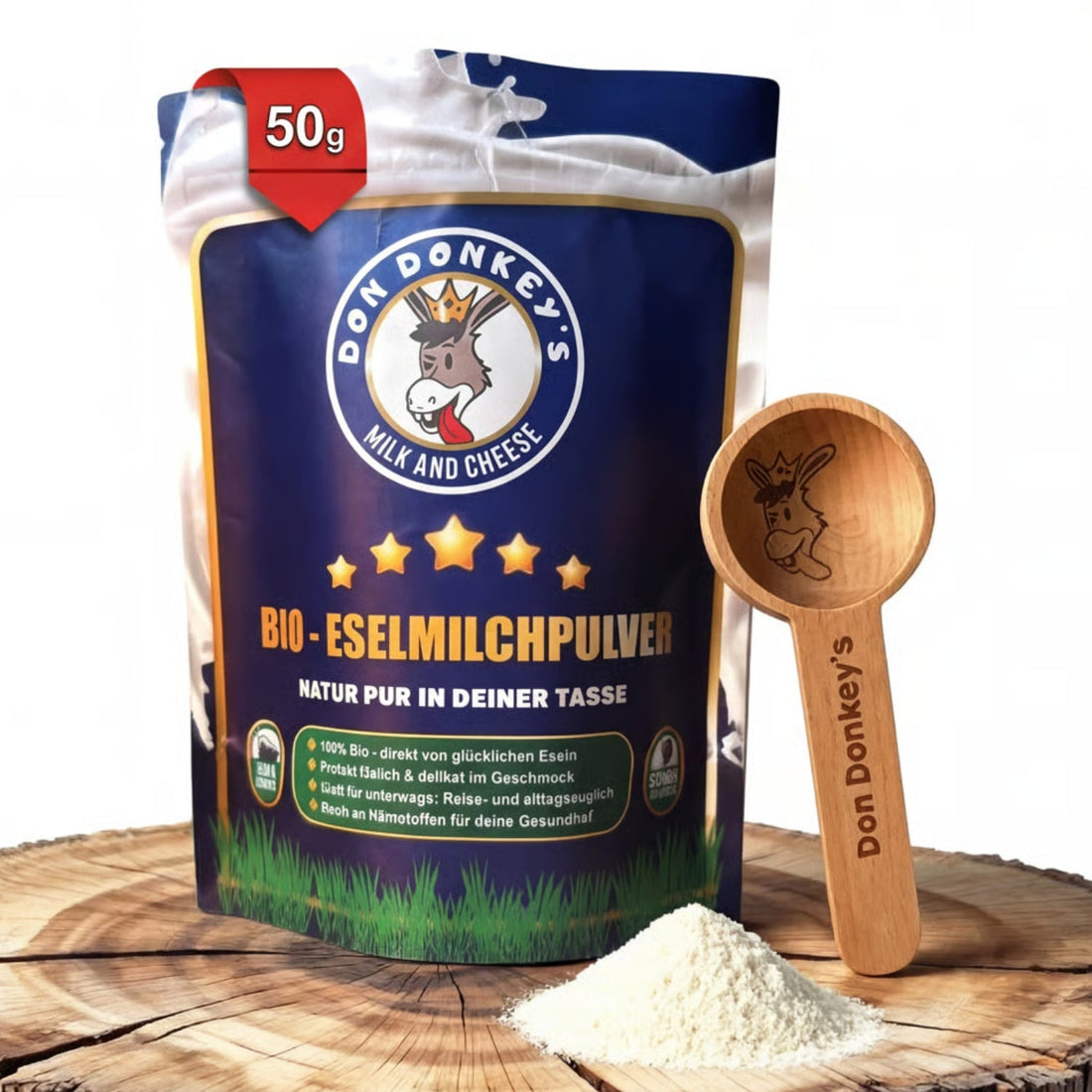
Donkey Milk Powder
Donkey milk in powder form
For anyone who prefers a longer shelf life: our donkey milk in powder form – easy to store and portion.
20g · Unit price: €1.245,00 / 1 kg · incl. VAT, plus shipping