
 Buyer protection

Research on donkey milk · Study 47
What grows in cold donkey milk: a portrait of lactic acid bacteria
A Spanish research team stored raw milk from the rare Zamorano-Leonesa breed chilled for a day and identified the bacteria in it. Two strains were examined more closely: in an acidification test, under acid and bile and by decoding their genetic material.
What it's about
Why bacteria from donkey milk are interesting
Lactic acid bacteria turn milk into yoghurt, kefir or cheese. Researchers are looking for strains that acidify well, are robust and are considered safe. Raw milk is a natural source for this.
Which bacteria persist in donkey milk has hardly been researched. The team wanted to know what grows in raw milk stored at 4 °C as in the cold chain, and whether this includes strains with useful properties for foods.
What exactly was studied?
Briefly explained
Terms from the study
Bacteria that ferment sugar into lactic acid – the basis of yoghurt and cheese.
A bacterial culture grown individually from the sample, here for example B8 or B19.
A section of genetic material that can be used to identify bacteria.
Genes that make bacteria insensitive to antibiotics – undesirable in food cultures.
Raw pooled milk stored for 24 h at 4 °C.
Cultured and 14 isolates identified.
8 strains tested for acid, bile and acidification.
Genetic material of the two best strains decoded.
Interactive · The data at a glance
From the milk sample to the genome
Findings, robustness, acidification, genetic material and resistance – switch between the views.
| Strain | pH 2.5 | 0.3 % bile |
|---|---|---|
| B3 | ||
| B4 | ||
| B5 | ||
| B8 | ||
| B9 | ||
| B12 | ||
| B13 | ||
| B19 |
0pH 3.5pH 7
All values from the text of the freely available original publication. Tolerance tests were only assessed qualitatively.
Key findings
What the researchers report
Leuconostoc dominated
6 of 14 isolatesAfter 24 hours of chilling, most isolates came from the genus Leuconostoc. In addition, enterobacteria and one Enterococcus, Bacillus and Lacticaseibacillus each were found.
B19 acidified most strongly
pH 4.04 after 72 hLacticaseibacillus paracasei B19 lowered the pH value of heated donkey milk the furthest. Together with Leuconostoc B8, it showed the best overall profile and withstood acid and bile.
No acquired resistance genes
B8 & B19 sequencedThe genetic material of both strains contained genes for cold and stress adaptation, sugar breakdown and adhesion, but no acquired antibiotic resistance genes. Both were sensitive to ampicillin.
The authors propose B8 and B19 as candidates for fermented dairy products and consider further experiments, for example on microbial inhibition and taste, necessary.
Critical assessment
A treasure trove for food research, not proof of health benefits
What the study shows
What it does not show
Research question for DON DONKEY’S®
Which bacteria are found in our milk?
For us, two things matter: regular laboratory testing of our milk and knowing which bacteria occur naturally.
Original publication
Cold-Resistant Lactic Acid Bacteria from Zamorano-Leonesa Donkey Milk: Isolation, Functional Screening, and Genome-Based Insights for Technological Applications
Original title of the publication.
Bulnes D., Albertos I., Jiménez J.-M., Castro-Alija M. J., Díez-Méndez A.
Applied Microbiology · 2025 · volume 5, issue 4, article 135 · open access
Catholic University of Santa Teresa de Jesús (Ávila) · University of Valladolid, Spain
DOI: 10.3390/applmicrobiol5040135
Transparency: according to the publication, without external funding and without conflicts of interest; milk from a donkey cooperative in Zamora. No product-related statement for DON DONKEY’S®.
Summarised and reviewed by the DON DONKEY’S editorial team on the basis of the original publication · as of October 2026
The study summarised above was carried out independently of DON DONKEY’S® and does not relate to our products. It serves solely to inform about the state of research.
DON DONKEY’S® donkey milk and donkey milk powder are foods. They are not intended to prevent, treat or cure any disease and do not replace medical advice.

From our shop
DON DONKEY’S® donkey milk
100 % donkey milk · raw milk, frozen
On this page we report the findings of a published study. Independently of that, you will find our donkey milk here: 100 % donkey milk, frozen as raw milk.
100 ml bottle / 100ml · Unit price: €249,00 / 1 l · incl. VAT, plus shipping
Also in our shop
Donkey Milk Powder
Donkey milk in powder form
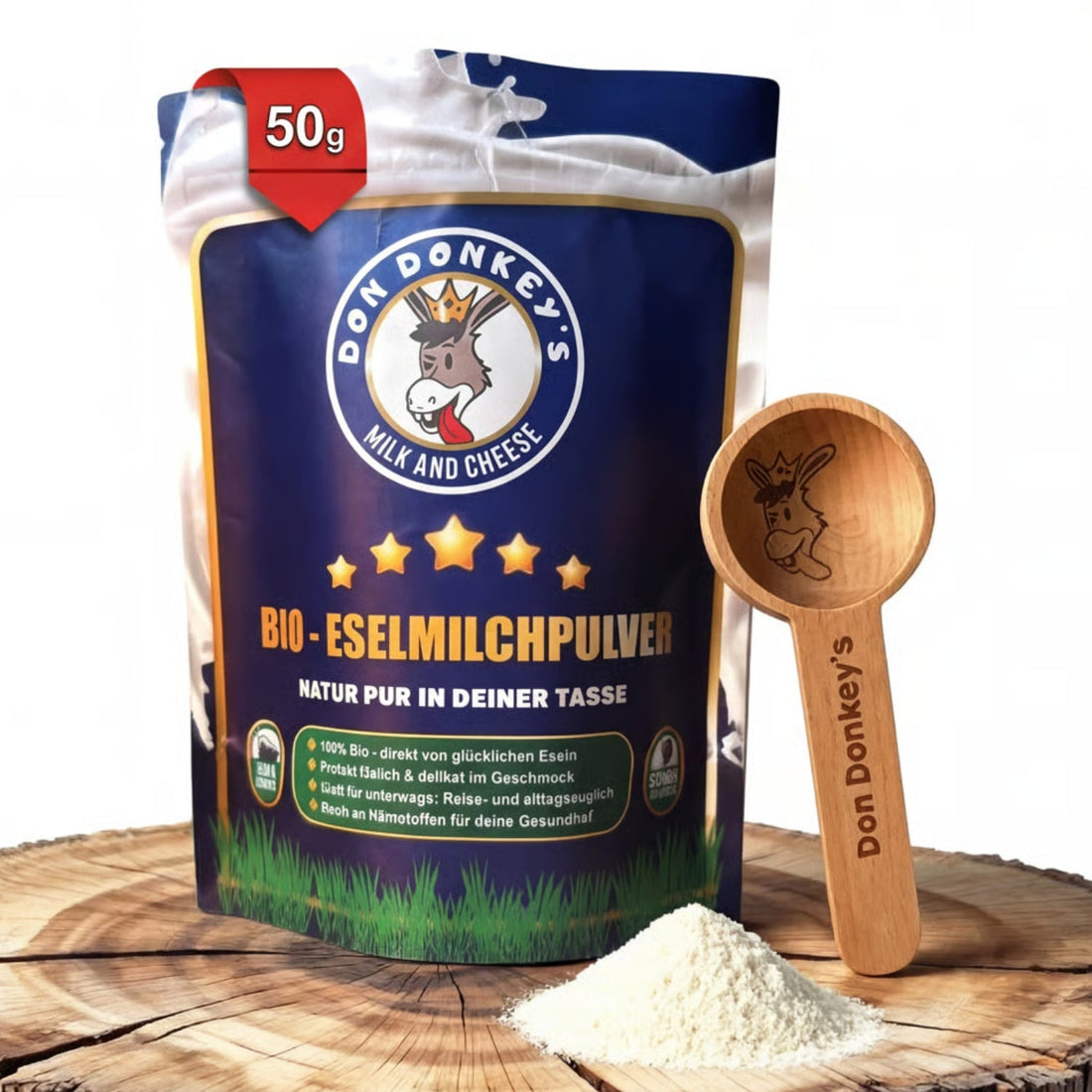
For anyone who prefers a longer shelf life: our donkey milk in powder form – easy to store and portion.
20g · Unit price: €1.245,00 / 1 kg · incl. VAT, plus shipping